
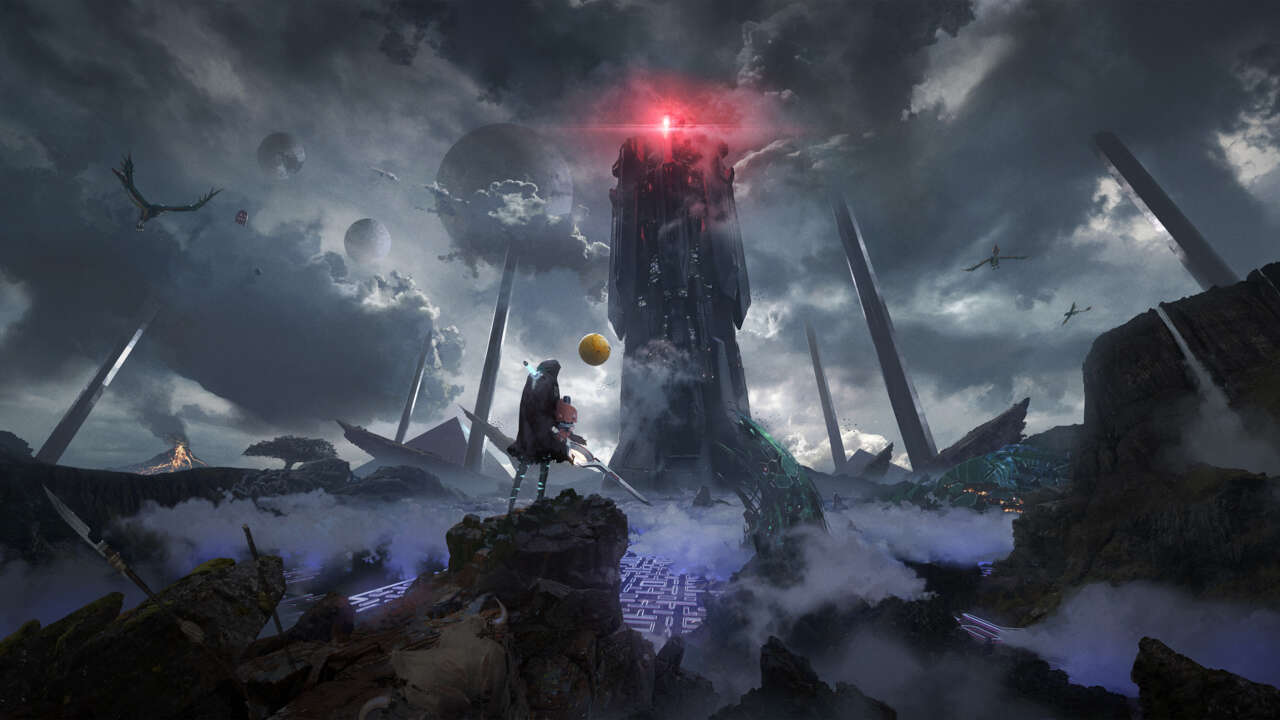
In my view, “Pac-Man: Circle” is the highlight of Amazon’s “Secret Level” anthology series. While many episodes felt like drawn-out advertisements for their respective games, “Pac-Man: Circle” offered a surprising twist on Namco’s classic character. It boldly reimagined the pellet-eating icon by injecting elements of intense violence and body horror. It was creative and daring, but, ironically, also served as a prolonged trailer for an upcoming game.
Bandai Namco revealed “Shadow Labyrinth” shortly after “Secret Level” aired. Like the episode, this 2D Metroidvania explores a darker interpretation of the beloved character. Regrettably, its execution falters with a lackluster, confusing, and ultimately forgettable narrative. Furthermore, frustrating, repetitive combat and questionable checkpoint placements mar what should have been a compelling reinvention of the character, who has been around for nearly half a century.

Prior viewing of “Pac-Man: Circle” isn’t necessary, although the brief episode introduces the core concept of “Shadow Labyrinth.” Even so, you might still feel lost, as “Shadow Labyrinth’s” plot quickly descends into a jumble of obscure dialogue filled with tired tropes, sci-fi jargon, technical explanations, and excessive self-importance.
Presumably, some of this confusion is intentional. You play as an amnesiac warrior, summoned from another dimension to assist Pac-Man in escaping a dangerous planet. However, it’s not exactly Pac-Man; it’s Puck, referencing his original Japanese designation. You are an instrument of his will, with Puck serving as the manipulative influence on your decisions. This setup holds promise, but the story fails to leverage it. Events unfold around you, with no sense of agency or player impact, despite Puck’s obvious machinations. You are merely a passenger on a disappointing ride that fails to capture the unsettling atmosphere established in “Pac-Man: Circle.”
This is unfortunate, as some nods to Bandai Namco’s rich history might have resonated more within a more compelling game. “Shadow Labyrinth” marks the debut of Pac-Man within the United Galaxy Space Force timeline, a shared universe encompassing many of Bandai Namco’s older titles. Consequently, you’ll encounter elements such as a village of Bosconian characters, adversaries from “Dig Dug,” “Galaga,” and “Galaxian,” and several references to the “Xevious” series. While these details add some depth to the world, their impact is diminished by stilted dialogue and uninspired plot points, representing a missed opportunity.
As a 2D Metroidvania, “Shadow Labyrinth” initially follows a linear path for approximately the first five hours. While there are branching paths leading to upgrades, secrets, and areas initially inaccessible, true freedom of exploration is delayed. Later in the game, you’re presented with multiple objectives and the ability to explore in any direction. While this would typically be a highlight, several factors prevent “Shadow Labyrinth” from reaching the quality of its peers.
One issue lies with the repetitive art design of the environments. Most locations consist of caves and industrial areas with little visual distinction beyond minor color variations. This makes exploration tedious, except for a few areas that attempt something unique, such as a cave system shrouded in darkness until you activate glowing skulls, or a valley filled with potentially lethal plants.
The game’s level design also presents challenges. As the title implies, “Shadow Labyrinth” is appropriately maze-like, with the map gradually revealing interconnected paths leading to new areas and hidden secrets. However, the game offers little guidance. There are no waypoints, and any hints you can buy are intentionally vague, forcing you to rely on your own exploration. Unclear signage and paths that lead nowhere can be more frustrating than rewarding.
Character progression is also noticeably slow, with significant time gaps between unlocking upgrades, such as the grappling hook and double jump. This limitation not only restricts access to new areas but also leads to repetitive platforming. While “Shadow Labyrinth’s” platforming generally has merits, featuring fun navigational puzzles and challenges reminiscent of “Celeste,” the long wait between acquiring new abilities diminishes the excitement.
Each area is also punctuated by frequent combat encounters that lock you into enclosed spaces until all enemies are defeated, placing significant emphasis on “Shadow Labyrinth’s” combat system. You begin with a basic three-hit combo, a stun attack, a dodge roll, and a stronger attack that consumes stamina (ESP). While standard for the genre, with a parry and air-dash unlocked later, a strong initial sense of impact is undermined by limited enemy variety, inconsistent hitboxes, poor checkpoint placement, and a lack of meaningful progression.

Throughout the game, you’ll primarily face a limited selection of enemies, regardless of the environment. Even when new enemy types are introduced, they often prove to be reskins of familiar foes. Most enemies can be defeated quickly and pose more of a nuisance than a genuine challenge, primarily because contact with an enemy results in damage, even when not directly attacked. This outdated design choice can be frustrating when facing multiple enemies from all directions, especially when hitboxes extend beyond the enemy’s visible model. It’s not uncommon to take damage after successfully dodging, despite being clearly out of range.
The player character is also quite fragile, making survival difficult. Coupled with sparsely placed checkpoints that force you to repeat lengthy sections, the flaws in the combat system are magnified by its frequency. While healing potions are available, the game uses a two-tiered checkpoint system. “Miku Sol” checkpoints allow you to teleport, upgrade your character, and replenish health and healing items, while smaller checkpoints only serve as revival points after death. The lack of health potion refills artificially increases the difficulty and feels unfair, especially when the minor checkpoints are located before boss fights. Fighting a boss without healing items, combined with a 40-second run back to the arena after each death, leads to a negative experience.
Furthermore, each boss encounter feels unnecessarily drawn out. Beyond basic pattern recognition, there’s little strategy involved, and the challenge stems from the time required to deplete a boss’s health bar while avoiding damage. Your offensive options are limited to the basic three-hit combo and a heavier attack, but overuse of the latter can deplete your ESP gauge, preventing you from dodging until it refills. Perks can provide bonuses such as revealing enemy health bars or reducing the ESP cost of dodging, but they don’t significantly alter the combat experience. The ability to transform into a Pac-Man dragon mech for brief periods boils down to repetitive button-mashing. Recent titles such as “Prince of Persia: The Lost Crown” and “Nine Sols” have set a higher standard for Metroidvania combat, making “Shadow Labyrinth’s” stale and simplistic design feel dated.
The most interesting design choices involve incorporating Pac-Man into the gameplay. Puck primarily acts as a passenger, with even his body horror-esque possession relegated to cutscenes after boss fights. It’s puzzling that the terrifying boss-eating Puck isn’t integrated more directly into the core gameplay. However, there are moments where you can control the yellow orb directly, transforming into Puck to ride specific surfaces in classic Pac-Man style, complete with the familiar “waka waka waka” sound effect. This offers a novel way to explore, but even here, the jumping mechanic feels awkward. You can only jump in three directions: straight up, forward, or diagonally. Aligning these jumps can be manageable, but the clunky nature proves frustrating during fast-paced sequences.
The game’s worst moments occur when forced into enemy gauntlets as Puck. You cannot dodge, parry, or heal, and jumping forward is your only option to avoid most attacks. This often propels you directly into the enemies you’re trying to evade. These sections are infrequent, but I spent an hour struggling through just one.

The maze segments are the most successful, transporting you to a pocket dimension with frenetic versions of classic Pac-Man levels. New elements, such as a decoy Pac-Man and weaponized platforms, add variety. The vibrant colors and upbeat soundtrack evoke “Pac-Man Championship Edition DX,” widely considered the best Pac-Man game. However, the strict five-minute timer can be restrictive. The objective isn’t always clear, and the awkward platforming hinders speed. Repeating these segments isn’t terrible, though.
Despite these criticisms, “Shadow Labyrinth” isn’t a completely negative experience. While there are many frustrating moments, a dull story, and repetitive gameplay, it manages to be acceptable for extended periods. It’s a conventional Metroidvania with occasional Pac-Man elements. It’s an odd blend, and I wish a better game had been built around it. Still, we’ll always have that “Secret Level” episode.