
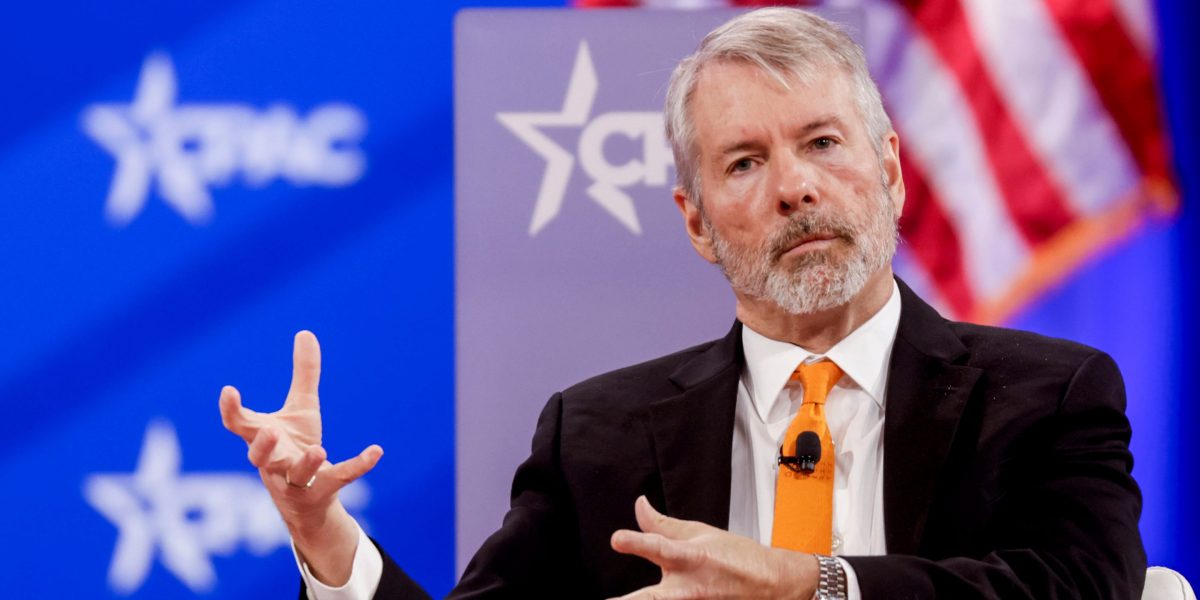
Michael Saylor, the executive chairman and a vocal supporter of cryptocurrency at Strategy (previously known as MicroStrategy), discussed the company’s financial position in a video interview with the Financial Times. He stated that even if Bitcoin were to plummet by 90% and remain at that low level for an extended period of approximately five years, the company itself would remain stable. However, he acknowledged that this scenario would likely result in significant losses for equity holders due to Strategy’s high leverage through convertible debt and bond offerings.
Strategy, a business intelligence firm, has become a major player in the Bitcoin world, holding a substantial amount of the cryptocurrency on its balance sheet. By reinvesting proceeds from stock sales and convertible bonds, the company has accumulated 568,840 BTC, currently valued at approximately $59 billion.
Saylor’s investment philosophy centers on Bitcoin.
In a conversation with Yahoo, Saylor expressed his conviction that “Bitcoin represents the pinnacle of property ownership and serves as the premier investment asset. The ultimate objective is to acquire more Bitcoin, believing that the entity holding the largest amount will ultimately prevail.”
Craig Coben, previously with Bank of America and now in equity capital markets, mentioned to the Financial Times that the company’s focus appears to be primarily on obtaining “new recruits” and securing “new money” rather than on the organic growth of its business software offerings.
To fuel further Bitcoin acquisitions, Strategy initiated a new preferred stock offering in January. This offering features dividend payments and a liquidation preference of $100 per share, guaranteeing investors that amount if the company is ever liquidated. According to the FT, this effort raised $580 million.
In March, the company launched another offering, named the perpetual strife preferred stock, again, to raise money to buy Bitcoin. According to a release, it is payable “solely in cash.”
While Strategy is actively exploring avenues to increase its Bitcoin holdings, Coben suggests that these actions “raise concerns regarding the long-term viability of their strategy,” particularly in the event of a significant Bitcoin price crash.
According to its form 10-Q, as of March 31, Strategy held $60.3 million in cash, a small fraction compared to its $43.5 billion Bitcoin investment. If the company were “forced to sell” its Bitcoin “at a substantial loss” to meet working capital requirements, a measure Saylor strongly opposes, it “could negatively impact the business and financial condition.”
In February, following a 13% weekly decline in Bitcoin’s value, Saylor posted on X, stating: “Sell a kidney if you must, but keep the Bitcoin.”
Saylor remains steadfast in his belief about the company’s financial stability, even amidst potential downturns in the cryptocurrency market.
Saylor commented to the FT, “Our financial framework is designed to withstand a scenario where Bitcoin drops by 90% and remains depressed for four to five years, ensuring our continued stability.”
However, Saylor conceded that shareholders would likely experience significant losses if the coin were to plummet.
Saylor stated, “It would not be a favorable result for equity holders. Those higher up in the capital structure would bear the brunt due to leverage, while others lower in the structure would receive payouts.”
Dave Weiseberger, a former managing director at Citigroup, informed Fortune that while Strategy has incurred considerable debt to finance its Bitcoin investments, a decline in cryptocurrency value “would almost certainly precipitate a sharper decrease” in Strategy’s stock price.
Despite the recent downturn in Bitcoin, the cryptocurrency’s value has increased by roughly 20% this month and by more than 65% compared to the same period last year.
Coben stated, “As long as MicroStrategy can maintain a premium relative to its net asset value, the strategy will continue to be beneficial for shareholders.”
Fortune’s request for comments from Strategy and Saylor went unanswered. The interview featuring Saylor and the Financial Times can be viewed below.