

Key Takeaway
Gemini’s co-founder, Tyler Winklevoss, asserts that JPMorgan’s newly introduced fees will significantly hinder the growth of cryptocurrency and other fintech companies while compromising consumer rights.
America’s largest banking institution, JPMorgan Chase, is intensifying its ongoing dispute with fintech firms regarding the accessibility and utilization of customer data.
Jamie Dimon vs. Open Banking
Taking advantage of potential regulatory changes, JPMorgan’s CEO, Jamie Dimon, has proposed implementing substantial fees for fintech companies to access customer data.
Critics argue that this policy could negatively impact platforms such as Plaid, which facilitate connections between banks and crypto applications like Gemini, Coinbase, and Kraken.
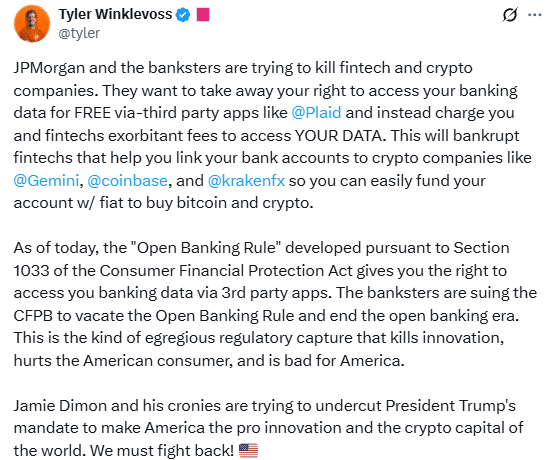
Tyler Winklevoss, co-founder of Gemini, stands out as a prominent voice against this measure, viewing it as a deliberate attack on innovation and a strategic maneuver to suppress competition.
“JPMorgan and other major banking institutions are attempting to eliminate fintech and cryptocurrency companies.”
Source: X
The “Open Banking Rule” established by the Consumer Financial Protection Bureau currently safeguards consumers’ entitlement to free access to their financial data through third-party applications.
However, should this rule be repealed, it could enable banks such as JPMorgan to impose significant charges for this access, which is essential for both consumers and data aggregators like Plaid.
Unsurprisingly, Winklevoss has denounced JPMorgan’s action as a clear instance of regulatory capture and a violation of consumer rights.
JPMorgan Defends Its Position
JPMorgan defends its decision, with spokesperson Pusateri stating that the new fees are designed to manage the high volume of data requests originating from fintech firms, the majority of which, according to the bank, are not directly related to genuine consumer activities.
In a discussion with Forbes, Pusateri stated,
“We process close to two billion monthly data requests from intermediaries, and over 90% of these requests are not connected to a consumer utilizing fintech services.”
Critics, including Winklevoss, characterize this as a textbook example of regulatory capture, where major banks exert influence over regulations to restrict competition.
Winklevoss Criticizes Dimon’s ‘Anti-Crypto Stance’
Although JPMorgan states that the new fees are needed to control excessive data requests, critics view it as part of a broader strategy by conventional finance to consolidate control over the evolving financial landscape.
Winklevoss remarked,
“Jamie Dimon and his associates are attempting to undermine President Trump’s directive to establish America as a hub for innovation and the global leader in crypto. We must resist this!”
He also alluded to the possibility that Gemini’s recent removal from the bank’s services was a retaliatory measure for his vocal criticism.
He remains steadfast in his position, pledging to continue challenging what he perceives as anti-competitive practices.
He declared,
“We will not remain silent, Jamie Dimon. We will persist in exposing this anti-competitive behavior, rent-seeking activities, and the immoral efforts to bankrupt fintech and crypto companies.”
JPMorgan’s Foray into Crypto
Interestingly, while engaging in data access disputes with fintech companies, JPMorgan has been taking measured steps toward crypto acceptance.
Reports indicate that the bank is considering offering loans secured by clients’ crypto assets, suggesting a more nuanced approach than outright opposition.