
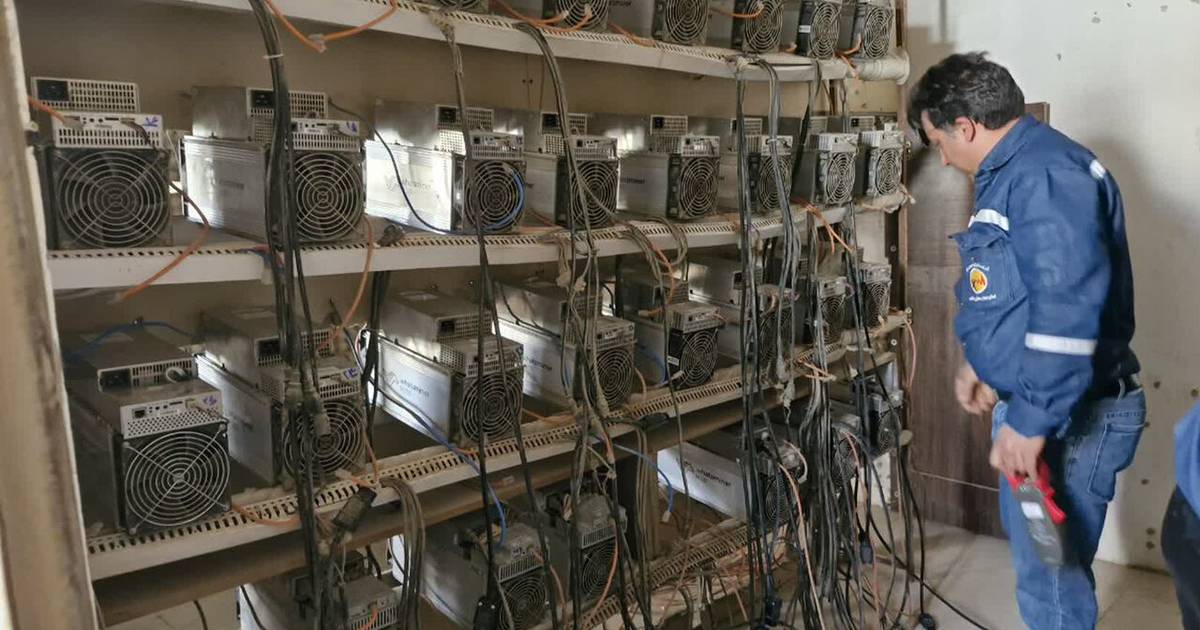
Cryptocurrency mining operations in Iran are reportedly consuming a significant amount of electricity, placing strain on the country’s power grid. Mohammad Allahdad, a top official at Tavanir, Iran’s power company, estimates that these mining activities are responsible for the usage of approximately 2,000 megawatts (MW) of power. This is roughly the equivalent of the electricity generated by two of Iran’s Bushehr nuclear power reactors.
Allahdad noted that this consumption represents about 5% of the nation’s total electricity usage. However, he emphasized that it contributes as much as 20% to the current power shortage. He described the situation as concerning.
A recent disruption in internet service linked to tensions with Israel led to a 2,400 MW drop in power consumption nationwide. Tavanir attributes this decrease to the shutdown of over 900,000 illegally operating crypto mining machines, highlighting the substantial impact of these operations on the power grid.
Allahdad’s statements come amid escalating concerns about blackouts, infrastructure stress, and public dissatisfaction during Iran’s hot summer months, when electricity demand peaks due to increased use of air conditioning, agricultural needs, and industrial production.
Allahdad underscored that utilizing electricity for crypto mining during periods of high demand is not only against the law and considered unethical but also presents dangers. He warned that it can lead to voltage dips, blown fuses, damage to home appliances, and even increase the risk of fires.
“Crypto mining equipment generates a considerable amount of heat,” he explained. “We have received numerous reports from fire departments regarding fires connected to mining rigs, some of which have spread to adjacent residences.”
Secret Mining Operations in Plain Sight
Authorities report that clandestine mining facilities are often established in vacant houses, abandoned storefronts, warehouses, and industrial buildings. These sites are typically characterized by elevated electricity consumption and the presence of surveillance cameras, which serve as indicators for law enforcement.
“Identifying these illegal operations can be difficult,” Allahdad acknowledged, “particularly in expansive industrial zones. This is why public assistance is so important.”
To aid in enforcement efforts, Tavanir has established a public hotline for reporting suspected illegal mining activities. Citizens who provide information leading to the discovery of illegal operations may be eligible for rewards of up to 200 million tomans (approximately $2,300).
The Power Equivalent of Bitcoin Mining
According to Hadi Sefidmou, who leads Iran’s Crypto Mining Oversight and Regulation Initiative, producing a single Bitcoin using older mining hardware can consume as much as 1 million kilowatt-hours (kWh) of electricity. This is equivalent to the annual electricity consumption of approximately 440 Iranian homes. Even newer, more efficient mining devices still require substantial power, with average consumption per unit ranging from 2 to 3.5 kW.
Sefidmou pointed out that given the continuous operation of these devices, each illegal miner consumes roughly the same amount of power as 12 households.
Stepped-Up Enforcement
As enforcement efforts have increased, there has been a corresponding rise in the seizure of mining equipment since last year. Over 250,000 unauthorized devices have been confiscated across Tehran, Khorasan Razavi, Isfahan, Fars, Kerman, and East Azarbaijan provinces. The majority of these units were discovered hidden in deserted residences, rural farming operations, industrial ruins, and suburban homes.
Recently, 108 mining rigs were seized in the southern city of Ahvaz. These machines were found inside an abandoned factory located in the village of Khabineh, according to Mohammad Forati, CEO of Ahvaz Power Distribution Company. Forati stated that the mining operation had caused voltage drops throughout the area, leading to complaints from local residents.
Mahmoud Mahmoudi, managing director of the Markazi Province Power Distribution Company, announced on Tuesday that 445 cryptocurrency mining devices have been identified and seized in the province since the start of the current Iranian year (March 21).
Another recent incident in Alborz province resulted in the closure of 26 crypto mining operations between March and June, with 168 illegal devices seized. Last week, power company personnel in Alborz intercepted a vehicle transporting 26 mining machines.
Electricity in Iran is heavily subsidized, making it among the cheapest in the world.
“With electricity consumption reaching unprecedented levels, exceeding 70,000 MW, we cannot overlook this issue,” stated Mostafa Rajabi Mashhadi, CEO of Tavanir. “Each illicit miner we disconnect helps conserve power for our citizens.”