
Leading up to the Bitcoin halving in 2024, which decreased the block reward to 3.125 Bitcoin (BTC Price), several Bitcoin mining operations have started to explore the burgeoning artificial intelligence sector.
While some adopted a cautious strategy, testing the waters, others made a full commitment, reconfiguring their systems, securing financing, and inking deals potentially worth billions.
But is this strategic shift proving successful in practice? For some, this adaptation provides a much-needed financial boost as revenue from Bitcoin mining has decreased. For other miners, this shift acts as a financial safeguard to mitigate the negative impact of future halving events.
Here’s an examination of how the top crypto mining companies have performed since deciding to move into the AI market.
AI Shift Provides a Lifeline for Bitcoin Miner
Core Scientific represents one of the more notable turnaround stories within the Bitcoin mining sector, where its entry into AI rescued its previously struggling operations.
Nasdaq
The company filed for bankruptcy protection in late 2022. It re-emerged in early 2024 and was relisted on the Nasdaq. Then, the company transitioned away from exclusively mining Bitcoin and evolved into a colocation service, renting its data centers to AI-focused businesses. They finalized a 12-year agreement worth $3.5 billion with CoreWeave in June 2024 to host CoreWeave’s high-performance computing (HPC) operations.
Core Scientific announced that its first-quarter revenue declined to $79.5 million, a decrease from $179.3 million in the prior year. The company cited the reduction in Bitcoin rewards due to the halving and their business shift to hosting high-performance computing as primary factors. However, the recent increase in Bitcoin’s value has offset some of those losses.
Related:
Bitcoin Knots gain ground: Will a chain split kill BTC price?
Late in June 2025, CoreWeave restarted talks about potentially acquiring Core Scientific, following a failed $1 billion attempted acquisition in 2024. The news of these renewed talks boosted Core Scientific’s stock value.
AI as a Secondary Pursuit for Many Bitcoin Miners
Hut 8’s artificial intelligence aspirations began to take shape in September 2024, when they officially introduced their GPU-as-a-Service program through a subsidiary called Highrise AI.
This strategy involved deploying over 1,000 Nvidia H100 GPUs – specialized processors frequently utilized for AI model training and operation – to support its cloud-based AI computing services. The launch included a five-year arrangement involving fixed payments and revenue sharing, timed with decreased revenues experienced by Bitcoin miners after the April 2024 halving.

Cointelegraph
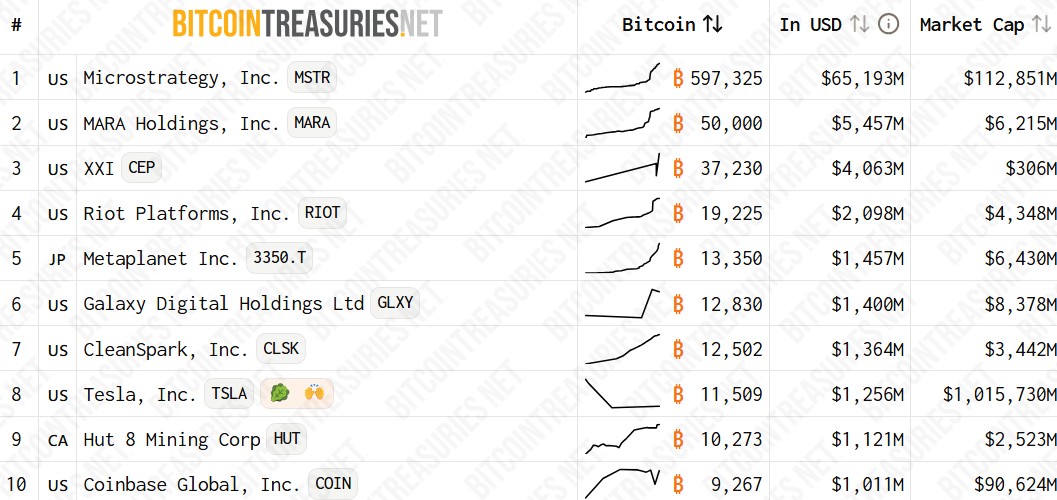
During the first quarter of 2025, the company’s Bitcoin mining operations generated 167 BTC, which is a decrease from 716 BTC produced in the previous year. Although Hut 8 reported a quarterly net loss of $134.3 million, CEO Asher Genoot stated that their financial results were the outcome of planned investments that led to a 79% increase in hashrate. They also hold 10,273 BTC, ranking them ninth amongst publicly traded companies in terms of Bitcoin holdings.
AI continues to represent a small portion of Hut 8’s overall business model as the firm continues to grow its Bitcoin business. More recently, American Bitcoin, a majority-owned subsidiary of Hut 8, announced it secured $220 million to acquire Bitcoin mining equipment. Sons of former US President Donald Trump are among the founders of American Bitcoin, of which Hut 8 acquired a majority stake in late March.
AI is Becoming an Important Source of Revenue for Some Bitcoin Miners
Certain Bitcoin miners, such as Iren and Hive, are beginning to observe substantial income from AI, even though mining operations still dominate their financial results.
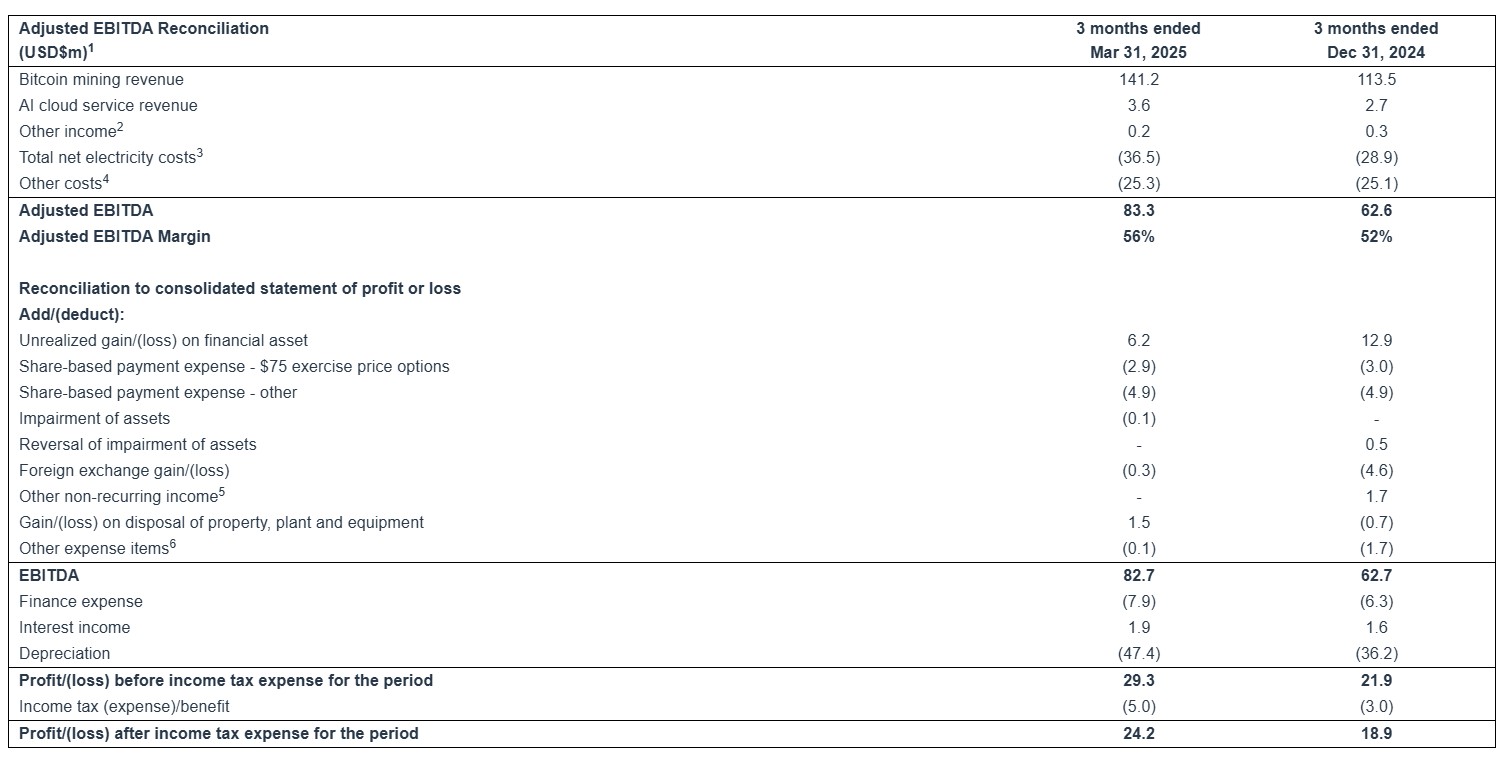
At the start of 2024, Iren (previously known as Iris Energy), an Australian mining company, began acquiring Nvidia GPUs. By February, they had signed their first AI contract powered by 248 GPUs. By mid-2025, the company had deployed around 4,300 GPUs. During the third quarter of the fiscal year 2025 (ending March 31), Iren mined 1,514 BTC, increasing from 1,232 BTC during the previous quarter.
Iren
Concurrently, revenue from its AI cloud services climbed 33% to reach $3.6 million. The company is also in the process of developing a liquid-cooled AI data center in Texas and a specialized facility located in British Columbia, Canada, which will be capable of accommodating up to 20,000 GPUs. However, a class-action lawsuit, initiated in October 2024, alleges that Iren provided misleading information to investors regarding the readiness of its Texas facility.
Related:
Bitcoin hashrate down 15%, 26 firms add BTC to balance sheets: June in charts
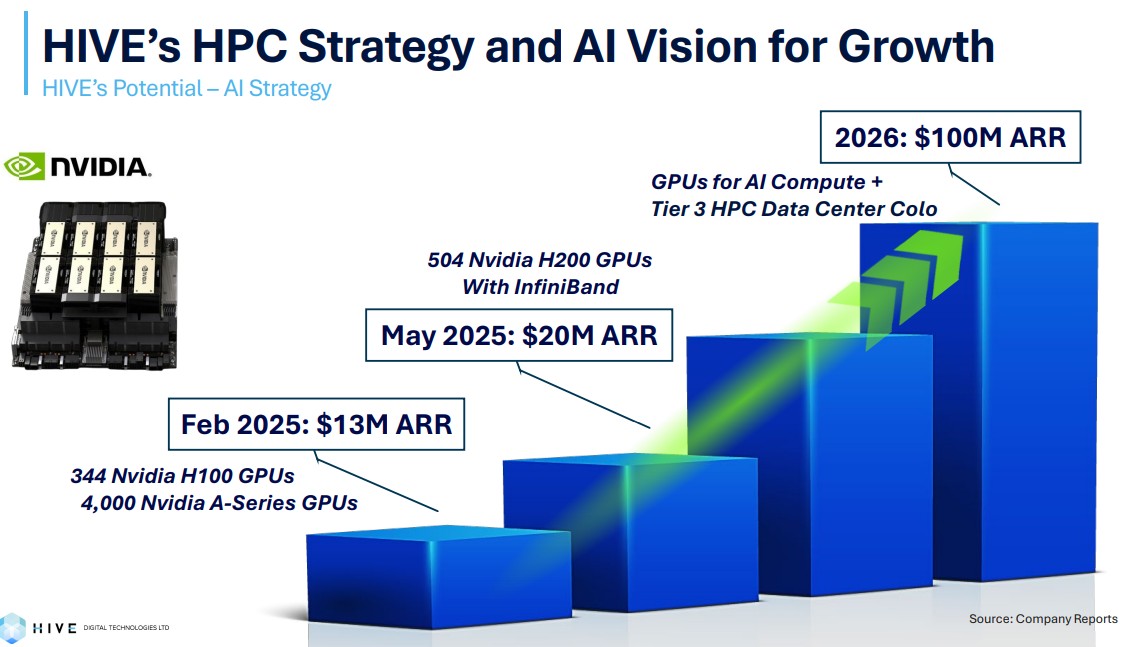
Hive initiated its transition into artificial intelligence in mid-2023 with a rebranding effort, changing its name from Hive Blockchain, and placed greater focus on Nvidia-powered computing clusters. Following initial small-scale implementations, Hive invested $30 million in December 2024 to implement GPUs in Quebec, Canada. By the middle of 2025, Hive had deployed more than 5,000 units.
For its 2025 fiscal year, Hive generated $115.3 million in revenue, with $10.1 million, which is triple the amount from the previous year, from AI and HPC hosting. This revenue now constitutes approximately 9% of their total earnings.
Hive Digital Technologies
Leading Bitcoin Miner Treasuries Don’t Guarantee Top Performance
Riot Platforms and MARA Holdings are two of the most well-known names within the Bitcoin mining sector, but both organizations are now actively preparing for a future beyond exclusively mining digital assets.
Riot began exploring potential AI and HPC applications in early 2025, launching a formal evaluation process to convert up to 600 megawatts of power capacity at its Corsicana, Texas facility into high-performance infrastructure. This shift was accompanied by a temporary halt in expanding Bitcoin mining operations at the location. Riot has not yet entered into any significant AI contracts, but its Corsicana site, which covers 355 acres and has the eventual capacity to handle 1 gigawatt of power, makes it well-positioned to attract significant clients in the future.
BitcoinTreasuries.NET
Riot remains financially strong in Bitcoin. In the first quarter of 2025, the company mined 1,530 BTC, which generated $142.9 million in mining revenue – doubling its revenue of $71.4 million in the first quarter of 2024. Riot attributed the gains to higher Bitcoin prices and an increased operational hashrate. The company also holds 19,225 BTC, making it the fourth-largest corporate Bitcoin holder in the world.
MARA possesses the largest Bitcoin treasury among all mining companies and is second only to MicroStrategy among all publicly traded companies with 50,000 BTC.
In March 2024, MARA revealed its MARA 2PIC700, an immersion cooling system designed for dense computing workloads, which includes AI and crypto mining. By mid-2024, the firm rebranded its broader strategy to focus on “edge computing.”
This strategic shift has not yet resulted in substantial contracts or consistent cash flows for both Bitcoin producers, but their Bitcoin holdings highlight why they are not under pressure to aggressively diversify into artificial intelligence expansion.
A Bitcoin Miner Shifts Away From Artificial Intelligence
While numerous Bitcoin mining firms are investing in AI and high-performance computing, ASIC manufacturer Canaan is moving in the opposite direction. In July 2025, the company announced its intention to shut down its AI chip division.
With just 2.1% of the global ASIC market, Canaan remains a smaller player compared to industry giants like Bitmain or MicroBT.
By focusing specifically on mining hardware and pursuing long-term sustainability in North America, the company is establishing a unique path in a sector that has largely embraced AI.
Magazine:
Fake JD stablecoins, scammers impersonate Solana devs: Asia Express