
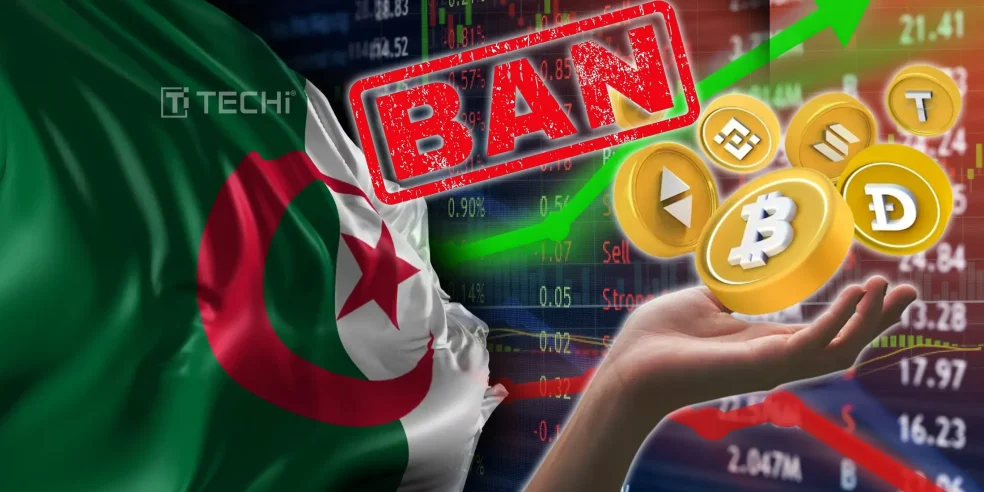
On July 30, 2025, Algeria enacted some of the world’s most stringent rules against cryptocurrency, effectively making all activities related to digital currencies illegal. This includes buying, selling, mining, owning, and even promoting crypto. The legislation, which was approved on July 24th and initially reported by Fibladi, a local news source, on July 28th, marks a major policy shift, placing Algeria among nations like China that have completely banned digital assets.
Under the new legal framework, anyone involved in crypto-related actions now risks imprisonment. Sentences could range from two months to a year, in addition to fines ranging from 200,000 to 1 million Algerian dinars (approximately $1,540 to $7,700 USD). In more serious instances, both imprisonment and fines could be imposed.
Complete Prohibition of Crypto Activities
This new legislation broadens pre-existing restrictions to encompass nearly every aspect of the cryptocurrency world. This includes owning digital assets, running cryptocurrency exchanges, engaging in crypto mining, and advertising tokens like Bitcoin or Ethereum. It also prohibits offering wallet services or promoting any crypto-related products.
This sweeping ban replaces Algeria’s previous ambiguous position on crypto, where digital assets were generally discouraged but not outright illegal. The change represents a decisive shift from regulatory uncertainty to complete prohibition.
“This action makes a strong statement: Algeria has no plans to participate in the international trend of decentralized finance,” stated Amir Haddadi, a fintech expert based in North Africa.
Reasons Cited: Financial Security and Combating Terrorism
Algerian authorities have defended the crypto ban primarily on the basis of national security and the stability of the financial system. Lawmakers identified tax avoidance, fraud, and money laundering as major concerns, along with the potential for cryptocurrencies to be used to fund terrorist activities.
The legal update is part of a wider effort to strengthen Algeria’s Anti-Money Laundering (AML) and Counter-Terrorism Financing (CTF) procedures. The government argues that outlawing crypto will help close loopholes used by illicit actors and shield individual investors from “dishonest practices.”
While some legal experts contend that improved regulation would better address these issues, Algerian policymakers have instead chosen complete prohibition.
A Contrast to Global Trends
Algeria’s stance contrasts sharply with worldwide trends toward crypto regulation and integration. The European Union, the United States, and several Southeast Asian countries have begun to introduce comprehensive legal structures designed to incorporate crypto into the mainstream financial system.
For instance, the EU’s Markets in Crypto-Assets (MiCA) regulation, expected to fully take effect later in the year, establishes specific protocols for wallet providers, exchanges, and token issuers. The U.S. Securities and Exchange Commission (SEC), while in legal battles with several companies, has also started granting limited licenses for regulated crypto ETFs and stablecoins.
“While nations around the world are figuring out how to regulate crypto with clear legal rules, Algeria has essentially rejected the technology,” said Lina Youssef, a financial policy researcher at the Middle East Blockchain Forum.
Concurrently, the worldwide crypto market has been showing indications of a resurgence. Ethereum, for example, has begun a strong rebound, with experts predicting a potential return to $4,000 in 2025, driven by increasing demand for decentralized finance and layer-2 solutions.
A Rapidly Expanding Market, Now Closed Off
This ban comes at a time when Algeria was quietly emerging as a key player in the regional digital finance landscape. According to a 2024 report by Chainalysis, Algeria was among the top five fastest-growing crypto economies in the MENA region.
This growth primarily occurred discreetly because of the lack of clear legal rules. Algeria’s banking sector is heavily regulated, with restricted access to foreign currencies and stringent limitations on the movement of capital. This had made crypto a valuable, although risky, tool for small businesses and tech-savvy young people looking to store value or make international transactions.
“The underground nature of crypto trading in Algeria was a way for many to survive financially,” said Rachid Bourbia, a digital entrepreneur based in Algiers. “Now, even that possibility is gone.”
Severe Penalties Could Hinder Innovation
Critics are warning that the chilling effect of the ban could damage Algeria’s long-term potential in cutting-edge technologies.
“Instead of fostering innovation, the government has created an environment of fear,” said Sarah Mahfouz, a venture capital consultant in the region. “This will push tech talent and capital to neighboring countries with more progressive policies.”
Countries such as Morocco and Tunisia, while remaining cautious, have recently started regulatory experimentation in the digital assets space, including discussions about Central Bank Digital Currencies (CBDCs).
Is It A Step Backward?
Observers believe that the move is not only a rejection of cryptocurrencies but also a missed opportunity to modernize Algeria’s financial system. With more than 40% of the population under 25 and a large proportion still without access to banking services, crypto had the potential to promote financial inclusion, according to some analysts.
“Algeria has chosen isolation over integration,” said Youssef. “And that decision could put it at a disadvantage in the global digital economy.”
Looking Forward
It is still unclear how Algeria plans to enforce the ban across decentralized platforms that often operate outside of government oversight. Enforcement may rely heavily on blocking at the ISP level, banking restrictions, and arrests related to peer-to-peer activity.
Even so, the symbolic weight of the law sends a strong signal: Algeria views cryptocurrencies not as tools for economic advancement but as threats to stability and governance.
As worldwide markets move toward integration and clarity, Algeria’s crackdown places it as an exception, for better or worse.