
The U.S. government’s latest digital asset report, unveiled Wednesday by the White House, outlines several proposed policy changes, notably excluding any concrete plans for a national Bitcoin (BTC) reserve.
The comprehensive, 166-page report delves into diverse aspects of the digital currency sector, offering recommendations on banking regulations, stablecoin frameworks, and measures to combat financial crimes. While it acknowledges the existence of the Strategic Bitcoin Reserve, first established in March, it offers no further direction on its development or expansion.
Some Bitcoin advocates are pushing for a more proactive approach, suggesting that the U.S. should mirror El Salvador’s strategy by directly purchasing and holding Bitcoin as a national asset.
While the broader cryptocurrency community generally views the report favorably, particularly regarding its potential impact on future blockchain legislation, some express concern that the lack of progress on a dedicated Bitcoin reserve signifies a missed opportunity.
Strategic Bitcoin Reserve Omission in White House Crypto Report Raises Concerns
Just days after taking office on January 23rd, former President Donald Trump initiated the process by signing an executive order to form the President’s Working Group on Digital Asset Markets, setting a six-month deadline for policy suggestions.
The U.S. government’s apparent support for cryptocurrency had fueled expectations of significant developments concerning the Strategic Bitcoin Reserve. Prior to the White House’s report release, industry experts like Bitcoin historian Pete Rizzo cautioned followers to prepare for notable news related to the reserve.

While Bitcoin is frequently mentioned within the document, acknowledging its pivotal role in the creation of the cryptocurrency market, the strategic Bitcoin reserve is only referenced briefly towards the end.
Even then, the White House’s “recommendation” simply restates the original directives from the March 6th executive order that initially established the reserve and a digital asset stockpile.
The Bitcoin community voiced dissatisfaction with the development. CJ Burnett, a top executive at Compass Mining, a U.S.-based crypto mining infrastructure provider, commented that the absence of any further action on the Strategic Bitcoin Reserve presented a missed chance for the US government to demonstrate leadership. He also stated that this creates unwanted uncertainty.
Burnett went on to say that the delay in establishing a more developed Bitcoin reserve could leave the United States behind other nations taking a more proactive approach.
Related: Who’s running in Trump’s race to make US a ‘Bitcoin superpower?’
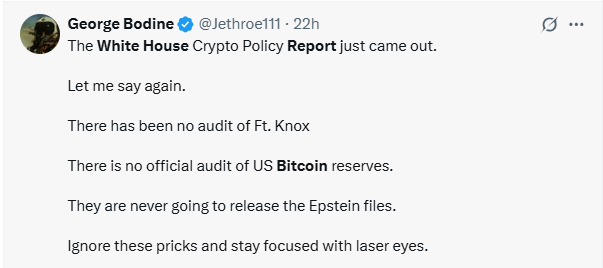
Influential Bitcoin commentator George Bodine characterized the lack of a more developed Bitcoin reserve as yet another instance of governmental misdirection.
Some observers presented a more positive perspective. Calvin Ayre, a Canadian investor involved in blockchain and Web3 ventures, stated that Bitcoin’s inclusion in the document, regardless of the reserve’s status, signified an important step: “While the lack of ‘Bitcoin reserve’ details is disappointing to many, the report should be given credit for at least attempting to comprehensively explain the space.”
Bitcoin journalist Susie Violet Ward argued that the report demonstrates a noticeable shift in regulatory strategy. She also stated that Bitcoin is now seen as seperate from other digital assets and is now seen on it’s own.
She added that even if the Bitcoin reserve has little development, this does indicate that bitcoin is being considered a strategic asset and that is a tonal shift for the government.
“For Bitcoiners, this is progress.”
White House Prioritizes Clear Regulatory Framework for Crypto
Beyond the Bitcoin reserve issue, the report outlines detailed suggestions for refining crypto regulations.
Bo Hines, the Executive Director of the President’s Council of Advisers on Digital Assets, revealed that the policy changes will be implemented in three stages.
-
The “demolition phase” involves eliminating existing regulations put in place during the prior administration.
-
The “construction phase” includes close collaboration between lawmakers and industry experts to establish laws that foster growth.
-
The “implementation phase” centers on enacting these new legislative measures.
A key objective of the report is the creation of a clear classification system, or “taxonomy,” for digital assets to determine whether they should be treated as securities or commodities. In this regard, it suggests shared oversight between the Commodity Futures Trading Commission (CFTC) and the Securities and Exchange Commission (SEC), with the CFTC taking the lead in regulating spot crypto markets.
The report additionally proposes allowing banks to offer crypto custody services and other related services to their customers. It also calls for simplification of the banking charter application process through clearer, more transparent requirements.
Taxation, a long-standing point of contention for crypto holders in the U.S. due to varying classifications and recommended tax treatments across different agencies, is also addressed in the report.
The administration recommended that legislation should be introduced that classifies digital assets with tax rules for federal income tax purposes.
Hines also suggested that the current administration aims to expand the crypto market to the point where going back on adoption would be very difficult to do.
The Biden administration faced a regulatory environment termed “Operation Chokepoint 2.0” by the crypto industry. Hines declared that “There’s no way that we’re going to face an Operation Chokepoint 3.0. I think one of the greatest ways to prevent that is through adoption.”
The realization of an active and substantial Bitcoin reserve, however, will have to wait, at least for now.
Magazine: Ethereum’s roadmap to 10,000 TPS using ZK tech: Dummies’ guide