

The digital asset landscape has entered a novel phase this year. Fresh market dynamics are influencing investor perceptions, challenging the traditional four-year cycle theory. Bitcoin’s historical patterns of halvings and market fluctuations have typically followed a predictable course, but the trends observed in 2025 suggest a departure from this pattern.
Bitwise Asset Management’s Chief Investment Officer, Matt Hougan, posits that the crypto sector has transitioned into a new era. In a recent analysis, Hougan suggests that the conventional four-year cycle is no longer a dependable model for interpreting market trends in the crypto space. He argues that the diminishing influence of factors that drove previous cycles, like the halving impact and blow-up risks, coupled with the emergence of more extensive, sustained trends that don’t fit the old pattern, are primary drivers of this change.
Hougan identifies the rise of crypto ETFs, increased institutional investment, and regulatory advancements as long-term forces shaping the market. As institutional capital enters the digital asset realm and regulatory clarity improves with legislation like the GENIUS Act, investors may need to re-evaluate their expectations.
Evolving Market Structure in the Crypto Sphere: The Influence of Sustained Trends
According to Hougan, each subsequent halving event has “half the significance” of the previous one, reducing its overall influence on market momentum. Unlike 2018 and 2022, where interest rate conditions added stress to risk-based assets, the current financial environment is more supportive of cryptocurrency.
Furthermore, the dangers associated with unregulated entities are decreasing as regulatory oversight improves and institutionalization grows. Hougan highlights that the expansion of regulated firms and enhanced transparency has brought stability to the market and mitigated some of its historical volatility.
He also emphasizes a developing risk: the increasing influence of Treasury companies that possess and move substantial amounts of cryptocurrency. Their capability to affect markets in the short term is considerable and requires close monitoring.
Simultaneously, larger forces are now at play. The movement of capital into crypto ETFs marks the start of a 5–10 year trend that began in 2024. Institutional acceptance is just beginning, with pension funds and endowments starting to explore this asset category. Regulatory progress gained momentum in January 2025, and Wall Street capital is only now starting to flow following the enactment of the Genius Act this month.
“These sustained, positive influences will outweigh the forces driving the historical ‘four-year cycle,'” Hougan stated. He anticipates a robust 2026, driven not by hype-induced spikes, but by what he calls a “consistent, sustained increase” as opposed to a hyper-cycle. While acknowledging continued price fluctuations, Hougan stresses that crypto’s advancement is genuine and accelerating. Investors might consider updating their approaches to align with this evolving environment.
The logarithmic chart displaying the total crypto market capitalization over time indicates a clear long-term upward trend, currently around $3.82 trillion. Following an extended period of stabilization that commenced in mid-2022, the market has shown a consistent rise and is nearing its all-time high between $3.9 trillion and $4 trillion. This zone served as a significant barrier during the previous cycle and remains a crucial psychological marker.
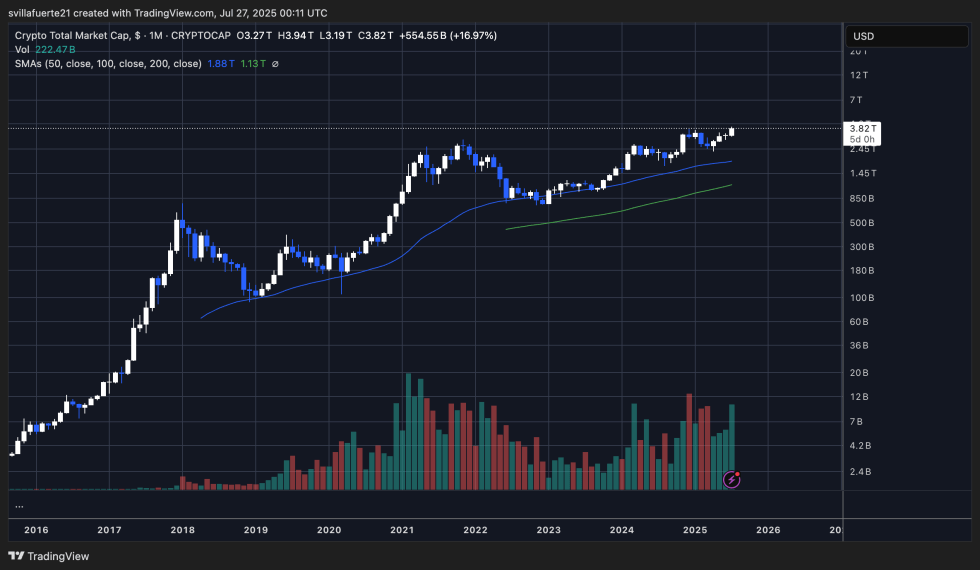
Technically, the 50-month simple moving average (SMA) is trending upward and currently positioned at $1.88 trillion, significantly below the present market value, signifying substantial long-term support. Moreover, trading volume has increased markedly in recent months—particularly during the last two positive periods—showing increased investor confidence and institutional flows, aligning with the trend of growing ETF adoption and increased regulatory clarity.
The market pattern also displays rising lows and peaks on the monthly chart, confirming that the bullish trend remains strong. Provided the crypto market cap remains above $3.2 trillion and achieves another monthly close exceeding $3.8 trillion, the possibility of a breakthrough into uncharted territory rises significantly.
Featured image from Dall-E, chart from TradingView

Editorial Process for bitcoinist is dedicated to providing deeply researched, precise, and impartial information. We maintain rigorous sourcing criteria, and every article undergoes thorough examination by our team of leading tech authorities and experienced editors. This ensures the accuracy, relevance, and value of our content for our audience.