

The growth rate of Bitcoin hashrate in the United States has plateaued around 36%, primarily due to increased competition for energy resources from companies specializing in Artificial Intelligence.
A recent report by GoMining Institutional suggests that the Bitcoin mining sector in the U.S. is facing rising challenges. This is driven by the aggressive procurement of long-term energy infrastructure by artificial intelligence (AI) enterprises.
According to GoMining Institutional analysts, this shift in energy consumption patterns, influenced by AI firms securing energy resources previously used by miners, is causing a slowdown in the expansion of domestic hashrate. It’s also leading key players in the mining sector to reconsider their strategic approaches.
AI and high-performance computing (HPC) companies, backed by substantial financial resources and less susceptible to fluctuations in electricity costs, are increasingly bidding higher than Bitcoin miners for access to vital resources like power, data center facilities, and grid capacity. GoMining Institutional’s newest “H1 Bitcoin Mining Market Review and Key Trends” report highlights that this dynamic is compelling miners to re-evaluate their growth strategies and explore alternative operational models.
‘Convergence of Tech Revolutions’
Fakhul Miah, Managing Director at GoMining Institutional, describes the first half of 2025 as a period where “two major technological revolutions are intersecting.”
Miah elaborated, stating, “While Bitcoin experienced unprecedented validation from both Wall Street and Washington, miners in the field are encountering a fresh challenge due to the AI industry’s relentless pursuit of energy resources.”
AI businesses are establishing long-term energy contracts, which were once the domain of Bitcoin miners. As an example, Galaxy Digital, a crypto investment firm, repurposed a significant portion of its Helios campus in West Texas from Bitcoin mining operations to AI computing. Furthermore, its partner, CoreWeave, increased its leased capacity from 133 MW to approximately 400 MW.
Riot Platforms has stopped its 600-MW mining construction project in Texas and is currently considering AI and HPC options at that site. Iris Energy has put a limit on its mining hardware capacity and is now focusing on its AI cloud services, which are currently generating more than $25 million each year.
Bitfarms, a mining business listed on a public stock exchange, has also adjusted its strategic direction. Ben Gagnon, the company’s CEO, stated that while the company remains “optimistic about mining economics,” its primary goal is to “generate long-term value for shareholders through expanding into the energy sector and HPC within the U.S.”
Untapped Markets
According to GoMining Institutional, this reallocation trend demonstrates a foundational change in how digital infrastructure is being monetized. Bitcoin miners are now facing competition from AI firms that can derive greater financial benefit from each megawatt. As a response, some companies are repositioning themselves as data center providers, while others are using business strategies that combine multiple revenue streams.
The wider repercussions of this can be seen in hashrate data. Although the U.S. is still the leading country for Bitcoin mining, accounting for 36% of the global hashrate according to the Hashrate Index’s Global Hashrate Heatmap, the rate of expansion has slowed. The Bitcoin halving event that occurred in 2024, which reduced block rewards from 6.25 BTC to 3.125 BTC, has tightened profit margins and made them more sensitive to energy costs.
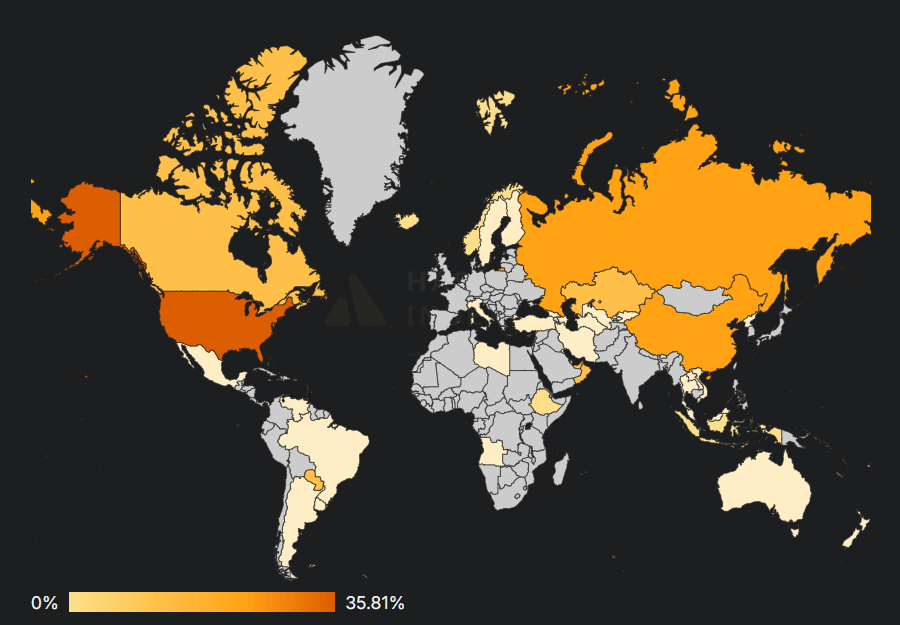
The Heatmap, which aggregates information obtained through ASIC trading, mining pools, and firmware indicators, reveals that miners in the U.S. are reducing their expansion plans due to the increased priority of AI in energy distribution, leading to fewer affordable energy options.
The report concludes that “in the future, the U.S. may find it hard to retain its dominant share of the global hashrate” as investments are redirected towards unexplored markets.
GoMining, established in 2017, is a digital mining platform that allows users to mine Bitcoin without the intricacies of managing physical equipment. GoMining secured $3 million through a funding round spearheaded by the VC firm, Bitscale Capital, in May of 2024.