
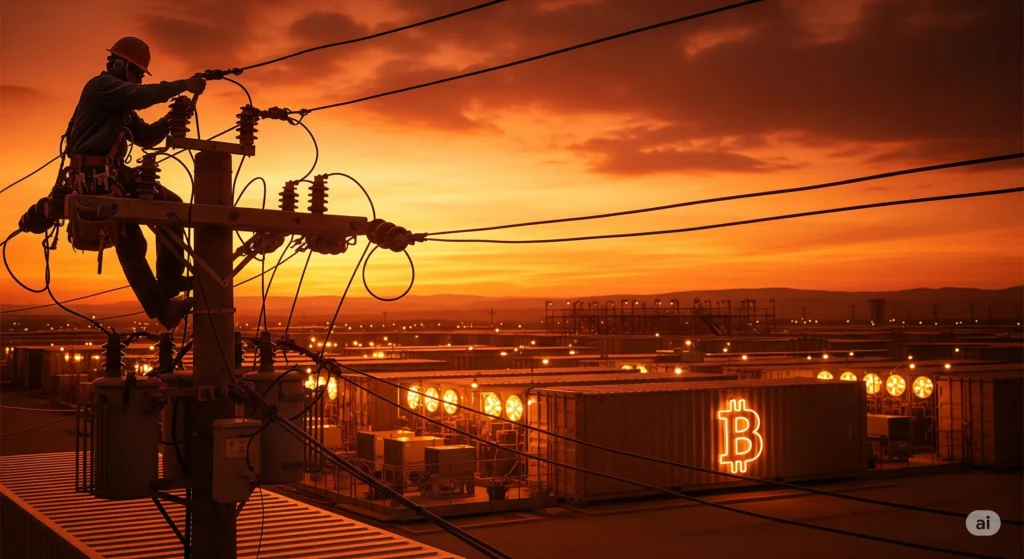
Many view Bitcoin as a simple digital asset: Acquire it, store it securely, and wait for its value to increase. Seems straightforward, right?
This is often the polished, high-level perspective on Bitcoin, ideal for boardroom presentations and investment reports.
However, the reality of Bitcoin mining is far more complex. It involves noise, physical labor, energy consumption, and real-world infrastructure. It’s about hands-on operation, not just theoretical discussions.
Miners aren’t simply holding Bitcoin. They are actively engaged in producing it.
This crucial element is often overlooked, yet it’s more significant than most recognize.
Experiencing Both Worlds
Prior to entering the mining sector, I was deeply immersed in the solar energy field. My work involved creating models, making projections, and presenting to clients. I had mastered the financial aspects. However, true understanding came from being on site with the installation crews, dealing with weather, deadlines, and supply chain disruptions.
It was the labor, not the calculations, that brought the solar power system to life. The hands-on experience made it tangible.
Bitcoin mining is analogous.
Currently, I am involved in both the strategic and operational sides of the business. I’ve witnessed our Paraguay location, with its rows of ASIC miners powered by hydroelectric energy, generating substantial hashrate. I’ve been with the technicians during the night, fixing the machines to avoid losing blocks.
Bitcoin isn’t created by magic. It’s generated through effort.
Bitcoin Mining and Holding: Divergent Perspectives
The Bitcoin community encompasses diverse viewpoints. Since 2020, numerous individuals have entered the space through finance. Their conversations center around ETFs, charts, and market trends. They are interested in investing for returns and protection from traditional financial systems.
But Bitcoin’s foundation is built on physics, not just theory. It embodies sovereignty achieved through proof-of-work. Miners aren’t just discussing decentralization, they are creating decentralization.
Miners have a deeper appreciation of scarcity since they directly experience the effort needed to create each satoshi. It represents more than profit. It encompasses labor, investment, and thermodynamics daily.
Bitcoin’s value is rooted in energy and real-world actions. It’s for those who don’t have the option of abstraction.
In the past, manual work was expected to give way to desk work. However, Bitcoin might change that.
Could this be an era when knowledge workers rediscover the satisfaction of tangible contributions, and become involved not just with money, but with physical effort?
This could signify the return of the value of hard work.
Conviction Demonstrated: Examples in Norway and Paraguay
I’ve observed this in different parts of the world.
My experience in Norway was straightforward: clean energy and the efficiency of miners performing their work. Real infrastructure speaks for itself.
While in Paraguay, the team focused on optimizing power distribution and adapting rigs for maximum productivity. Without the sensational, this is the kind of problem-solving that never gets media attention.
When I say conviction, I’m not simply talking about riding through market dips. I’m speaking about people working tirelessly in the dark because they know that their effort keeps Bitcoin alive.
These are not just traders or investors. They are custodians of the network.
The Importance of Bitcoin Mining
This isn’t merely a conceptual view. There are practical implications. When Bitcoin faces challenges – energy price increases, regulatory pressure, or liquidity issues – it won’t be the analysts who defend it. It will be the miners.
They will adapt.
They will relocate.
They will persevere.
This is driven by their commitment to Bitcoin.
Knowledge workers should consider this shift in perspective.
Beyond security, we need more people mining Bitcoin. The wider the participation at the core, the faster we can transition away from fiat currency-driven systems towards a Bitcoin-native economy.
There’s an ethical reason here as well: If you see how Bitcoin can change the world, maybe you don’t just get to hold it. Perhaps you have a duty to help build it.
An Invitation to the Community
Bitcoin requires both the miner and the allocator. Let’s recognize the importance of those who create the foundation.
Bitcoin is built on the labor of individuals showing up to address real-world challenges, not by figures on a report.
To those involved in the financial aspects, we invite you to participate. Get hands-on and contribute to the network. Whether you’re operating a single rig or managing a mining operation, you’re contributing to something significant. You’re contributing to Bitcoin.
Bitcoin is powered by proof-of-work. Miners are the ones performing the work. Let’s show our appreciation and support them.
Kent Halliburton is the CEO and Co-founder of Sazmining. The expressed views are the author’s alone and do not represent BTC Inc or Bitcoin Magazine.