
Journalist
Tanzeel Akhtar

Journalist
Tanzeel Akhtar
Share


In the year 2025, extracting Bitcoin has transformed. It’s no longer just about computing power and block rewards. Instead, it’s developed into a comprehensive infrastructural battle. Access to power sources, strategic global positioning, and synergy with cutting-edge tech, such as Artificial Intelligence, are what determine survival.
According to a newly published report titled Bitcoin Mining Market Review and Key Trends by Nico Smid, a research analyst, and Fakhul Miah, a managing director at GoMining Institutional, the industry now confronts a challenge from artificial intelligence (AI), one of today’s fastest-growing technology sectors.
AI’s exponential growth necessitates immense electrical power for training sophisticated models. This creates direct competition with Bitcoin miners, who also need consistent access to affordable and abundant electricity in order to maintain profitability.
The increased demand is resulting in a “power crunch” as the report describes, driving mining companies to actively re-evaluate their operational locations, approaches to procuring energy, and management of geopolitical risks.
The fight for electricity now stretches beyond the bounds of inter-mining rivalries. It has extended outwards, impacting major players like Riot Platforms, which has put a hold on a 600 MW expansion. Simultaneously, Iris Energy is diversifying away from just mining BTC and directing some capacity toward AI cloud services.
On February 13, Riot Platforms also announced that it is exploring potential collaborations within AI and HPC areas.
According to the report, global efforts to maintain functional power grids and favor innovative technologies are resulting in Bitcoin miners being priced out of the market, subjected to tighter regulations, or simply excluded.
Institutional Capital Pours In, but Miners Are Squeezed
The report brings attention to the fact that the power supply limitations coincide with an all-time high in institutional demand for Bitcoin. Billions of dollars from Wall Street have been invested in U.S. spot Bitcoin ETFs, and the U.S. government has given the asset formal recognition with a designated Strategic Bitcoin Reserve.
This situation results in a strange contradiction: demand for Bitcoin is growing, but the mining infrastructure required to provide the supply is becoming increasingly shaky.
While investments rush into ETFs, miners struggle with rising operational costs, shrinking fees, and limited access to the power needed to operate. Following the halving event, hash price has declined sharply, and transaction fees make up less than 1% of miner revenue.
Despite Bitcoin’s growing inclusion in institutional portfolios and public financial records, its production faces growing challenges. The report’s central warning highlights the emerging disconnection between Bitcoin’s acceptance into finance and the long-term viability of the mining industry.
Miners Turn to Financial Engineering to Survive
Bitcoin miners are now implementing sophisticated financial strategies to endure within this expensive, post-halving environment. Leading companies are evolving beyond their role as basic hardware operators, employing Bitcoin-backed loans, convertible notes, and innovative equity arrangements to secure capital without selling their existing Bitcoin.
The report highlights this shift as “the rise of the financially engineered miner,” where expertise in designing capital structures is as important as overall mining efficiency.
This transformation marks a key turning point in mining company operations. Access to affordable energy remains critical, but so does access to capital markets and having the advanced knowledge to effectively use them.
As mining businesses adjust to tighter profit margins and heightened market instability, their survival depends on managing debt, equity, and retained Bitcoin effectively while navigating increasing challenges from AI, evolving regulations, and potential tariffs.
Legacy Hardware Feels the Pain
The report emphasizes the economic difficulties faced by older ASIC hardware. The S19 mining hardware series, still accounting for approximately 25% of the total Bitcoin hashrate, is rapidly becoming outdated.
Profitability data indicates that S19 units operating with electricity costs above $0.06/kWh are already unprofitable unless the hash price exceeds $60 – a condition rarely seen in 2025. Miners paying over $0.05/kWh can face losses from even small drops in the hash price.
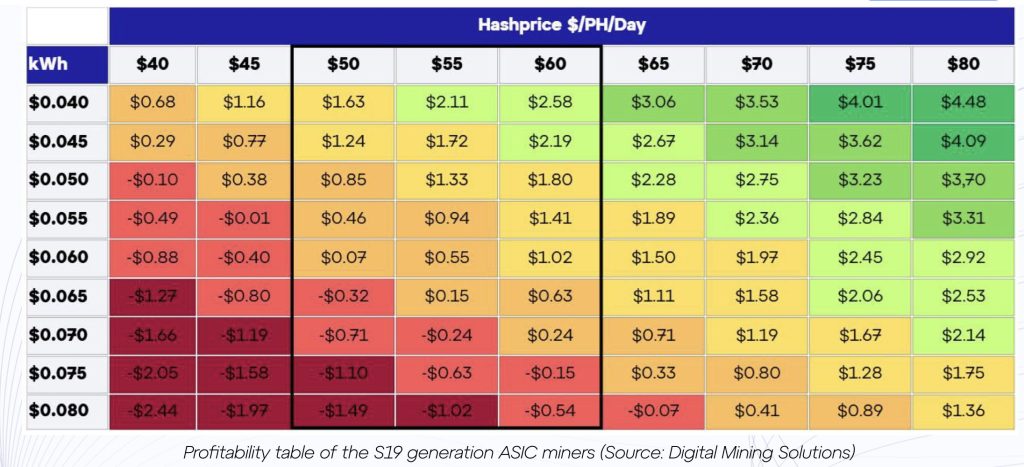
Even though the S19 series has been an industry standard for five years, it now represents a major liability for many mining operations. The reduced profit margins demonstrate how quickly economic conditions can change, specifically in an industry impacted by ongoing halving events and external competition from emerging AI infrastructure, according to GoMining Institutional.
Outlook: More Than Just Block Rewards
The report concludes that the first half of 2025 showed that Bitcoin mining is no longer self-contained. It has evolved into a key industry located at the intersection of finance, energy, and sophisticated computing.
As the network rebalances following the halving event in April, miners face critical decisions regarding scale, strategic planning, and how to ensure their long-term survival.
The second half of the year promises continued challenges, but the most successful miners will be those who are equally adept at navigating capital markets and managing hashrate.