
Understanding the Cup and Handle Chart Pattern
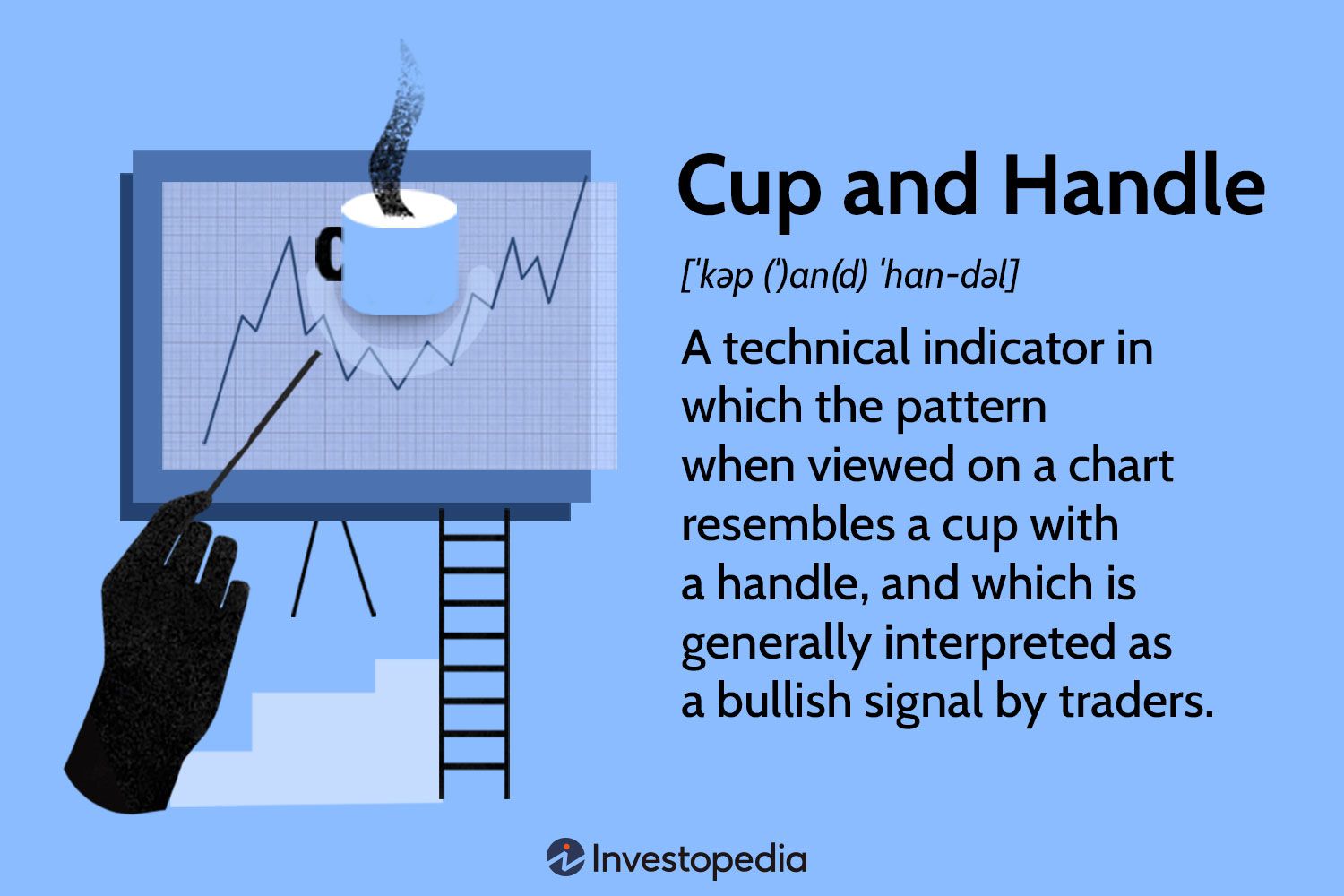
The “cup and handle” is a technical analysis pattern signaling a potential uptrend. Discovered by William J. O’Neil, this pattern suggests traders should consider buying. It resembles a “U” shaped cup followed by a slight downward drift or “handle.” O’Neil explained this pattern in his book, How to Make Money in Stocks, and it has been further analyzed in publications like Investor’s Business Daily. The pattern can take anywhere from a few weeks to over a year to form. A breakout above the handle’s resistance may lead to significant profit potential.
Key Points
- The cup and handle is a bullish chart pattern indicating a potential buying opportunity due to its cup-like shape with a handle formation.
- Typically, the pattern spans seven to 65 weeks, identified by a “U” shape followed by a smaller, descending handle.
- Traders can act on the pattern by setting a buy stop just above the handle’s resistance line or waiting for the price to surpass it, with profit targets based on the cup’s depth.
- Wynn Resorts serves as an illustration of how a well-defined cup and handle can predict significant price increases after a confirmed breakout.
- The pattern’s extended formation time and inconsistent cup depths are limitations, suggesting it should be used with other analysis tools.
Investopedia / Michela Buttignol
Deeper Dive: Implications of the Cup and Handle Pattern
Financial analyst William J. O’Neil introduced the cup and handle formation in his famous 1988 book, How to Make Money in Stocks. He later refined the pattern’s criteria through articles in Investor’s Business Daily, a publication he established in 1984. O’Neil outlined precise timeframes for the different segments of the pattern, emphasizing the significance of the rounded base that contributes to the pattern’s distinctive appearance.
As a stock approaches previous peak prices, some investors might sell, resulting in a brief dip lasting from a few days to a month before the price increases again. The cup and handle structure is viewed as a signal of a potential upcoming price increase and can guide decisions to buy.
When spotting cup and handle formations, keep these factors in mind:
- Duration: Cups with prolonged, gentle curves tend to be more reliable signals. Avoid cups that are too angular or V-shaped.
- Depth: A shallower cup is preferred. The handle should also stay within the upper half of the cup’s height. Overly deep handles can be a warning sign.
- Trading Volume: Volume should decrease as prices fall, remain low at the cup’s base, and then increase as the price climbs back towards its prior high.
Although the handle doesn’t necessarily have to reach the previous highs, the further it is from that level, the stronger the breakout might need to be.
How to Trade Using the Cup and Handle Pattern
There are various techniques for using the cup and handle pattern in trading. The most common approach is to seek a long position. In a standard cup and handle formation, you would place a buy stop order just above the handle’s upper trendline. The order would only trigger if the price breaks above the handle’s resistance. Be aware that aggressive entry can lead to slippage or entering a false breakout.
Alternatively, you could wait for the price to definitively close above the handle’s resistance, then place a limit order slightly below that level in case the price temporarily retraces. However, the risk here is that you might miss the trade altogether if the price continues upward without pulling back.
Image by Julie Bang © Investopedia 2020
To determine a profit target, measure the vertical distance from the cup’s bottom to the handle’s breakout point. Then, project that same distance upward from the breakout to estimate your profit target. For example, if the distance is 20 points, set your profit target 20 points above the handle. Stop-loss orders can be placed below the handle or even below the cup, depending on your risk tolerance and market conditions.
Example: The Cup and Handle in Action
Let’s examine Wynn Resorts, Limited (WYNN) as a historical illustration. Wynn went public on the Nasdaq around $13 in October 2002 and increased to $154 within five years. After a drop, the price came within a couple of points of the initial IPO price, well beyond O’Neil’s recommendation for a shallow cup. The subsequent recovery reached the prior high around 2011, almost a decade after its market entry.
The handle followed the standard expectation, finding support at the 50% retracement level with a rounded shape, and then returned to the high a second time 14 months later. The stock broke out in October 2013 and rose 90 points over the next five months.
Image by Julie Bang © Investopedia 2020
Caveats: Limits of the Cup and Handle Pattern
Like every technical analysis tool, the cup and handle should be combined with other methods before making trading decisions. Experts point out some limitations. One is the long formation time, which can delay decisions. While usually forming in one to twelve months, the timeframe is highly variable.
Also, the depth of the cup itself can be misleading. Sometimes a shallow cup provides a signal, but at other times, a deep cup can be a false alarm. In some cases, the cup develops without the handle. Additionally, the pattern’s reliability can be questionable for stocks with low trading volume.