
Interested in a straightforward method for cryptocurrency investment? Crypto Exchange Traded Funds (ETFs) might be the solution.The approval of spot Bitcoin and Ethereum ETFs by the US Securities and Exchange Commission (SEC) has attracted a surge of new investors to the crypto landscape.
If you’re researching the prime crypto ETFs available, you’re in the right place. This guide aims to assist you in selecting the best ETF for 2025 and beyond, aiding in your pursuit of profitable crypto investments.
Understanding Crypto ETF Varieties
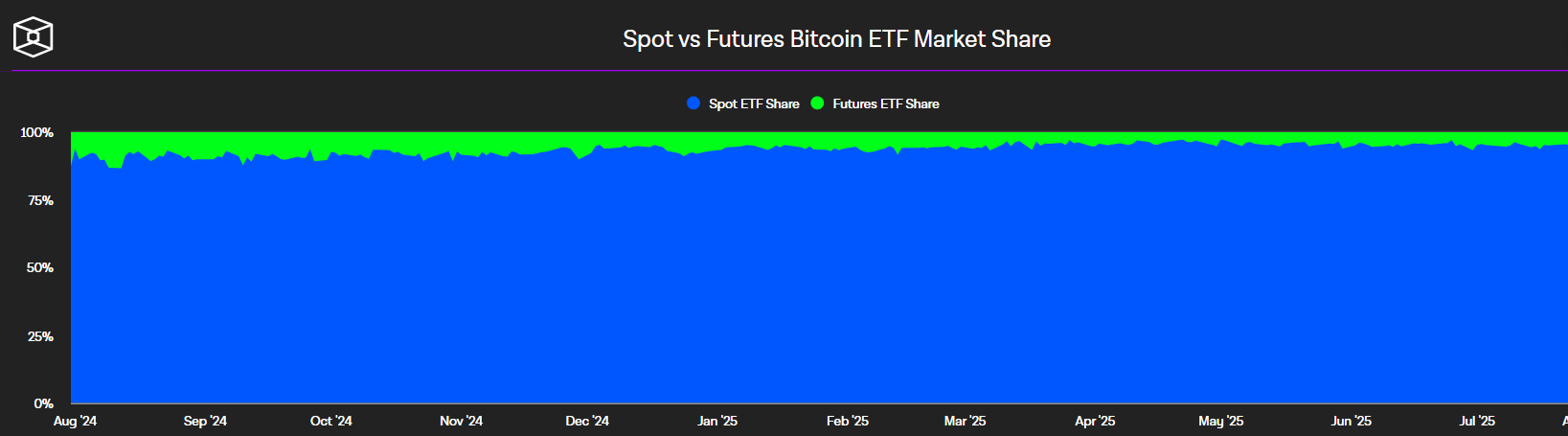
The cryptocurrency ETF market primarily includes two main categories: spot crypto ETFs and crypto futures ETFs. These differ in how they mirror cryptocurrency price movements:
Spot Crypto ETFs
- These ETFs reflect the current market price of specific cryptocurrencies as they trade on exchanges.
- Spot ETFs generate shares based on the amount of cryptocurrency held in their portfolios, adjusting to market demand.
- Compared to other ETF types, they offer a more direct avenue to invest in digital currencies.
- Spot ETFs are typically preferred by long-term investors seeking a simplified way to engage with cryptocurrencies without direct ownership or storage responsibilities.
Crypto Futures ETFs
- Instead of tracking the digital currencies themselves, these ETFs monitor the price movements of futures contracts.
- These contracts represent agreements to exchange cryptocurrencies at a set price on a future date.
- The prices of futures ETFs may deviate from the real-time market value of the underlying cryptocurrency.
A Selection of Cryptocurrency ETFs
- iShares Bitcoin Trust ETF (IBIT): Best suited for investors wanting easy access to Bitcoin through a familiar ETF structure.
- Fidelity Wise Origin Bitcoin Fund (FBTC): A good option for those with a higher risk tolerance who are focused solely on Bitcoin.
- Grayscale Bitcoin Mini Trust ETF (BTC): Tailored for investors looking to incorporate Bitcoin exposure into their existing investment portfolios.
- iShares Ethereum Trust ETF (ETHA): Represents the most liquid and widely held Ethereum-based ETF.
- Global X Blockchain ETF (BKCH): Provides diversified portfolio solutions designed for individual investor needs.
- ProShares Bitcoin Strategy ETF (BITO): Caters to investors interested in tracking Bitcoin’s price movements using a regulated ETF framework.
- Global X Bitcoin Covered Call ETF (BCCC): An effective choice for generating income during volatile periods through regular distributions.
- ProShares Ether ETF (EETH): Known for its systematic approach to managing Ethereum exposure via futures contracts.
- Volatility Shares 2x Solana ETF (SOLT): Designed for experienced traders who understand the amplified risks associated with leveraged Solana exposure.
- Evolve Cryptocurrencies ETF (TSX: ETX): Ideal for investors who want daily exposure to the price changes of both Bitcoin and Ethereum.
Top 10 Cryptocurrency ETFs to Consider Now
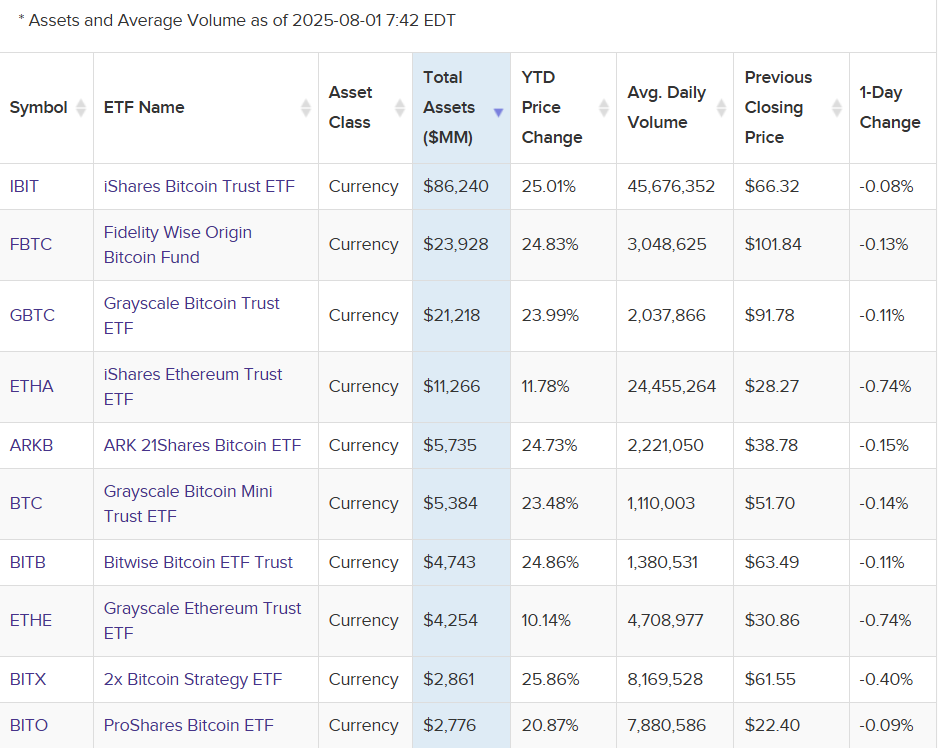
Source: etfdb.com
1. iShares Bitcoin Trust ETF (IBIT)
The iShares Bitcoin Trust ETF (IBIT) has earned its place as a leading Bitcoin ETF, outperforming many competitors. It aims to mirror the performance of the CME CF Bitcoin Reference Rate’s New York Variant Index. The ETF’s utilization of Coinbase Prime for custody enhances its attractiveness.
Since gaining SEC approval, IBIT has expanded investment options. Investors can trade IBIT shares and access gradual weekly increments. This offers opportunities to generate income via strategies like cash-secured puts and covered calls. The iShares Bitcoin Trust ETF manages substantial assets, exceeding $83.2 billion, with fees at 0.25% and a 30-day median bid-ask spread of 0.03%.
2. Fidelity Wise Origin Bitcoin Fund (FBTC)
The Fidelity Wise Origin Bitcoin Fund (FBTC) is managed by Fidelity, recognized for its excellence in mutual funds and brokerage. Like other Bitcoin ETFs, FBTC operates as a grantor trust, tracking Fidelity’s bitcoin benchmark total return index.
FBTC provides exposure to cryptocurrency markets and adheres to typicalBitcoin ETFprinciples. The Fidelity Wise Origin Bitcoin Fund oversees assets worth over $24.4 billion and charges 0.25% in fees, with a 30-day median bid-ask spread of 0.05%.
3. Grayscale Bitcoin Mini Trust ETF (BTC)
The Grayscale Bitcoin Mini Trust ETF (BTC) provides a more affordable alternative to the Grayscale Bitcoin Trust (GBTC). With assets exceeding $5.3 billion, BTC has a 30-day median bid-ask spread of 0.02% and a service fee of 0.15%. The launch of BTC has stabilized capital flow, responding to investor demand for lower costs compared to the 1.5% expense ratio of GBTC.
Grayscale allocated 10% of GBTC’s assets to establish BTC, featuring a 0.15% expense ratio. The Grayscale Bitcoin Mini Trust ETF tracks Bitcoin’s value using advanced custody and cold storage for security.
4. iShares Ethereum Trust ETF (ETHA)
For investors looking for a prime ETF option tied to Ethereum, the iShares Ethereum Trust ETF is a strong contender. ETHA was among the initial ETFs approved by the SEC, featuring the largest assets under management (AUM) among Ethereum-based funds.
The fund is fully invested in Ethereum, with an expense ratio of 0.25%, on par with similar funds. Furthermore, it offers a reduced fee of 0.12% for the initial $2.5 billion in fund assets over the first 12 months, starting in July 2024.
5. Global X Blockchain ETF (BKCH)
The Global X Blockchain ETF (BKCH) invests in companies benefiting from blockchain technology. This includes firms in cryptocurrency transactions, blockchain applications, cryptocurrency mining, and digital asset integration, as well as those involved in blockchain and cryptocurrency hardware.
The BKCH ETF aims to mirror the price and yield performance of its target firms. It manages assets worth $191.8 million with an expense ratio of 0.50% and a 30-Day Median Bid-Ask Spread of 0.48%.
6. ProShares Bitcoin Strategy ETF (BITO)
BITO tracks CME-traded Bitcoin futures contracts backed by collateralized US Treasury bills. Initially a temporary solution before spot Bitcoin ETFs were approved in 2024, BITO products helped generate cash flow from Bitcoin.
The ProShares Bitcoin Strategy ETF stands out due to its monthly income distribution. Monthly payments come from profits made when the fund rolls futures contracts during bull markets. BITO distributes taxable income annually, resulting in high monthly yields that depend on market conditions.
7. Global X Bitcoin Covered Call ETF (BCCC)
The Global X Bitcoin Covered Call ETF provides exposure to BTC’s real-time price. It prioritizes high-income potential and periodic distributions using a synthetic covered call strategy tracking US-listed futures and spot-based Bitcoin futures.
The fund uses a covered-call strategy involving Bitcoin exchange-traded products (ETPs), with call options “sold” on these ETPs. BCCC primarily aims to provide income and exposure to the returns of Bitcoin ETPs.
8. ProShares Ether ETF (EETH)
The ProShares Ether ETF (EETH) invests in ETH futures contracts, reflecting the cryptocurrency’s performance through standard futures contracts on the Chicago Mercantile Exchange (CME). The fund uses USD cash-settled Ether future contracts based on back-month contracts.
EETH maintains its exposure to ETH by replacing expired futures contracts with new ones having future expiration dates. The fund leverages proceeds from reverse purchase agreements to meet exposure targets. New investments are capped at 25% each quarter.
9. Volatility Shares 2x Solana ETF (SOLT)
The Volatility Shares 2xSolana ETF(SOLT) targets SOL futures contracts trading on exchanges registered with the Commodity Futures Trading Commission (CFTC).
SOLT trades using cash, cash-like instruments, and high-level securities as collateral. This leveraged ETF seeks to align with a daily performance score of over 200% of the Solana network. SOLT’s total expense ratio is 1.85%, and it pays a dividend annually.
10. Evolve Cryptocurrencies ETF (TSX: ETX)
The Evolve Cryptocurrencies ETF is a Canadian fund managing over C$61.35 million. Launched in 2021, it was among the first to combine Bitcoin and Ether exposure in one ETF, enabling portfolio diversification and exposure to both cryptocurrencies.
Investors can customize their allocations based on market capitalization and switch portfolios monthly. The fund does not charge management fees, but the underlying funds holding the assets charge a 0.75% fee plus applicable taxes.
Comparing Top Crypto ETFs
| ETF Name | Ticker | Exposure | Expense ratio |
| iShares Bitcoin Trust ETF | IBIT) | Bitcoin | 0.25% |
| Fidelity Wise Origin Bitcoin Fund | FBTC | Bitcoin | 0.25% |
| Grayscale Bitcoin Mini Trust ETF | BTC | Bitcoin | 0.15%. |
| iShares Ethereum Trust ETF | ETHA | Ether | 0.25% |
| Global X Blockchain ETF | BKCH | Bitcoin | 0.5% |
| ProShares Bitcoin Strategy ETF | BITO | Bitcoin | 0.95% |
| Global X Bitcoin Covered Call ETF | BCCC | Bitcoin | 0.65% |
| ProShares Ether ETF | EETH | Ether | 0.95% |
| Volatility Shares 2x Solana ETF | SOLT | Solana | 1.85% |
| Evolve Cryptocurrencies ETF | TSX: ETX | Bitcoin/Ether | 0.75% |
Conclusion: Are Crypto ETFs a Good Investment?
If you’re an investor seeking to broaden your portfolio but prefer to avoid the complexities of direct crypto ownership, crypto ETFs can offer a simplified route to cryptocurrency investment. With significant regulation, investing incrypto ETFspresents several benefits.
ETFs make it easy to invest in cryptocurrencies via traditional, trusted platforms. Investors can select ETFs that track single crypto assets or those that combine multiple cryptocurrencies. The security of investing in cryptocurrency exchange-traded funds is a major advantage, eliminating the need to manage wallets or worry about private keys.
Since they’re traded on regulated markets,Bitcoin ETFsintroduce oversight, transparency, and investor protection. This growth might be a key factor in broader cryptocurrency adoption, attracting both retail and institutional investors.
Frequently Asked Questions
Which Crypto ETF is the Best to Buy?
IBIT, the world’s largest Bitcoin ETF, is widely regarded as a top choice due to its size and prominence, which has grown following the passage of the GENIUS Act in the US.
What is the Best Crypto ETF in Canada?
Canada was a global leader in licensing crypto ETFs, starting in February 2021. The Purpose Bitcoin ETF and the CI Galaxy Bitcoin ETF are popular among Canadian investors.
Are There 3x Leveraged Bitcoin ETFs?
Yes, Leverage Shares -3x Short Bitcoin BTC ETP offers an exchange-traded note aimed at providing a -3x Leveraged Exposure to Bitcoin, holding short positions in BTC futures contracts and micro-Bitcoin futures on the CME.
Does BlackRock Offer a Crypto ETF?
Indeed, BlackRock manages the iShares Bitcoin Trust (IBIT), the largest Bitcoin exchange-traded fund available.
What is the Largest Crypto ETF?
BlackRock’s iShares Bitcoin Trust (IBIT) is the largest Bitcoin ETF, managing over $70 billion in assets, marking a significant milestone.
What is a Crypto ETF?
Crypto ETFs are innovative investment products merging the dynamic world of cryptocurrencies with traditional ETF structures. Instead of tracking typical assets, they focus on cryptocurrencies, providing a creative approach to crypto investment.