
Understanding the Double Top Chart Pattern
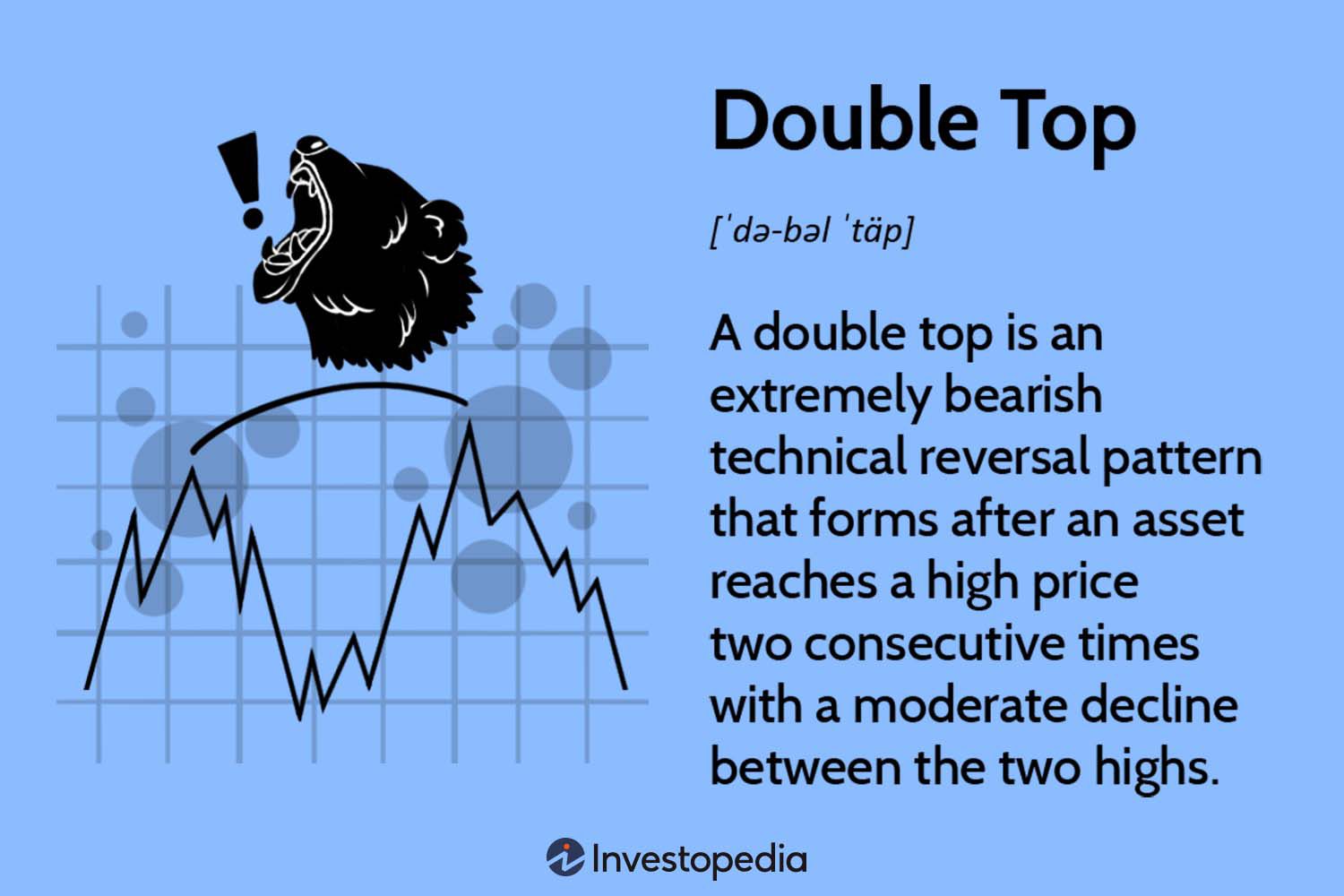
The double top pattern is a bearish signal spotted in technical analysis, suggesting that an asset’s price might reverse course after failing to breach a certain high point on two separate occasions. This indicates a potential shift from an upward price trend to a downward one. Traders often see it as a chance to initiate “sell” or short positions. Confirmation occurs when the price dips beneath the support level – usually the lowest point situated between the two peaks.
Key Points to Remember
- A double top is a bearish pattern. It may foreshadow a change from an rising market trend if an asset forms two close-together highs, with a low point in between.
- Traders consider a price drop below the “neckline” (a support level) as confirmation. This hints at a trend change, possibly signaling selling opportunities.
- Although useful for identifying entry/exit points and managing risk, double tops aren’t always right and might give off false signals.
- Pinpointing double tops can be somewhat subjective. The highs and lows may not be perfectly mirrored. Success in trading relies on market factors and confirmation from other indicators.
Interpreting Double Top Signals in Trading
A double top can indicate a shift in an asset’s trend over the medium to long term. Let’s explore some real-world instances of double tops.
Looking at Amazon.com Inc. (AMZN), a double top appeared from September to October 2018 around $2,050. The crucial support mark rested near $1,880. While the stock dipped approximately 8% from its peak to this support area, the double top was officially confirmed once the price went below $1,880, which caused an additional slide of 31%.
Consider Netflix Inc. (NFLX) for another example. Here, a double top seemed to be forming, but support was never really tested. The stock continued upward along a bullish trend. Later on, though, another possible double top surfaced in June and July. This time, a shift was confirmed as the price fell under the $380 support, resulting in a 39% decrease to $231 by December. Additionally, observe how the $380 support line acted as resistance twice in November when the stock was increasing.
Double Top Versus Double Bottom: A Comparison
The double top pattern emerges following an uptrend, serving as a bearish indicator of a potential reversal. It’s characterized by two peaks, nearly the same height, with a valley in between, signaling that the price struggled to break through a certain level. Traders often interpret this pattern as a sign to sell or initiate short positions, anticipating price declines.
The opposite of this is the double bottom, a bullish reversal pattern that appears after a downtrend. It includes a peak nestled between two roughly equal troughs, highlighting that the price failed to drop below a certain support level.
Essentially, a double top and double bottom look quite similar, except regarding the peaks and bottoms. A double top has consecutive “highs,” while a double bottom shows consecutive “lows.”
Important Note
Remember that double tops can produce misleading signals; even the most pronounced patterns can occasionally break down unexpectedly.
How to Spot a Double Top Pattern
Identifying a double top involves several critical steps, even though each case may differ. Incorrect signals can lead investors to believe a double top is forming prematurely. Here’s a guide to identify a legitimate double top.
- Look for an Established Uptrend: Before a double top appears, the price must show a clear upward trend, marked by successively higher highs and lows.
- Identify the First Peak: Locate the highest point the price reaches in the uptrend before it begins to decline.
- Find the Trough: After the initial peak, the price will briefly decrease. Identify the subsequent low point or valley.
- Locate the Second Peak: The price will then rally again, attempting to reach a new high. However, this second peak will fall short of the first and start to decline again.
- Confirm the Pattern: To validate the double top, ensure that the decline following the second peak goes below the trough that followed the first peak. This indicates that the price failed to overcome the previous resistance.
- Draw the Neckline: Connect the low points of the troughs with a horizontal line. This is the neckline, representing a support level and serving as an essential reference for the pattern.
- Verify the Double Top Pattern: Finally, to confirm, watch for the price to break below the neckline. This breakthrough can be viewed as a sell signal, indicating a likely trend reversal.
Key Elements of a Double Top Pattern
When identifying double-top formations, keep these key components in mind:
- Existing Uptrend: The price should be trending upward prior to pattern formation, demonstrated by higher highs and lows.
- Two Peaks: The pattern should show two peaks that are nearly equal in price. These act as resistance where the price stalls and starts to fall back down.
- Intervening Trough: A trough or valley should exist between the two peaks, marking a period of price decline or consolidation.
- Neckline Formation: The neckline is a horizontal line connecting the low points of the trough. It serves as a support level crucial for confirming the pattern.
- Neckline Break: A break below the neckline is a key indicator. When the price falls below this line, the pattern is validated, signaling a potential trend reversal.
- Trading Volume: Volume can provide further insight into the pattern. Volume frequently increases as the price breaks below the neckline and diminishes during the formation of the two peaks. A rise in volume on the breakdown may strengthen the pattern’s validity.
- Price Objective: After the breakdown, project the vertical distance between the neckline and the peaks downward from the neckline to give a rough target for the price decline.
Quick Fact
The time between peaks can vary; in one double top, the peaks might occur within a week, while another pattern can unfold over several months.
Trading Strategies Using Double Tops
There are three primary strategies for trading the double top pattern. First, wait for the price to drop below the neckline to confirm the pattern, suggesting a potential trend reversal. Then, enter a short trade or a sell position.
To manage risk, consider setting up a stop-loss order above the recent swing high. Alternatively, determine a profit target by projecting the vertical distance from the neckline to the highest peak downward from the neckline.
Second, following the break of the neckline, the price may retest it from below before moving lower. Watch for a price break, wait for the retest, then look for a bearish confirmation, such as a candlestick pattern, to enter a short trade.
Establish profit targets by projecting the pattern’s height downward or identifying potential support levels. Set your stop-loss above the latest swing high.
Third, improve the reliability of the double top using technical indicators like the MACD or RSI. Watch for bearish divergence, where indicators show lower highs as the price forms peaks. After the neckline breaks, you can enter a short trade when the indicators confirm a bearish signal, following the stop-loss and profit target criteria mentioned above.
Advantages and Disadvantages of Trading the Double Top Pattern
Benefits of a Double Top
A double-top pattern gives a visual signal of a possible shift in trend, from rising prices to falling ones. This is valuable for traders seeking to benefit from changes in market direction, opening new profit possibilities.
Furthermore, consecutive peaks forming at nearly the same price creates a clear resistance level. Traders can use this as a benchmark to place stop-loss orders and set profit goals, enhancing risk management and trade planning.
The break of the neckline in a double-top provides a good entry point for short positions. If the price doesn’t break below the neckline, this indicates a specific point for entering the market and helps determine the pattern’s failure. The pattern’s height can also forecast profit targets, offering traders a specific exit point.
Analyzing volume can give extra reassurance about the pattern’s accuracy. Volume typically rises as the price falls below the neckline and decreases during the formation of the two peaks.
This surge in volume can further enhance the pattern’s signaling strength. Thus, in some ways, a double top can be a more predictable, reliable pattern than other strategies.
Recognizing a double-top pattern allows traders to set profit and downside targets based on the pattern’s height. Since the profit potential usually surpasses the initial risk (stop-loss), it provides a favorable risk-reward ratio.
Drawbacks of a Double Top
The double-top pattern isn’t perfect. Like all chart patterns, it can sometimes generate false signals. A false double-top pattern could appear if the price briefly forms two peaks before continuing its upward movement. The breach of the neckline and supportive signs should provide confirmation; traders should proceed with caution.
Identifying a double-top pattern can involve some subjectivity. Traders may interpret the positions of peaks and troughs, and the required symmetry of the pattern, differently. This subjectivity can create inconsistencies and varying outcomes across traders.
Not all double-top patterns have perfect symmetry. Price ranges, timeframes, and shapes can vary, making it difficult to accurately identify entry and exit points or target levels.
A double-top’s downside target is usually based on the pattern’s height from the neckline. However, the potential profit target can be limited compared to the initial risk or stop-loss level. Market conditions might prevent the price from reaching the expected target, resulting in lower profits.
Pros
-
Enables visual pattern-based trading
-
May indicate clear resistance areas
-
Can provide clear entry and exit signals
-
The volume of shares traded may confirm it
Cons
-
Like any chart pattern, can produce false signals
-
May be subjective in identifying patterns
-
Can show slight variations across different investments
-
May offer limited profit potential
Is a Double-Top Pattern Bullish?
No, the double-top pattern is considered a bearish indicator. It signals a potential trend shift from an uptrend to a downtrend.
What Does a Double-Top Pattern Signify?
A double-top pattern, a technical charting pattern, often indicates the potential reversal of an uptrend into a downtrend. This arises when the price of an asset reaches a resistance point twice, fails to break through, and then starts to decline.
Can Trading a Double-Top Pattern Be Profitable?
Trading based on a double top pattern can be profitable if approached with proper analysis, risk management, and consideration of market conditions. However, profitability isn’t guaranteed and depends on numerous factors.
What’s the Success Rate of Double-Top Patterns?
The success rate of any chart pattern relies on a number of variables.
Market conditions, the time scale used, how well the pattern is formed, and whether confirming signs are present, all affect the success rate.
It’s crucial to remember that chart patterns, like the double top, do not always reliably predict future price movements. They can give false signals or appear unsuccessfully, yet they’re valuable for detecting possible trends and trend reversals.
In Conclusion
Traders and analysts interpret the double-top pattern as a bearish indicator. It suggests the uptrend has weakened, making a price decrease more likely.
Traders often confirm the pattern by looking for a break of the neckline, a horizontal line formed by connecting the low points of the troughs. A price drop below the neckline is seen as a signal to initiate short positions or sell, expecting the price to decline further.