

Cloud Mining Versus Staking: Examining the Core Differences in 2025
As we approach 2025, the concepts of cloud mining and cryptocurrency staking frequently arise in discussions about generating passive income within the crypto realm. However, these represent fundamentally distinct avenues for achieving financial gains.
Cloud mining entails leasing computing power from remote facilities dedicated to Bitcoin mining. Staking, conversely, involves locking up your cryptocurrency tokens to participate in validating transactions on proof-of-stake blockchain networks. Reputable platforms, such as ECOS and MiningToken, currently offer average cloud mining returns on investment (ROI) in the range of 5% to 10% annually. However, be aware of riskier schemes – often connected to XRP – which promise improbable annual percentage rates (APRs) ranging from 100% to 800%.
Staking offers more predictable returns. Ethereum staking provides yields near 3% APY, Solana averages from 6% to 8%, and employing liquid staking solutions like Marinade can reach between 10% and 12%.
This article provides a comprehensive overview of cloud mining compared to staking in 2025, evaluating diverse cryptocurrency income strategies, realistic profitability benchmarks, and the optimal balance between potential returns and inherent risks for crypto investors.
Understanding How Cloud Mining Functions in 2025
Cloud mining enables users to participate in Bitcoin or Ethereum mining operations without the need to acquire or manage specialized mining hardware (ASICs).
Instead, participants enter into contracts with data centers, essentially renting hashing power which is used to mine on their behalf. In exchange, participants receive daily payouts (less applicable service and maintenance costs) directly proportional to the amount of BTC or ETH generated by their allocated hashing power.
By 2025, a few notable platforms are leaders in the cloud mining sector, namely MiningToken, ECOS, NiceHash, and IQ Mining:
- MiningToken places a strong emphasis on regulatory adherence to Swiss law, deploying artificial intelligence to optimize hash allocation, and prioritizing energy sourcing from renewable resources. They provide contract options with terms as short as one day.
- ECOS, based within Armenia’s Free Economic Zone, integrates mining services with wallet functionalities, ROI calculation tools, and payout processing, offering accessible entry-level contracts starting from $50.
- NiceHash serves as an open marketplace, providing buyers and sellers with the ability to trade computing resources based on dynamically adjusted rates. However, the platform charges commissions of around 3% on transactions.
Bitcoin cloud mining contracts typically offer an annual return rate between 5% and 10%. However, potential pitfalls exist in the form of speculative schemes, such as XRP-funded options promising highly unrealistic APRs of 100%-800%, which frequently exhibit characteristics of Ponzi schemes.
The increased efficiency of modern ASICs, along with mining farms powered by renewable resources, contributes to improving margins and sustainability. However, ongoing centralization concerns and environmental effects require consideration as part of any balanced analysis between staking and mining options.
Interesting Fact: Numerous Bitcoin mining facilities situated in Iceland capitalize on natural Arctic air for cooling purposes. This strategy drastically lowers the need for conventional air conditioning and reduces operational expenditure.
Deep Dive: How Cryptocurrency Staking Works in 2025
By 2025, proof-of-stake (PoS) consensus mechanisms have solidified their position as a leading method to achieve passive income streams within the crypto ecosystem.
Staking involves token holders actively “locking” their cryptocurrency assets to secure a network’s operation and receive incentives as compensation. Some users manage independent validator nodes, while the more common approach involves delegating tokens to established validators to earn staking rewards, minus a small fee.
Typically, staked tokens are subject to a lock-up period of days or weeks. Liquid staking platforms, such as Lido and Marinade, have emerged to issue representative derivative tokens (e.g., stETH and mSOL) which empower users to maintain liquidity while still generating returns.
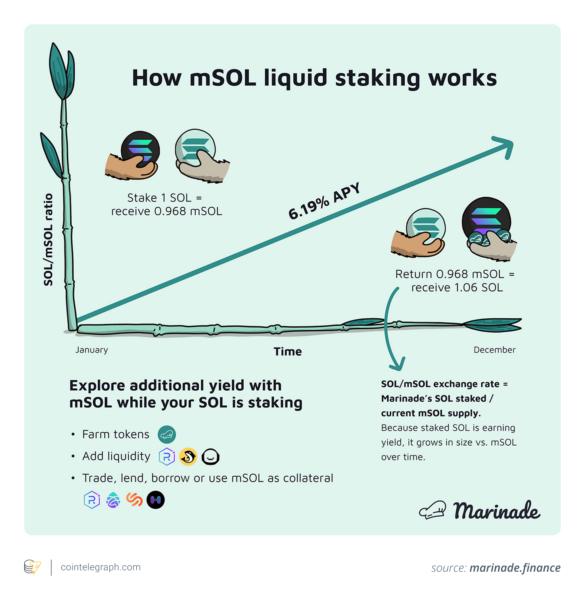
As of July 29, 2025, returns vary depending on the specific blockchain. Ethereum staking generates approximately 3% APY, Solana provides 6-7%, and Cardano users can expect between 4% and 6%. Cosmos validators generate up to 18% (roughly 6% net through exchanges), while NEAR returns between 9% and 11%.
In contrast to the often erratic nature of cloud mining returns in 2025, staking provides much more stability in payouts. While risks still exist (validator downtime, “slashing” penalties, and potential token devaluation), the staking infrastructure has considerably matured.
For institutional investors, advanced staking-as-a-service offerings feature regulatory compliance frameworks, comprehensive custody solutions, routine audits, and insurance provisions, thus making PoS an increasingly viable path.
Did you know? Smaller PoS networks like Injective, SEI, and SUI generate double-digit staking yields, although with increased volatility and reduced liquidity.
ROI Comparison: Cloud Mining vs Staking in 2025
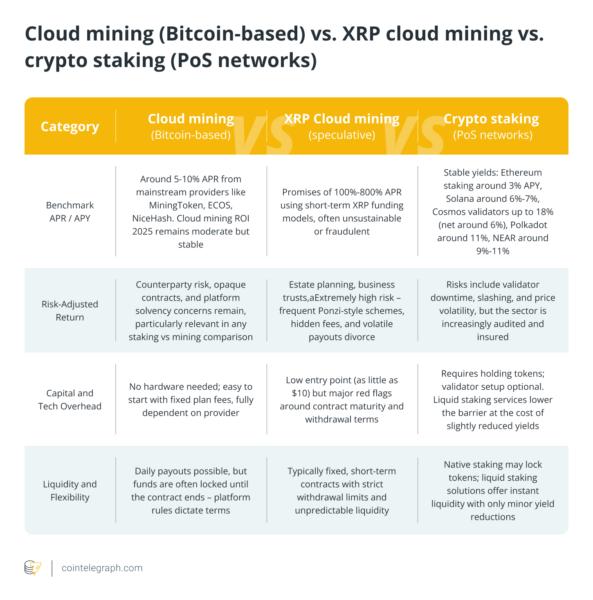
Cloud mining generates relatively stable returns in the 5%-10% APR range with low barriers to entry, but involves potential platform-related risks and limited liquidity. XRP-based cloud mining carries substantial risks, promising unsustainable returns of 100%-800% APR. Staking provides returns from 3% to 11% APY based on the specific blockchain network. Liquid staking enhances flexibility with a modest trade-off in yield.
Maximizing Passive Cryptocurrency Income in 2025: Investor Profiles
The most effective strategy depends on your individual investor profile.
Beginner and Low-Tech Users
For newcomers to cryptocurrency seeking passive income streams with minimal involvement, cloud mining represents an appealing option. Platforms like MiningToken or ECOS simplify the process by handling infrastructure and delivering cloud mining earnings of approximately 5%-10% APR.
However, caution is warranted. Contracts based on XRP that advertise returns of 100%-800% are generally scams. Alternatively, staking via exchanges or liquid staking service providers presents a straightforward entry point, offering yields around 3% (Ethereum) and 7% (Solana).
High-Risk, High-Yield Seekers
Aggressive investors are often drawn to highly speculative XRP cloud mining ventures, although the inherent lack of transparency raises significant concerns. Staking can offer safer, higher-yield alternatives: delegating to Cosmos, Polkadot, or NEAR validators may yield returns in the 15%-20% range for those prepared to manage slightly more complicated arrangements.
Institutional and Compliance-Focused Investors
Cloud mining struggles with lacking standardized audits and custody frameworks. Proof-of-stake solutions are gaining acceptance due to their superior regulatory and security protocols. Service providers are increasingly offering KYT/KYB compliance checks, insured custody, and reporting suitable for regulatory agencies.
Sustainability-Oriented Investors
Cloud mining relies heavily on the energy-intensive Bitcoin mining mechanism, whereas proof-of-stake models are vastly more eco-friendly and naturally align with ESG-minded crypto investing.
Key Considerations: Staking vs. Mining
Several factors warrant careful evaluation before investing.
Tax Implications
Both staking and cloud mining rewards are typically treated as taxable income, with any subsequent sale potentially triggering capital gains taxes. In the UK, Her Majesty’s Revenue and Customs (HMRC) increasingly correlates data from exchanges and cloud mining platforms to identify instances of under-reporting, which can result in penalties.
Market Volatility
All payouts are made in cryptocurrency. Sharp market swings, especially prevalent in speculative ventures, can quickly negate any fiat gains.
Liquidity
Cloud mining payouts may occur daily, but the invested capital is generally locked until contract expiration. Staking frequently involves unbonding periods. However, liquid staking offerings provide faster exit options at the cost of modestly reduced yields.
Did you know? On Cosmos-based chains, delegators are generally able to redelegate to another validator without needing to undergo the unbonding process.
Platform Reliability
Choose thoroughly vetted, transparent, audited providers with clear SLAs and proven uptime records. Staking platforms are increasingly publishing these metrics, whereas reliable cloud mining operations remain relatively scarce.
Ultimately, the decision between staking Ethereum versus mining Bitcoin, or any staking versus mining strategy, relies on your specific objectives. Your degree of risk tolerance, sustainability considerations, and level of trust in service providers will factor into your preferred pathway for generating cryptocurrency income in 2025.