
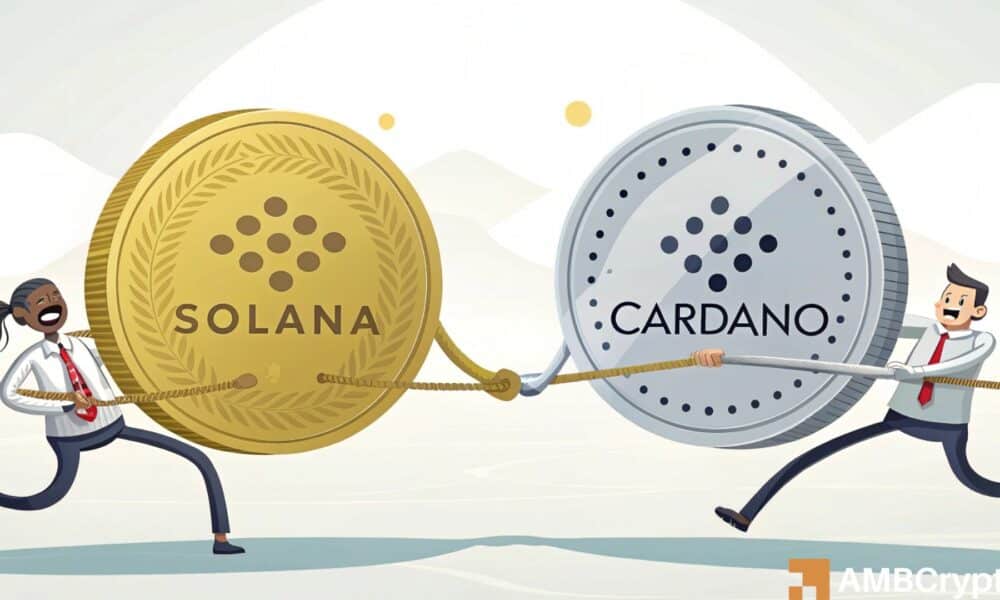
Key Differences Unveiled: Cardano vs. Solana for Blockchain Developers
When it comes to blockchain technology, Cardano and Solana take distinctly different approaches. Cardano prioritizes meticulousness and predictability in asset management, leveraging a coding style that demands precision. Solana, conversely, champions rapid development, emphasizing speed, developer accessibility, and aggressive performance enhancements.
The competition for blockchain developers is intensifying among leading Layer-1 platforms. For developers embarking on new projects, Cardano (ADA) and Solana (SOL) present contrasting options. Their fundamental designs embody opposing philosophies regarding blockchain functionality.
Cardano emphasizes a deliberate, security-focused, and decentralized approach. Solana, on the other hand, focuses intensely on speed and expedited development cycles.
Let’s examine the distinctions in their technology, toolsets, and community ecosystems to ascertain which platform is poised to attract the next generation of coding talent.
Distinct Architectural Frameworks: EUTXO versus Accounts
Blockchain architecture exerts a significant influence, notably in how networks handle asset tracking. The primary divergence between Cardano and Solana resides in their ledger models:
Cardano: The EUTXO Model
Cardano’s architecture refines Bitcoin’s original design, utilizing the Extended Unspent Transaction Output (EUTXO) model. Consider the ledger as a repository of digital notes, or UTXOs. Every transaction uses existing notes, creating new ones and embedding smart contract logic.
Advantages:
Predictable Transactions: Confirm the precise outcome and cost of transactions before submission.
Parallel Processing Capabilities: Autonomous UTXOs enable concurrent transaction execution, improving scalability.
Challenges:
Contentious UTXO Usage: Conflicts arise if multiple actions target the same UTXO. Developers must carefully engineer solutions to avoid these collisions, which may prove challenging for those transitioning from Ethereum’s approach.
Solana: Account-Based System
Solana employs a more conventional account-based ledger, resembling Ethereum. This system maintains a unified record of all accounts and their respective balances. Smart contracts, referred to as “programs,” modify this collective list.
Advantages:
High Velocity: Solana achieves high performance through Sealevel, enabling the parallel processing of numerous transactions, provided they don’t interact with the same data.
Intuitive Developer Environment: This model resonates with web developers, facilitating a smoother onboarding process.
Challenges:
Transaction Uncertainty: The precise outcome of a transaction is uncertain until execution, as account data may fluctuate.
Potential Stability Concerns: Elevated network traffic has resulted in service interruptions, raising questions about the platform’s reliability for mission-critical applications.
Developer Experience: Contrasting Environments
Blockchain architecture significantly shapes the developer experience, with Cardano and Solana offering contrasting pathways.
Cardano initially presented a challenging learning curve. Its primary smart contract language, Plutus, is rooted in Haskell, which offers precision but is unfamiliar to many programmers. However, the landscape is evolving.
Aiken, a more user-friendly language, is gaining popularity for smart contract creation. Moreover, tools like Mesh SDK and Lucid allow developers to construct applications using widely adopted languages such as JavaScript or TypeScript.
To further aid newcomers, the Cardano Foundation has introduced a “Tool Compass” website, connecting developers with pertinent resources.
Conversely, Solana has aggressively pursued fast and user-friendly development. Rust is the primary coding language, celebrated for its performance and memory safety.
The Anchor framework streamlines the intricacies of blockchain development, enabling developers to build more efficiently.
Solana accommodates various programming backgrounds: Seahorse supports Python-based smart contracts, and Solang facilitates Solidity, attracting Ethereum developers.
Solana Playground offers an immediate online code editor without installation for rapid experimentation. This ease-of-use focus has proven effective, as Solana now boasts over 2,500 monthly active developers.
Speed and Future Expansion: A Forward View
Disregard advertised metrics; actual network performance and scalability plans are critical factors.
Solana routinely processes thousands of transactions per second in real-world scenarios, including validator communications.
Transactions confirm in under a second and cost almost nothing, making it the preferred platform for rapid DeFi trading and NFT launches.
To further accelerate performance, Solana is integrating Firedancer, a new validator software created by Jump Crypto. Tests suggest Firedancer can handle over a million transactions per second.
Its phased deployment promises both enhanced speed and stability.
Cardano’s main network is intentionally slower, handling fewer transactions with longer confirmation times. Its scalability strategy is more complex.
Hydra, a Layer-2 solution that offloads activity into “state channels,” is a key project.
Under controlled circumstances, Hydra achieved over a million transactions per second, showcasing its potential for high-volume applications.
Simultaneously, Cardano is upgrading its core network with Ouroboros Leios. This update incorporates “Input Endorsers,” enhancing transaction processing and boosting the main layer’s speed.
Community and Governance: Building for Longevity
Developers need assurances of a platform’s longevity, making a robust app ecosystem and predictable governance essential. Cardano seeks to establish a truly on-chain democracy.
Through Project Catalyst, ADA holders can vote on projects seeking funding from the network’s treasury.
This empowers developers to secure funding without relinquishing equity and influence the platform’s direction. The forthcoming Voltaire phase will expand this with a formal constitution and elected representatives for future governance.
Solana adopts a streamlined, top-down governance approach. Solana Labs and its primary partners develop major updates, which network validators then approve.
While regular token holders lack direct voting rights, this structure allows for rapid adaptation. The Solana Foundation drives growth by distributing substantial grants and organizing hackathons to foster innovation.
A recent hackathon attracted over 8,300 participants, generating over a thousand new project concepts.
The Regulatory Landscape
Government regulations are creating divergent realities for these platforms. Europe’s MiCA regulations provide clarity for crypto projects.
Cardano has aligned with these rules by submitting compliant documentation. The United States presents a more ambiguous picture.
The SEC has indicated in lawsuits that both ADA and SOL may be securities, generating legal uncertainty that deters large corporations and institutional investors.
The platform that effectively navigates these regulatory obstacles will gain a significant advantage.
The Verdict: Which Platform Wins?
The ideal choice for developers hinges on individual priorities. Solana stands out for projects requiring speed, low-cost transactions, and immediate access to a substantial user base.
Its accessible tools and multi-language support make it ideal for rapid development and deployment, particularly for DeFi, gaming, and NFT initiatives. It attracts developers focused on speed and market share.
Conversely, Cardano appeals to developers prioritizing security, reliability, and decentralization.
Its methodical, academic approach and community-driven governance ensure a strong foundation for applications demanding precision, such as high-value financial systems.
It attracts developers prioritizing long-term value over short-term hype.
Ultimately, both platforms have merit. Solana will likely continue attracting a larger volume of developers seeking variety and speed.
Cardano will remain a haven for those pursuing a more calculated, long-term strategy. The most adept developers will understand both platforms and choose the appropriate tool for each project.