

Bitcoin’s value has surged consistently over the past week, approaching levels last seen at its peak. Currently, the digital currency is valued at over $120,000, inching closer to its all-time high exceeding $123,000.
During the preceding seven days, Bitcoin demonstrated a substantial increase of roughly 5.1%, ranking it among the top-performing assets within the digital currency landscape.
Analyzing on-chain data related to USDT transactions on the TRON network offers valuable insights into the prevailing market dynamics. CryptoQuant’s Amr Taha conducted an in-depth review of TRC-20 USDT transaction patterns, uncovering potential links that could foreshadow shifts in Bitcoin’s price.
The research categorized transactions into six distinct size brackets, ranging from typical retail transactions around $100 to substantial “super whale” transactions surpassing $10 million, the goal being to differentiate between standard market activity and large-scale institutional trades.
Decoding Market Sentiment Through Large USDT Transfers
Taha’s findings indicate that when USDT transactions exceeding $10 million on the TRON network reach a daily total of over $5 billion, it frequently aligns with significant profit-taking activities involving Bitcoin.
Such actions typically involve converting Bitcoin holdings into USDT, followed by transfers of these stablecoins to private digital wallets, effectively diminishing buying momentum on the open market.
Illustrative examples include July 16, when USDT transfers exceeding $10 million hit $5.2 billion, subsequently leading to a 4.5% decrease in Bitcoin’s value. Similarly, on July 23, around $5.8 billion in substantial transfers preceded a 3.8% drop within a 48-hour timeframe.
However, the most recent data reveals an absence of such large-scale transactions, suggesting that major stakeholders are presently not aggressively selling into stablecoins. This lack of significant whale-driven outflows could imply that substantial investors are holding their positions rather than divesting from the market.
Potential Scenarios in Bitcoin’s Evolving Market Dynamics
A separate study by ShayanMarkets at CryptoQuant examined the average size of executed orders in Bitcoin futures markets, offering another perspective on prevailing trends.
This indicator, calculated by dividing the total volume traded by the number of executed orders, helps determine whether market activity is primarily driven by individual retail investors or by larger, more influential institutional traders.
Data collected from late 2024 and early 2025 highlighted periods of institutional dominance, which correlated with notable price rallies. Conversely, recent weeks have witnessed a surge in smaller, retail-sized orders, while large-scale institutional trades have decreased.
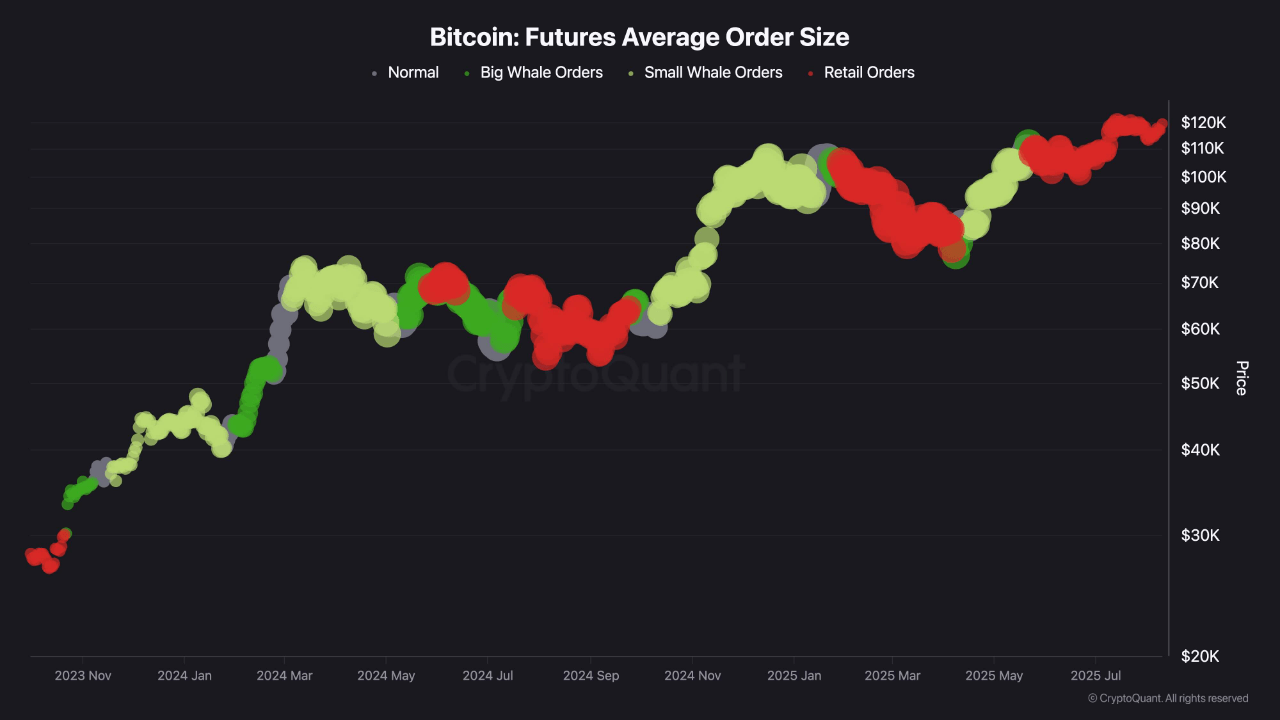
This shift suggests that major buyers may be maintaining positions secured at lower price points, or are awaiting more favorable market conditions before deploying substantial capital.
Historically, extended periods of institutional dominance near market peaks have often been associated with distribution phases, where significant holders realize profits.
The current absence of such behavior leaves the door open for a potential bullish surge beyond Bitcoin’s previous all-time high, provided that renewed selling from significant investors does not materialize shortly.
Featured visual generated using DALL-E, Chart sourced from TradingView