
Features Lead
Elena Bozhkova

Features Lead
Elena Bozhkova
Share


Key Points:
- Cryptocurrency security faces a potential disruption from quantum computing. Experts forecast possible breaches by 2030, emphasizing the eventual impact of quantum technology on cryptocurrencies, albeit with varying predictions on timing.
- Protecting crypto assets requires implementing post-quantum cryptography and upgrading blockchain systems, a complex undertaking.
- Gaining an edge in the market might be possible for those who adopt quantum-resistant technologies early, drawing investors to cryptocurrencies that are “quantum-safe.”
- The expansion of quantum computing might result in stricter rules, shielding investors from cryptocurrencies that are easily compromised.
- The cryptocurrency sector may unexpectedly benefit from quantum computing.
While quantum computers might appear to be just another tech trend, they present a significant and growing threat to cryptocurrencies. Although the exact timing is debated, experts largely concur that the arrival of “Q-day” is inevitable.
To gain insight into the expected timeline, protective actions, and potential advantages of these powerful machines for the crypto world, we consulted with quantum specialists globally.
- In This Article
Show Full Guide
Understanding Quantum Computing
Quantum computers diverge from traditional computers by using quantum bits, or qubits, as their basic data unit. Unlike traditional bits that are either 1 or 0, qubits can exist in a state of both 0 and 1 concurrently—a principle called superposition.
Quantum computers can handle calculations at the same time because of this, analyzing massive amounts of data far more quickly than conventional computers.
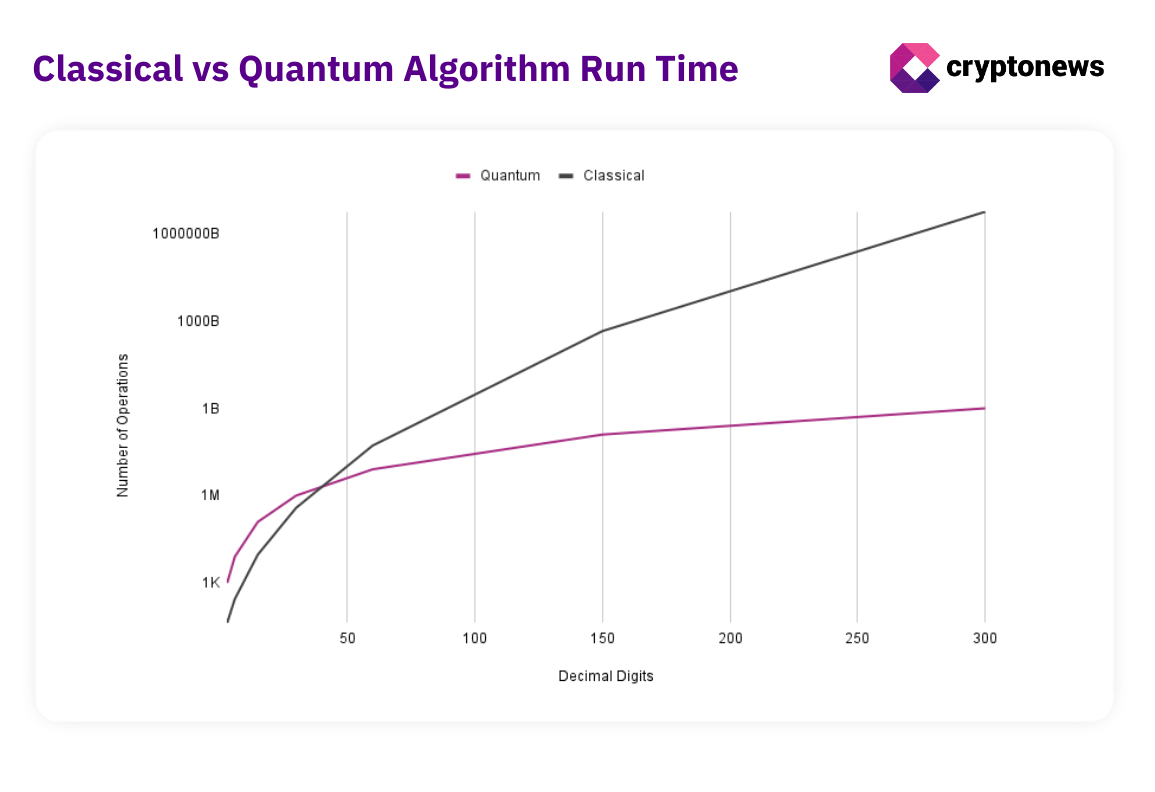
Quantum computers can drastically cut down the time required to solve problems by simultaneously holding and processing numerous potential outcomes. This capability is especially useful for tasks like factoring large numbers, which is essential to the encryption used by most cryptocurrencies.
Breaking down a large number into smaller, simpler numbers called factors through a mathematical process known as integer factorization. Multiplying these factors together gives the original number. If these integers are limited to prime numbers, the process is referred to as prime factorization.
How Quantum Computers Could Jeopardize Cryptocurrencies
The mathematical relationship between private and public keys is a crucial element of cryptocurrency security. A public key, which is linked to the wallet address, is a lengthy string of characters that can be freely shared. Used to sign transactions, a private key must be kept private. This mathematical link is only in one direction; the public key can be obtained from the private key, but not the reverse. Itan Barmes, Deloitte’s Global Quantum Cyber Readiness Capability Lead, told Cryptonews:
“The quantum computer breaks the unidirectional nature of this connection. Therefore, having someone’s public key enables you to determine their private key, impersonate them, and move their funds.”
Conventional computers are now unable to complete this task. In 1999, however, mathematician Peter Shor demonstrated that a quantum computer could solve the factoring problem considerably more quickly. Furthermore, Shor’s algorithm is capable of resolving the Discrete Logarithm Problem, which underpins the security of the majority of blockchains. This implies that if such a powerful quantum computer were to exist, it would be able to compromise the cryptocurrency security paradigm.
Quantum attacks would pose varying degrees of risk to different cryptocurrencies. Itan Barmes and his Deloitte research team analyzed the entire Bitcoin blockchain in 2020 to ascertain the number of coins that were susceptible. They discovered that about 25% of Bitcoins may be in danger.
|
“Pay To Public Key” |
“Pay to Pubkey Hash” |
|
Because these addresses make use of the public key directly, they are open and susceptible to quantum attacks. |
These addresses use a cryptographic hash of the public key. They don’t show the public key directly until coins are moved. |
Vulnerable coins include those held in P2PK (“Pay To Public Key”) addresses, which directly expose the public key, making them easy targets for a quantum attack. Coins in reused P2PKH (“Pay to Pubkey Hash”) addresses are also at risk because these addresses display their public key when the owner moves the funds. Known as a storage attack, this method applies to coins residing in static addresses. Itan Barmes added:
“A quantum attack only applies to specific coins, not everything. If we conducted the same research today, the percentage of vulnerable coins would be lower because the number of vulnerable addresses remains more or less the same, but due to mining, there are more coins in circulation.”
Itan Barmes pointed out that there is also an assault on active transactions in addition to the storage attack, as the public key is exposed for the first time.
“Such an attack must be performed within the mining time (for Bitcoin, around 10 minutes), which adds a requirement for the quantum computer to not only be powerful enough but also fast. This so-called ‘transit attack’ is likely to be possible later than the storage attack due to this additional requirement.”
Ideally, Bitcoin users should generate a new address for each transaction. However, according to recent research by Bitmex, about 50% of transaction outputs still go to previously used addresses, suggesting that address reuse is more common in Bitcoin transactions than is often assumed.
Can Quantum Computers Crack Bitcoin by 2030?
Are we approaching the point where quantum computers present a genuine danger? In 2017, Divesh Aggarwal, Gavin Brennen, and other researchers released an article that cautioned that “by the most optimistic estimates,” a quantum computer may completely break the elliptic curve signature scheme used by Bitcoin “as early as 2027.”
Cryptonews contacted the authors to see whether their estimate had shifted. Gavin Brennen of Australia’s Macquarie University said that while the field of quantum computing has evolved significantly, the central message remains the same:
“Quantum computers threaten blockchains, especially by attacking digital signatures. Cryptocurrencies should start upgrading their systems to utilize post-quantum cryptography sooner rather than later to protect their asset valuations.”
Quantum computers would probably need thousands, if not millions, of qubits to compromise cryptocurrency security. At the moment, the most advanced machines have around 1000.
Error reduction is another significant hurdle. Quantum bits are very sensitive to their surroundings; even minor disruptions, such as changes in temperature or vibration, can cause computation errors, a problem known as quantum decoherence.
Numerous public and private firms are currently actively working to advance the development of sizable quantum computers. IBM has ambitious plans to create a 100,000-qubit chipset and 100 million gates by the end of the decade.

PsiQuantum intends to have one million photonic qubits within the same timeframe.
Major tech companies are accelerating the quantum race. Microsoft claims its new chip demonstrates that quantum computing is now only “years, not decades” away. Amazon anticipates its chip will shorten the time to a functional quantum computer by five years. Google claims that its new “Willow” chip solved a problem in five minutes that would have taken a conventional computer billions of years.
Quantum gate fidelities and quantum error correction have also advanced significantly. Gavin Brennen continued:
“All this means that estimates on the size of quantum computers needed to crack the 256-bit elliptic curve digital signatures used in Bitcoin have dropped from 10-20 million qubits to around a million. An article published by the French quantum startup Alice & Bob estimates that it could be cracked with 126,000 physical qubits, though that does assume a highly specialized error model for the quantum computer. In my opinion, a plausible timeline for cracking 256-bit digital signatures is by the mid-2030s.”
Gavin Brennen added that substantial technological improvements would be required to reduce all types of gate errors, connect modules, and combine fast classical and quantum control, which is “a challenging but surmountable problem.”
However, Marcos Allende, a quantum physicist and CTO of the LACChain Global Alliance, believes that we may not even be aware if quantum technology becomes sufficiently advanced to compromise cryptocurrency security. In an email exchange with Cryptonews, Allende stated:
“What is certain is that those who reach that power first will use it silently, making it impossible to guess that selected hackings are happening because of having quantum computers.”
Quantum Computers Face Skepticism
Many scientists are still doubtful about the quantum threat to cryptocurrency. Speaking to Nature magazine, Winfried Hensinger, a physicist at the University of Sussex in Brighton, UK, described quantum computers as “They’re all terrible. They can’t do anything useful.”
Several obstacles prevent quantum computing from achieving its full potential. The fragile nature of qubits makes it challenging to keep them in a quantum state for long periods. Another challenge is cooling requirements. Many quantum processors must operate at temperatures close to absolute zero, necessitating sophisticated and expensive refrigeration technology. Lastly, quantum systems must be integrated with existing classical ones.
“Just having 200 million qubits not connected to each other is not going to do anything. There are a lot of fundamental physics problems that need to be resolved before we get there. We are still very much at the beginning. But even in the past year, there’s been tremendous improvement. The technology can accelerate in a way that all the timelines will be much shorter than we expect,” Itan Barmes told Cryptonews.
Cryptocurrency Sector Needs a Strategy
Tommie van der Bosch, Partner at Deloitte and Blockchain & Digital Asset Leader of Deloitte North and South Europe, believes the important question is not if quantum computing will compromise cryptocurrency security, but when: “The mere possibility should prompt action. A plan is essential.”
Notably, multiple prominent crypto firms and the World Economic Forum (WEF) have voiced concerns this year regarding the implications of quantum computing for cryptocurrency security.
In a post released in May, the WEF cautioned that central bank digital currencies (CBDCs) may become a prime target for quantum attacks. Ripple’s recent report also indicated that quantum computers may break the digital signatures that currently secure blockchain assets.
Earlier this year, Ethereum founder Buterin proposed that the Ethereum blockchain would need to undergo a “recovery fork” to prevent a scenario where “bad actors already have access to them and are able to use them to steal users’ funds.” Blockchain systems will need to integrate post-quantum cryptographic algorithms to protect against these potential quantum attacks. However, incorporating these algorithms into existing blockchain protocols is complex.
First, new cryptographic methods must be created, tested, and standardized. This process can take years and necessitates consensus within the cryptographic community to guarantee the security and effectiveness of the new methods. The National Institute of Standards and Technology (NIST) initiated a project in 2016 to establish new standards for post-quantum cryptography. The project finalized its three main digital signature methods—CRYSTALS-Dilithium, FALCON, and SPHINCS+—in 2024. Later, NIST also selected 14 more options for the second round of Additional Digital Signatures.
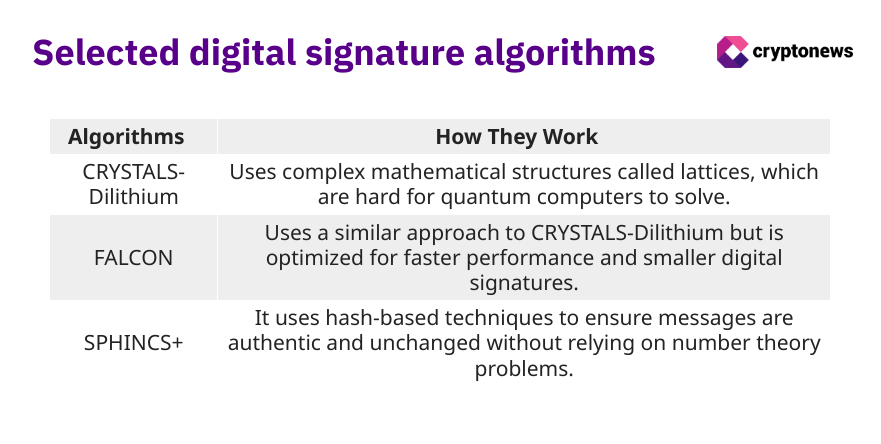
Once standardized, these new cryptographic algorithms must be implemented within the blockchain’s existing framework. Subsequently, all network participants must adopt the updated protocol.
Itan Barmes explained, “Suppose someone could provide the precise date—three years from now—when such quantum computers will exist. How quickly can the Bitcoin protocol be modified to withstand these attacks? Bitcoin’s decentralized governance may prove to be a double-edged sword, impeding timely action.”
Often, quantum-resistant algorithms demand greater processing power and larger key sizes, potentially leading to performance issues on the blockchain. These may include slower transaction times and increased computational demands for mining and verification.
Economic Model and Regulatory Shifts
Tommie van der Bosch shared with Cryptonews that quantum computing’s rise could ultimately impact the entire economic model of cryptocurrencies.
Cryptocurrencies that promptly upgrade to quantum-resistant protocols might gain a competitive edge. Investors and users may favor these “quantum-safe” cryptocurrencies, perceiving them as more secure long-term investments. This shift could increase demand for these cryptocurrencies, potentially boosting their value and market share compared to slower adaptors. Tommie van der Bosch stated:
“Let’s draw a parallel with the banking system. We’ve all seen the effects of a bank collapsing or even the rumor of one. Your money suddenly seems at risk. How quickly do people shift their assets? It can trigger a domino effect.”
Regulatory adjustments may also result from the growth of quantum computing. Regulators may begin to impose more stringent regulations on the trading and custody of cryptocurrencies that have not upgraded their cryptographic protocols. These measures are intended to shield investors from the possibility of losing funds to vulnerable assets.
Itan Barmes commented, “Few are aware that the cryptographic algorithm used in Bitcoin and essentially all cryptocurrencies is not part of the NIST recommendation (NIST SP800-186). This issue already arises if organizations must comply with NIST standards. The problem becomes even more complex if algorithms must be replaced; whose responsibility is it to replace them?”
Potential Benefits of Quantum Computers for Cryptocurrencies
Can quantum computing actually be beneficial to the cryptocurrency industry? Gavin Brennen suggests that it might. In an email exchange with Cryptonews, Brennen discussed the development of quantum-enabled blockchains.
Although Brennen notes that the improvement over conventional mining rigs would be restricted and would necessitate quantum computers with hundreds of millions of qubits, which is far beyond current capabilities, quantum computers could expedite mining.
“New computational problems have been suggested, like the boson sampling problem, that are slow for all types of classical computers but would be fast on a quantum device. Interestingly, the boson sampler is a small, specialized processor using photons of light, that is not as powerful as a full quantum computer, but much cheaper to build, and that solves a problem immune to ASIC speedups with an energy footprint that is orders of magnitude lower for reaching PoW consensus.”
Currently, proof-of-work (PoW) requires vast amounts of electrical power for mining, raising concerns about sustainability and environmental impact. Boson sampling may become a greener alternative, significantly reducing the energy footprint of blockchain operations while maintaining security and efficiency.