
Environmental groups are expressing concerns that proposed cryptocurrency legislation in Congress, intended to provide necessary regulation, will actually worsen the industry’s already significant energy consumption and contribute to increased climate pollution.
This week, House Republicans have designated “Crypto Week,” aiming to pass several crypto-related bills. A key piece of legislation is the Guiding and Establishing National Innovation for U.S. Stablecoins Act, known as the GENIUS Act.
The GENIUS Act has garnered bipartisan support, including endorsements from Senators Kirsten Gillibrand (D-N.Y.) and Cory Booker (D-N.J.). These senators believe the bill, which previously passed the Senate in June, offers crucial safeguards for consumers and financial markets.
Former President Donald Trump, who is familiar with the crypto space through his own $TRUMP meme coin and an estimated $1 billion in crypto assets, announced on Truth Social Tuesday evening that he persuaded House Republicans who were hesitant about crypto to support the bill.
While some economists predict the GENIUS Act could backfire, leading to economic instability and potentially triggering another global financial crisis, environmental advocates are concerned that the legislation will intensify the environmental impact of a resource-intensive industry, regardless of its effect on financial systems.
“Increased legitimacy and use of cryptocurrency generally will inevitably lead to more crypto mining,” said Mandy DeRoche, deputy managing attorney for Earthjustice’s clean energy program.
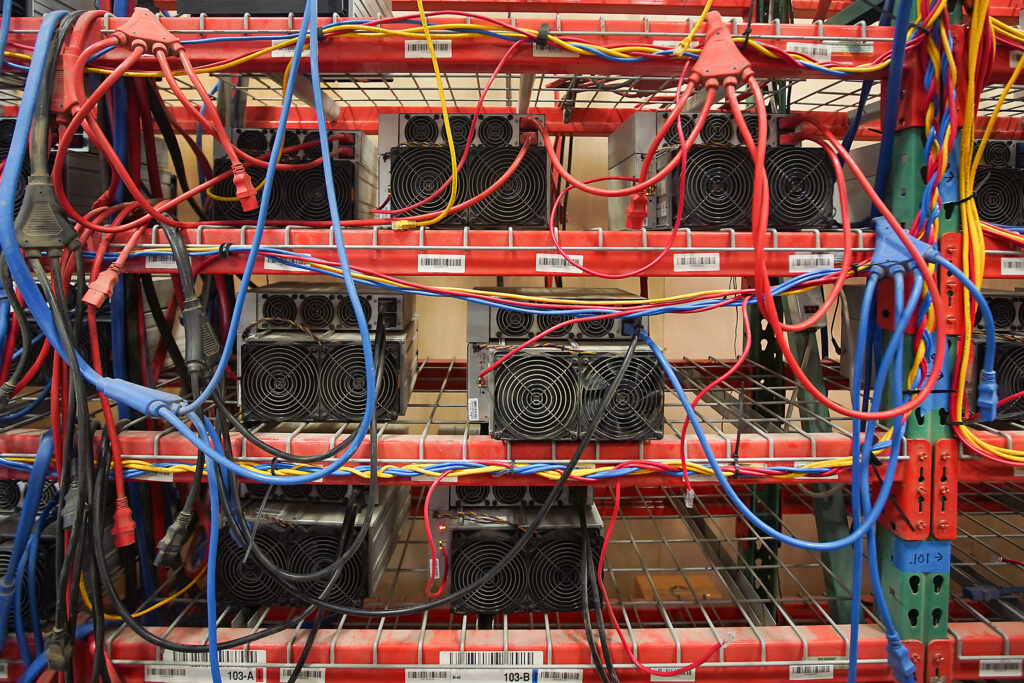
Cryptocurrency “mining” is a widespread process used to authenticate transactions and generate new cryptocurrency, such as Bitcoin. This process involves high-powered computers constantly solving complex mathematical problems to unlock the correct code. Successful miners receive a limited number of newly minted Bitcoins as a reward.
The energy demands of the crypto industry have surged as cryptocurrency gains popularity and the difficulty of the codes required to generate new coins increases.
According to the U.S. Energy Information Administration, cryptocurrency mining accounted for as much as 2.3 percent of all U.S. electricity consumption in 2022.
Many crypto mining operations are located in smaller towns and rural communities.
“These are massive, billion-dollar companies that come in and dominate local communities, often with little to no oversight,” said Jackie Sawicky of the National Coalition Against Cryptomining.
In Texas, the leading state for Bitcoin mining, there is growing opposition to large mining operations due to water usage and noise pollution.
However, an alternative, more environmentally friendly method exists for authenticating cryptocurrency transactions. This method, known as “proof of stake,” relies on validators who already possess a significant stake in the specific cryptocurrency. These validators verify transactions used to generate new currency, earning transaction fees for their work. They also agree to lock up a portion of their own holdings during the verification process to ensure honest participation.
After Ethereum, the second-largest cryptocurrency after Bitcoin, transitioned from mining (also known as “proof of work”) to “proof of stake” verification in 2022, it experienced a 99.99 percent reduction in energy consumption.
The GENIUS Act aims to regulate stablecoins, a type of cryptocurrency pegged to the value of another asset, like the U.S. dollar, to reduce price fluctuations.
New stablecoins can be validated using either mining or proof of stake. The GENIUS Act does not stipulate the method for minting new stablecoins.
Neither Senator Gillibrand’s nor Senator Booker’s office has responded to inquiries regarding the continued allowance of cryptocurrency mining under the GENIUS Act.
Most cryptocurrency, including Bitcoin, which accounts for over 60 percent of the global crypto market, depends on mining. Environmental advocates warn that any growth in the industry facilitated by stablecoins will only stimulate more mining.
Amanda Wick, founder and CEO of the Association for Women in Cryptocurrency, stated in a C-SPAN interview Wednesday that mining is the predominant method for minting stablecoins.
However, Adi Wolfson, a researcher at Shamoon College of Engineering in Israel, argues that it doesn’t have to be this way. He recently published a study on the sustainability of stablecoins compared to other cryptocurrencies. He stated that mining stablecoins has a similar environmental impact to mining other cryptocurrencies. However, producing them via proof of stake translates to “less energy, less pollution, less carbon.”
“The choice is there,” Wolfson added.
About This Story
This news, like all of our journalism, is freely available. Inside Climate News operates as a nonprofit 501c3. We do not require subscriptions, have paywalls, or display website advertising. We want to make climate and environment news accessible to everyone.
Further, we freely share our content with numerous media outlets nationally. Many cannot afford independent environmental reporting. We have established bureaus nationwide to report local news, collaborate with local news organizations, and co-publish to maximize the impact of our work.
ICN began in 2007. After six years, we received the Pulitzer Prize for National Reporting. Now, we operate the oldest and largest climate newsroom in the U.S. We provide in-depth reporting, hold polluters accountable, expose environmental injustices, debunk misinformation, and examine solutions.
Reader donations support every aspect of our operations. Please consider supporting our vital journalism addressing the planet’s most significant crisis and helping us reach a wider audience.
Please donate to support our mission. Every contribution is meaningful.
Thank you.