

Cryptocurrency contract trading platforms, whether operating in a centralized or decentralized exchange environment, provide the infrastructure for trading crypto-based contracts. They present a means for traders to speculate on changes in a crypto asset’s price, without needing to actually acquire or possess the underlying digital currency.
This piece will delve into a thorough analysis of the leading contract trading platforms anticipated for 2025. We’ll spotlight their distinguishing characteristics, benefits, and potential drawbacks. Additionally, we’ll clarify the concept of contract trading, explore the various types of crypto contracts available, and give guidance on selecting the platform that best aligns with your needs.
Top Crypto Contract Trading Platforms of 2025
- Binance: Stands as the most expansive exchange for digital assets.
- BTCC: Highly regarded as the prime crypto contract trading platform within the United States.
- Bybit: Distinguished as the premier crypto trading platform that doesn’t require KYC.
- BYDFi: Noted as the best contract trading platform overseen by FinCen.
- Coinbase: Acclaimed as the top platform for trading, catering especially to beginners.
- Gemini: Recognized as the most secure, SOC-certified exchange.
- Kraken: A leading exchange specifically for experienced futures traders.
- MEXC: Celebrated for offering the most cost-effective trading experience with the lowest fees.
- Phemex: Stands out as the best platform for trading perpetual futures.
- PrimeXBT: Top exchange for accessing a broad spectrum of financial markets for trading.
Contract Trading Platforms: A Comparative Overview
| Contract Trading Platform | Types of Derivative Contracts Available | Derivatives Trading Fees (Standard Users) |
| Binance | USDS-M futures, Coin-M futures, and USDT options. | Futures: 0.02% maker / 0.05% taker.
Options: 0.03% maker / 0.03% taker. |
| BTCC | USDT-M and Coin-M perpetual futures. | 0.025% maker / 0.045% taker. |
| Bybit | USDT and USDC-settled perpetuals, standard futures (expiry dates), and coin-settled inverse contracts. | Perpetuals & Futures: 0.02% maker / 0.055% taker.
Options: 0.02% maker / 0.03% taker. |
| BYDFi | USDT-M and Coin-M perpetuals, plus leveraged tokens. | Perpetuals: 0.02% maker / 0.06% taker.
Leveraged Tokens: 0.2% fees (USDT). |
| Coinbase | Futures and perpetual (no-expiry) contracts. | 0.4% (40 bps) maker / 0.6% (60 bps) taker. |
| Gemini | Cross-collateral custody-free perpetuals. | 0.02% maker / 0.07% taker. |
| Kraken | USD linear perpetuals, inverse Coin-M perpetuals, inverse Coin-M fixed maturity futures, Multi-collateral perpetuals, and CME futures (US only). | 0.02% maker / 0.05% taker. |
| MEXC | USDT-M, USDC-M, and Coin-M perpetuals. | 0.01% maker / 0.04% taker. |
| Phemex | USDS-M and Coin-M perpetuals. | 0.01% maker / 0.06% taker. |
| PrimeXBT | Fixed maturity futures and CFD trading across various markets, including crypto. | Futures: 0.01% maker / 0.045% taker.
Crypto CFDs: 0.05% fees. |
In-Depth Reviews of 10 Prime Contract Trading Platforms
1. Binance
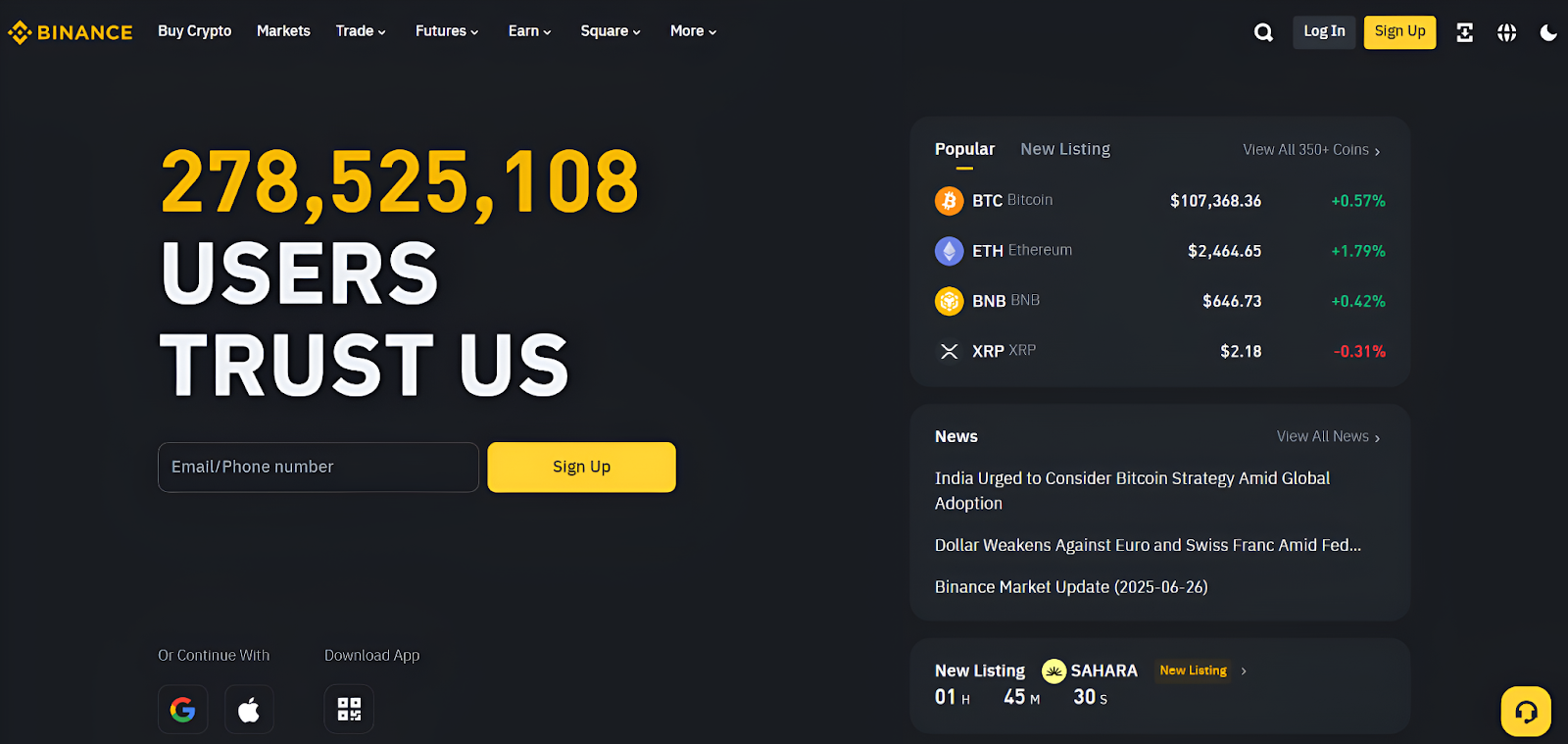
Binance distinguishes itself as a leading platform for crypto contract trading, with futures contracts available across more than 535 trading pairs and leverage extending up to 125x on particular pairs. The exchange primarily offers three types of crypto derivatives: USDS-margined (M) futures, Coin-margined (M) futures, and options.
While USDS-(M) futures are settled in stablecoins, notably USDT and USDC, Coin-M futures are settled in cryptocurrencies. For those interested in perpetual contracts, options include USDC, USDT, or Coin-M perpetuals.
Binance also provides crypto options priced and settled in stablecoins, primarily USDT, allowing users to securely enter and exit positions even during times of market volatility. Whether in bull or bear market conditions, the intrinsic value of the underlying collateral is unlikely to suffer drastic declines.
Binance caters to institutional investors with over-the-counter (OTC) trading, including options request for quote (RFQ) for block option trading.
Binance also allows for the automation of trades through pre-configured trading bots, such as futures grid, or the deployment of custom bots to mirror profitable trading strategies. The Binance trading platform also accommodates leveraged and spot trading.
New traders can leverage Binance’s copy trading feature to emulate the strategies of experienced traders, and can practice in a simulated environment with a demo account before engaging in real trades.
Regarding trading fees, Binance charges a 0.02% maker fee and a 0.05% taker fee for regular futures traders. BNB holders enjoy a 10% discount, reducing maker and taker fees to 0.018% and 0.045%, respectively.
Pros
- Robust security protocols: cold wallets, two-factor authentication (2FA), end-to-end encryption, proof of reserves (PoR), anti-phishing code, and Secured Asset Fund for Users (SAFU).
- Provides learning resources through Binance Academy.
- Supports a wide range of cryptocurrencies, with over 500 cryptocurrencies and 1300+ trading pairs.
- Allows users to earn passive income on 300+ assets and utilize yield-maximizing products such as dual investments and smart arbitrage.
- Offers informative blogs and institutional-level market analysis reports.
- User-friendly mobile app.
Cons
- No phone or email support.
- Trading interface isn’t necessarily intuitive for beginners.
- Availability limited in some countries: US, UK, Singapore, Netherlands, Canada, Japan, and Nigeria.
- Limited options for fiat off-ramps in certain locations.

2. BTCC
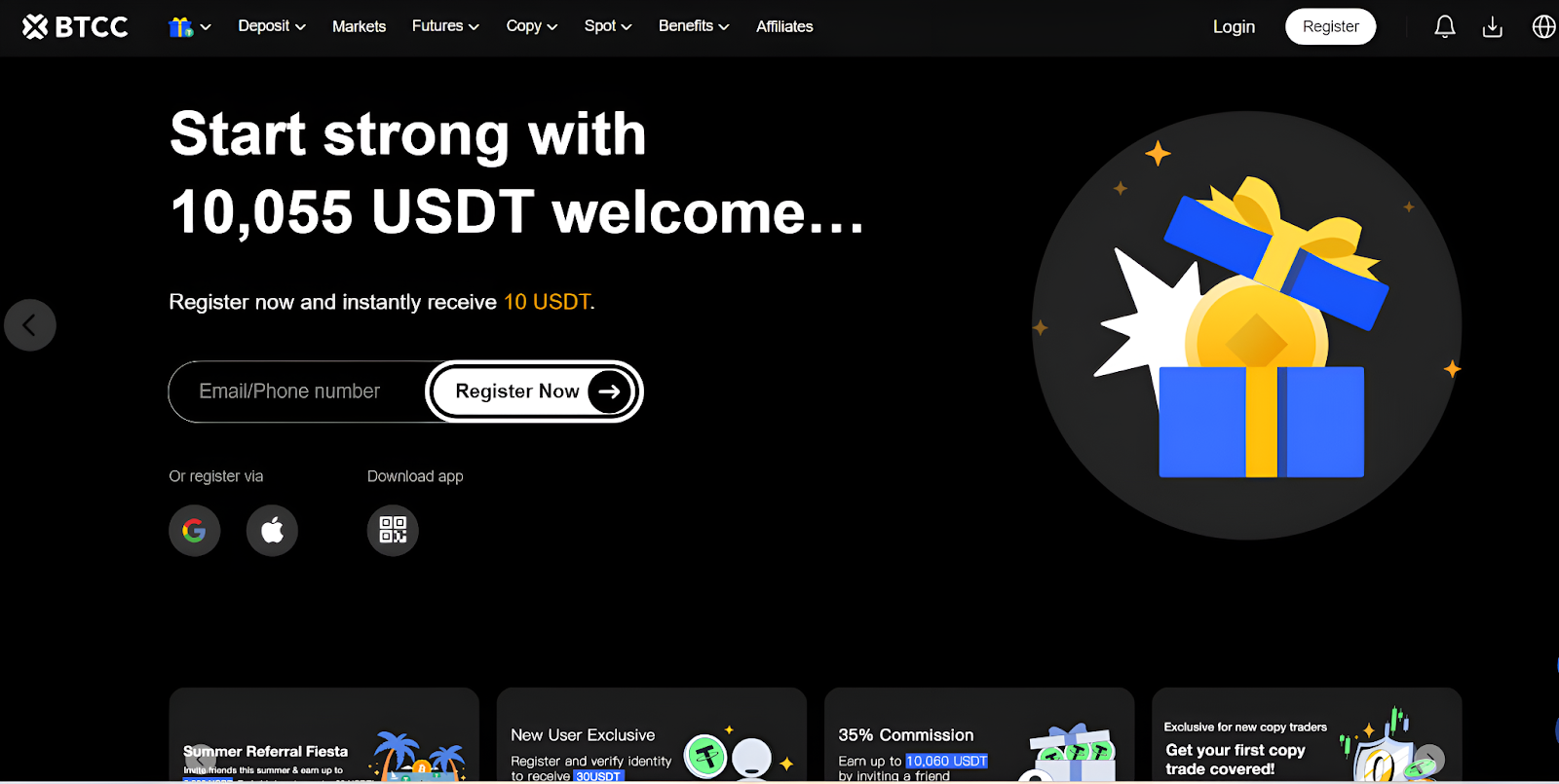
BTCC is a top choice among crypto futures trading platforms, particularly for traders in the USA. It holds licenses in the US, Europe, and Canada, supporting transparent, seamless, and inclusive trading services. It features over 300 futures pairs and 200+ spot pairs and is specifically designed for traders focusing on USDT-M perpetual futures.
BTCC uniquely enables trading without mandatory KYC procedures. It offers up to 500x leverage for contract trading, a fast order matching engine, narrow bid-ask spreads, adaptable margin settings (isolated and cross margin), and support for multiple contracts.
With high liquidity, orders are filled quickly with minimal slippage, even during volatile market conditions.
Trading costs on BTCC are also lower than those of Coinbase and Kraken, mainly beneficial for high-volume traders. Futures trading includes a 0.025% maker fee and a 0.045% taker fee, with higher VIP tiers offering more significant fee discounts. Spot trading fees are consistently 0.2% (maker) and 0.3% (taker) across all tiers.
The exchange employs advanced security, including multi-signature cold wallets, 1:1 storage of user assets, KYC verification for deposits and withdrawals, 2FA, penetration testing, and data encryption. It also provides an insurance fund to protect users from losses due to forced liquidations.
Pros
- Up to $100,000 in virtual funds for demo trading.
- A copy trading platform with over 600,000 users.
- Zero fees for crypto deposits.
- Risk management tools: stop-loss and take-profit orders.
- Allows crypto trading with low minimum balances.
- Desktop and mobile apps with intuitive interfaces.
- Custom lot sizes for better risk management.
Cons
- Doesn’t support crypto options trading or DeFi projects.
- No staking or yield farming options for passive income.
- May not be the most beginner-friendly platform.
3. Bybit
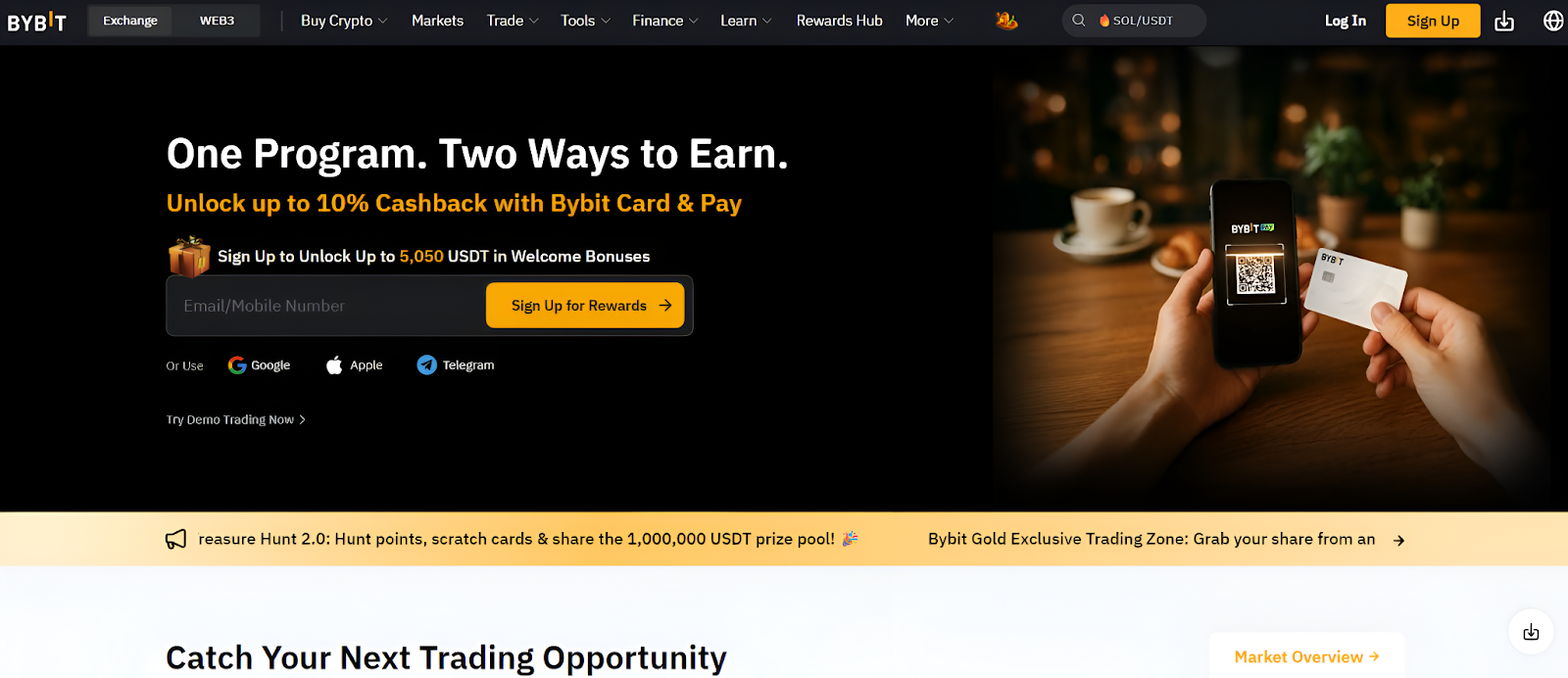
Bybit acts as a bridge linking the virtual and real economies, establishing itself as a leading contract trading platform and Web3 gateway. It offers futures contracts settled in USDC, USDT, and other cryptocurrencies, featuring perpetual contracts, standard futures with expiry dates, and inverse (coin-settled) futures.
It provides a unified trading account (UTA) that allows you to leverage over 70 assets as collateral, enhancing capital efficiency. The UTA combines spot, perpetuals, futures, and options with cross margins, boosting trading power and flexibility, and hedging solutions for USDC and USDT contracts.
Bybit offers low latency rates (under 10ms), particularly in options trading, with TradeGPT (AI-powered token analysis), leaderboard, and TradeFi tools. TradeFi offers 100+ trading pairs, including stock indices, forex, commodities, and crypto, up to 500x leverage, high liquidity, and tight spreads.
New traders can utilize Bybit’s position builder to simulate profits and losses (PnL) for perpetual, futures, and options pairs before executing real orders.
Profits can be increased through copy trading, and automated bots like Futures Grid, Futures Martingale, and Futures Combo can automatically rebalance portfolios.
Trading fees are low: 0.02% maker and 0.055% taker for perpetuals and futures, and 0.02% maker and 0.03% taker for options.
Risk management features: adjustable collaterals, dual-price liquidation systems, and fast execution of trigger or trailing stop loss orders.
Pros
- Direct crypto purchases in the spot market with up to 10x leverage.
- Structured products like dual asset and smart leverage up to 200x.
- Airdrop livestreams, news, and Bybit Learn for crypto knowledge.
- TradingView integration with advanced charting tools.
- Supports 640+ futures pairs with 99.99% uptime.
- Processes up to 100,000 transactions per second with zero slippage.
- Security: cold wallets, triple-layer asset protection, bug bounty programs, and live risk monitoring.
Cons
- Not accessible in the US, UK, and Canada.
- KYC mandatory for unlimited deposits and withdrawals.
4. BYDFi
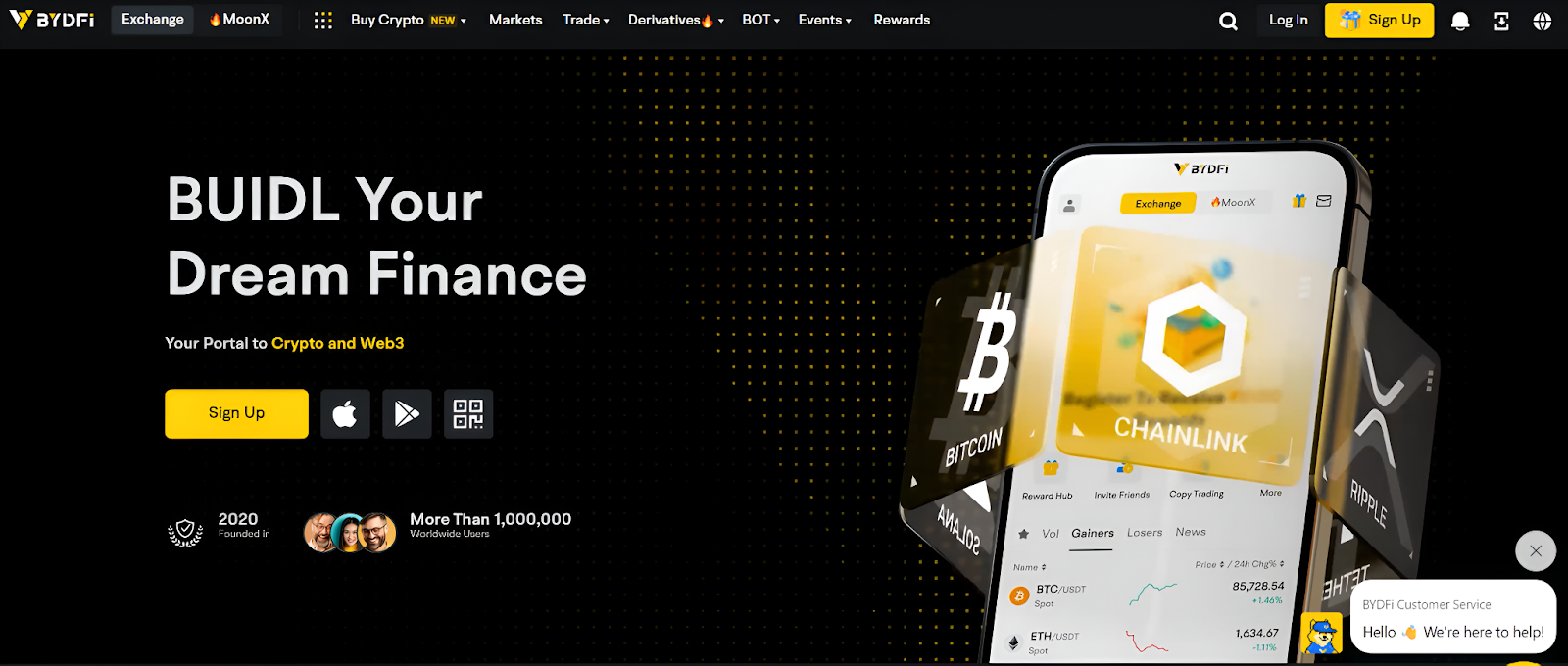
BYDFi is a notable crypto contract trading platform in the US, regulated as a Money Service Business by FinCen. It’s popular among crypto users and offers trading without KYC, making it great for both new and experienced traders seeking speed, flexibility, and security.
You can trade USDT-M and Coin-M perpetuals, and explore BTC and ETH-based leveraged tokens to enhance trading power and gains without managing liquidation risks.
BYDFi is a high-performance platform with low trading fees (0.02% maker and 0.06% taker) and economical funding rates. It offers strong security: 2FA, PoR audited by third parties, multi-signature approvals, insurance coverage, and hot and cold wallet separation.
The trading interface is customizable and includes charting options, margin adjustment, and order book depth. For automation, use bots or the pre-coded Futures Grid. Spot traders can use bots like Spot Grid, Spot Investment, and Spot Martingale, with excellent 90-day APY.
Pros
- Offers demo trading.
- Contract trading with up to 200x leverage on derivatives, including 400+ perpetuals.
- Supports multiple order types: take profit, stop loss, market, limit, and OCO.
- Zero-fee fiat deposits and crypto purchases with credit cards.
- 24/7 multi-lingual customer support via email, live chat, and Telegram.
- Excellent affiliate program, offering up to 70% revenue share.
Cons
- Doesn’t support fiat withdrawals.
- Fewer copy traders compared to other exchanges.
5. Coinbase
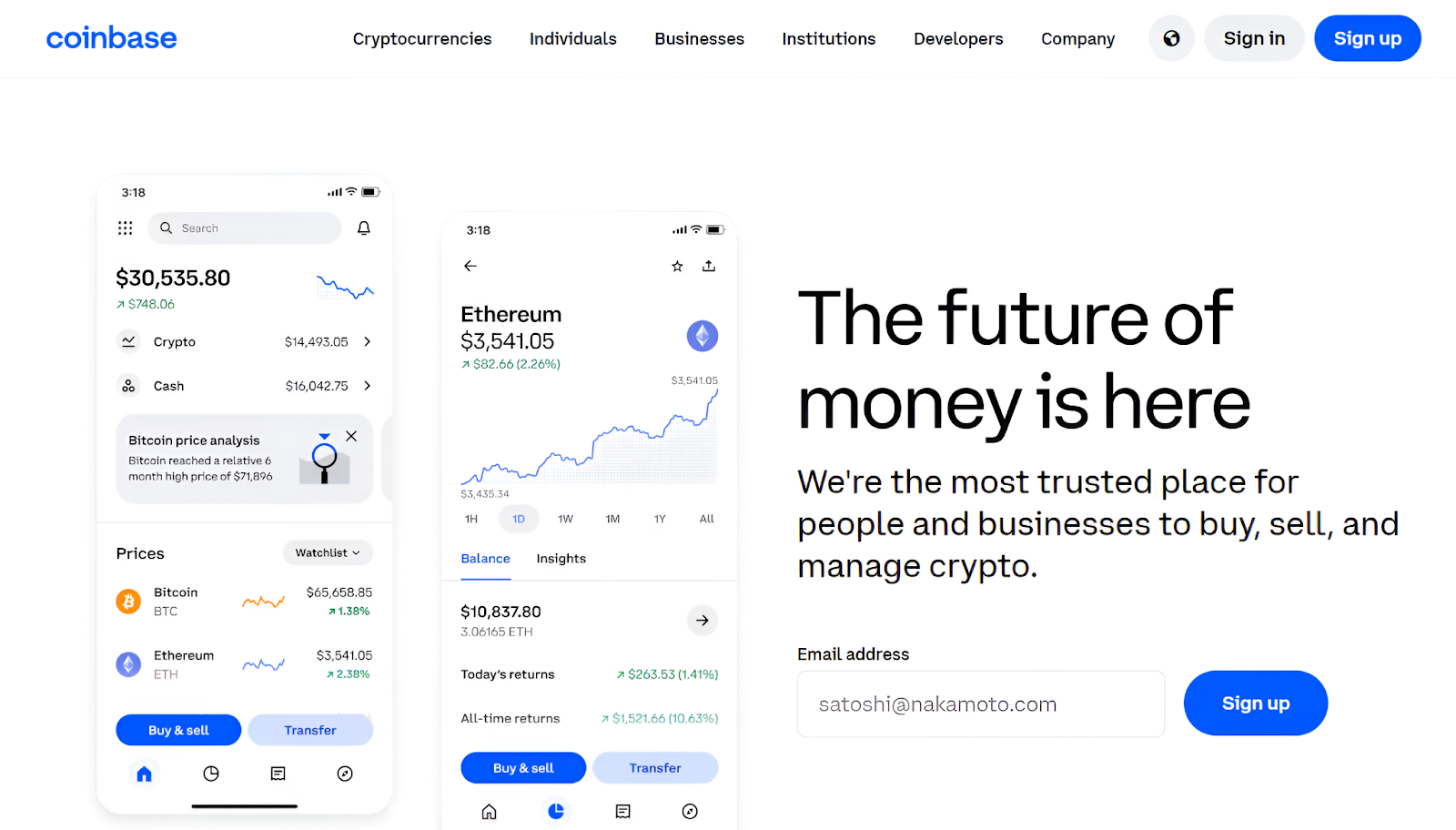
Coinbase provides contract trading in crypto perpetuals and futures. Founded in 2012, it stands out with its competitive trading costs, sophisticated trading tools, ease of use, and strong security.
Coinbase offers both crypto futures and perpetual contracts for retail traders. Users can increase position sizes or create new positions with less capital through derivative contracts tailored to risk levels and trading styles.
Coinbase is ideal for those who trade Ethereum or Bitcoin futures, offering 24/7 futures trading and real-time tracking of ETH and BTC price movements.
Coinbase’s intuitive trading interface provides integrated access to 550+ spot pairs and 18+ futures pairs across sectors like energy, metals, and crypto.
Analytical tools, sophisticated charting, market data, liquidity, and live order books help monitor price movements in both spot and derivatives markets.
It provides educational resources with explainer blogs, guides, tips, and tutorials, helping traders understand contract trading easily.
Coinbase has low trading fees for spot trading (0% maker) but high charges for futures orders (0.4% maker and 0.6% taker).
Pros
- User-friendly interface, easy to use.
- Staking services on 100+ crypto assets.
- Security: data encryptions, self-custody wallet, 2FA, and cold storage.
- Multiple order types: market, limit, OCO, stop, and stop orders.
- Coinbase Derivatives Exchange with risk management features.
Cons
- Crypto derivatives not available in Spain or the UK.
- Charged by the SEC in June 2023.
- Higher trading fees than average.

6. Gemini
