

Bitcoin’s price has experienced substantial gains over the last week, pushing it back toward its historical peak. Currently, the leading cryptocurrency is valued above $120,000, inching closer to its all-time record of over $123,000.
The digital asset has risen by around 5.1% in the past week, positioning it as one of the top-performing assets in the cryptocurrency sector.
Concurrently, examination of on-chain data related to USDT transactions on the TRON network provides insights into prevailing market dynamics. CryptoQuant analyst Amr Taha has analyzed these USDT flows on TRC-20, pinpointing patterns that potentially foreshadow future Bitcoin price movements.
The analysis classifies transactions into six distinct categories based on size, spanning from smaller retail trades of $100 to “super whale” transactions exceeding $10 million, aiming to differentiate between everyday trading activity and institutional-level investments.
Large USDT Transfers: A Key Market Indicator
Taha’s research indicates a correlation between substantial USDT transfers (over $10 million) on the TRON network exceeding $5 billion in a single day and significant profit-taking behavior in Bitcoin.
This trend usually involves converting Bitcoin into USDT, followed by the transfer of these stablecoins to private wallets, which reduces buying demand in the spot market.
For instance, on July 16th, USDT transfers of $10 million or more totaled $5.2 billion, preceding a 4.5% decline in Bitcoin’s value. Similarly, on July 23rd, $5.8 billion in similar transfers occurred before a 3.8% price decrease within a 48-hour timeframe.
However, current data lacks evidence of such large-scale transactions, implying that major Bitcoin holders aren’t actively converting their holdings into stablecoins right now. The absence of significant outflows from whales suggests that major investors are likely holding onto their positions instead of exiting the market.
Evolving Bitcoin Market Participation and Potential for a Breakout
A separate analysis by CryptoQuant analyst ShayanMarkets, focusing on the average size of executed orders in Bitcoin futures markets, presents another perspective on market participation trends.
This metric, determined by dividing the total trading volume by the number of completed orders, helps determine whether market activity is driven by retail investors or larger, institutional traders.
Data from late 2024 and early 2025 revealed periods of dominance by larger entities, which coincided with robust upward price trends. Conversely, recent weeks have witnessed an increase in smaller, retail-sized orders, while the influence of whale-driven trades has decreased.
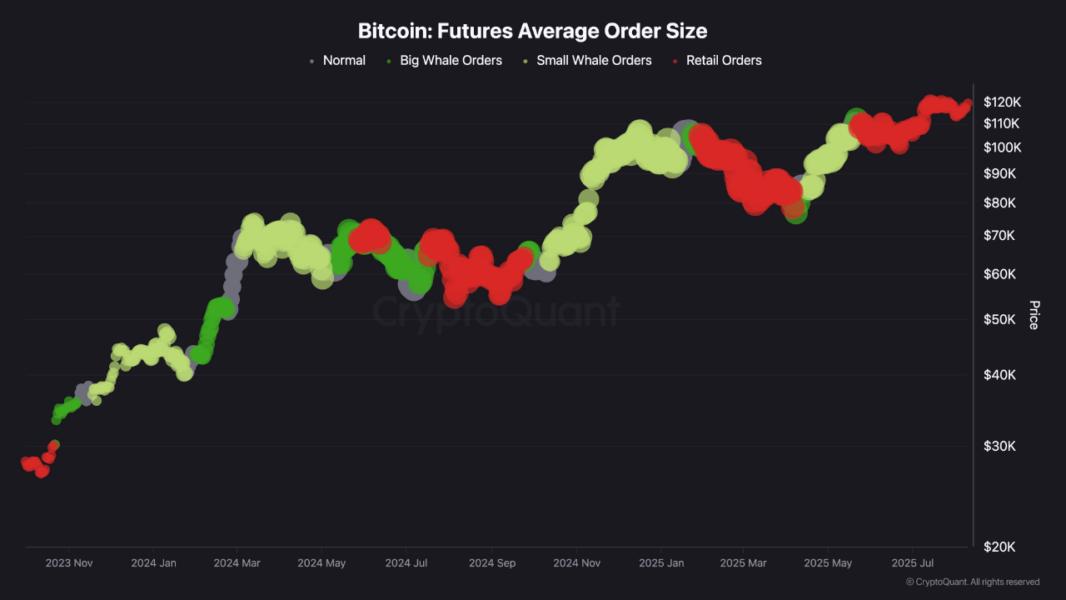
This shift indicates that large-scale buyers may be maintaining positions acquired at lower prices or are awaiting new market conditions before making significant re-entries with substantial investments.
Historically, prolonged dominance by whales near market peaks has often indicated distribution phases, where large holders secure profits.
The present absence of this pattern suggests the possibility of a bullish surge above Bitcoin’s existing all-time high, provided that renewed selling from major investors doesn’t emerge in the short term.
Featured image created with DALL-E, Chart from TradingView