

Disclosure: VanEck holds positions in digital assets including Bitcoin, MSTR, STRK, and STRF.
Key Insights:
- Strategy (MSTR) as a Leveraged Bitcoin Investment: The price of MSTR shares is closely tied to Bitcoin’s performance because the company borrows money and issues stock to buy more Bitcoin. This strategy can lead to significant gains when Bitcoin rises, making MSTR an appealing way for investors to gain exposure to Bitcoin without directly owning it.
- Premium Valuation of MSTR: MSTR’s stock price is significantly higher (+112%) than the actual value of its Bitcoin holdings and its software business combined. This premium reflects investor confidence in the company’s future Bitcoin purchases, potential regulatory advantages, and speculative trading activity.
- MSTR’s Premium as a Self-Sustaining Engine: The high stock price allows MSTR to raise more capital, which it uses to buy more Bitcoin. This cycle drives up the stock price further, creating a positive feedback loop fueled by Bitcoin’s volatility and investor interest.
- Convertible Securities and Associated Risks: MSTR issues bonds and preferred shares (STRK and STRF) that can be converted into common stock. These securities offer different levels of income and exposure to Bitcoin, but they also come with added complexity, potential losses, and sensitivity to market volatility. The convertible bond maturing on March 15, 2030, has the most direct link to MSTR’s stock performance, but all these instruments are heavily influenced by Bitcoin and the sustainability of MSTR’s premium.
Strategy (MSTR) comprises a substantial portion, nearly one-third, of the total market capitalization of companies primarily focused on equity-to-crypto investments. It also constitutes 10% of the holdings within the Market Vector Global Digital Assets Equity Index (MVDAPP). Therefore, deciding whether to include MSTR in an investment portfolio is crucial for fund managers aiming to profit from the growing digital asset industry.
There is considerable debate surrounding the advantages of investing in MSTR compared to Bitcoin (BTC) itself, or even leveraged Bitcoin products. This discussion is complicated by MSTR’s complex financial structure, which includes convertible bonds and different types of equity, such as high-yielding convertible preferred shares (STRK) and even higher-yielding non-convertible preferred shares (STRF).
This analysis examines MSTR’s structure, evaluating the potential benefits and drawbacks of investing in its stock or debt. We have determined that MSTR common stock offers a better investment opportunity than the other options available from the company, due to its:
- Highest degree of exposure to Bitcoin’s price movements
- Straightforward investment approach
- Favorable balance of risk and potential return
What is Strategy?
Strategy, previously known as MicroStrategy, is an enterprise analytics software firm that pioneered the concept of holding Bitcoin as a corporate treasury asset. In August 2020, recognizing the vulnerability of its cash reserves to inflation amidst low interest rates, Strategy made its initial investment, allocating $250 million of its cash to purchase 21,454 BTC.
In December 2020, Strategy issued $650 million in convertible notes, clearly stating its intention to use the funds to acquire more Bitcoin. This marked the company’s transformation into a leveraged Bitcoin investment vehicle, moving beyond its traditional software business. Through the use of debt and equity offerings, Strategy has accumulated approximately 2.7% of Bitcoin’s total supply, valued at $61 billion at the time of this report.
Strategy aims to maximize the price of MSTR shares by increasing the amount of Bitcoin backing each share. By raising capital through debt or equity, the company increases the Bitcoin holdings per share, a metric they refer to as “Bitcoin Yield.” Leverage and additional equity issuance are pursued when investor demand is high, typically during periods of Bitcoin price increases. This creates a self-reinforcing cycle where Strategy’s Bitcoin exposure and leverage tend to grow over time. As Bitcoin’s value rises, Strategy can borrow more money to buy additional Bitcoin. Similarly, favorable market conditions allow Strategy to sell more stock to further increase its Bitcoin holdings. As a result, MSTR stock offers increasing exposure to Bitcoin, mirroring its price appreciation, and functioning somewhat like a call option on Bitcoin.
Understanding the Premium on MSTR Shares
MSTR’s stock currently trades at a premium (“The Premium”) relative to the combined value of its Bitcoin holdings and its core software business. Currently, the MSTR stock price exceeds (+112%) the estimated value of its underlying assets (Bitcoin Holdings + Core Business). This premium can be expressed mathematically as follows:
Source: VanEck Research, data as of 3/25/2025
The causes of MSTR’s premium are subject to debate, but we believe they are primarily driven by:
- Expectations about Strategy’s future Bitcoin acquisitions
- Limited investment options for gaining exposure to Bitcoin
- The leverage Strategy provides to Bitcoin’s price movements
- Speculative market activity
The first driver of MSTR’s premium is the market’s anticipation of Strategy’s future Bitcoin purchases. Estimating the potential future value of Strategy’s Bitcoin holdings involves considering the expected total number of Bitcoins held, the projected future price of Bitcoin, and the appropriate discount rate to apply. A significant portion of the premium on MSTR stock reflects the market’s expectation that the company will continue to accumulate more Bitcoin over time. This premium also suggests that each Bitcoin will increase in value, reflecting the discounted future price of BTC.
The second contributing factor, often referred to as a “regulatory premium,” stems from limitations within the investment landscape. Many institutional and individual investors face restrictions that prevent them from directly purchasing Bitcoin due to regulatory constraints, investment guidelines, distribution challenges, or a lack of secure custody solutions. MSTR provides a publicly traded alternative that can be more accessible, especially for those who cannot efficiently access leveraged Bitcoin exposure. Furthermore, unfavorable tax treatment and capital holding requirements in certain jurisdictions can make MSTR a preferred vehicle for Bitcoin exposure. The status of MSTR as a common stock also offers financial advantages as a collateral asset. These limitations faced by investors enhance MSTR’s appeal as a proxy for Bitcoin exposure, especially for those otherwise excluded from this asset class.
The third factor driving MSTR’s premium lies in the market’s recognition of Michael Saylor’s ability to leverage financial strategies that are not readily available to most investors. Saylor has demonstrated a knack for raising substantial capital at favorable interest rates, and his corporate structure offers resilience during Bitcoin market downturns. Unlike typical margin traders who may be forced to liquidate positions during downturns, Saylor is able to withstand losses and maintain long-term holdings. For example, even during periods in 2022 and 2023 when Strategy’s equity deficit reached hundreds of millions of dollars, MSTR’s market capitalization remained in the billions, highlighting investor confidence in the company’s long-term leveraged approach.
MSTR’s unique dynamics increase its 30-day historical volatility to roughly 113%, significantly higher than Bitcoin’s volatility of around 55%. This increased volatility reflects the leverage applied to Bitcoin within MSTR’s structure. Overall, MSTR provides investors with convenient access to a leveraged Bitcoin investment through a publicly traded stock. The premium on MSTR contributes significantly to both the volatility and the overall performance of the stock. By analyzing the weights, correlations, and volatilities of the components that make up MSTR (Bitcoin, core business, and premium), we find that the premium contributes approximately 96.5% of the total returns and 87.5% of the overall volatility.
| Weight | 49.45 | 1.12 | 49.44 |
| Return | 30.85 | 0.00 | 2.21 |
| Volatility | 192.17 | 20.94 | 43.21 |
| Return Contribution | 96.56 | 0.00 | 6.92 |
| Volatility Contribution | 87.48 | 0.14 | 12.39 |
| Premium | 1.00 | 0.54 | 0.47 |
| Business (QQQ) | 0.54 | 1.00 | 0.48 |
| BTC | 0.47 | 0.48 | 1.00 |
QQQ (Invesco’s NASDAQ-100 ETF) is used as a benchmark for the tech sector, particularly large-cap software and cloud firms, in order to characterize the attributes of MSTR’s core business operations.
Source: VanEck Research as of 3/26/2025. Past performance is not indicative of future results. The information, valuation scenarios, and price estimates presented here should not be considered financial advice or a recommendation to buy or sell. The future performance of Bitcoin is uncertain and may differ significantly from these hypothetical projections. Risks and other variables not factored into these scenarios could negatively impact performance. This is a simulation based on our research and is intended for illustrative purposes only. Conduct thorough research and form your own conclusions.
The fourth driver behind MSTR’s premium is speculative trading related to its volatility and capital structure. Since the premium significantly influences MSTR’s returns and volatility, any disruption to the factors that drive the premium could negatively impact MSTR’s share price. Michael Saylor leverages MSTR’s volatility to fund Bitcoin purchases, primarily through preferred equity, convertible preferred equity, convertible debt, and lastly, common equity. This hierarchy maximizes the “Bitcoin Gains” for common shareholders, which are determined by the Bitcoin attributed to each share. For instance, selling preferred equity dilutes the stock, but the proceeds are directly invested into Bitcoin, benefiting common shareholders.
The securities Strategy offers are popular among investors because MSTR’s high volatility creates trading opportunities across its capital structure and options on MSTR. Strategy can maintain low interest rates on its convertible debt because MSTR’s volatility makes the convertible debt’s option component highly valuable. By pricing this option value favorably, Strategy attracts relative value trading firms, which engage in sophisticated arbitrage strategies across various securities.
This dynamic creates a circular relationship where Strategy’s premium enables it to finance more Bitcoin purchases. The premium drives MSTR’s volatility, yet the premium depends on Strategy’s ability to finance Bitcoin buys. Investors are willing to buy Strategy’s securities because its capital stack is volatile, and Strategy sells this volatility at an attractive price. During the Q1 2025 earnings call, Saylor described this reinforcing dynamic as a “crypto reactor that can run for a long, long period of time.”
The premium exhibits a strong positive correlation with Bitcoin’s price. Over the past year, the correlation has been approximately 0.52 (T-Stat = 9) with a beta of 1.77 to BTC, indicating that the premium tends to increase as Bitcoin’s price rises, further boosting MSTR’s stock performance. The interplay between Bitcoin price, speculation, financing ability, and MSTR’s valuation creates a reinforcing cycle central to the company’s strategy.
Correlation of MSTR’s Premium to Bitcoin (BTC) Price
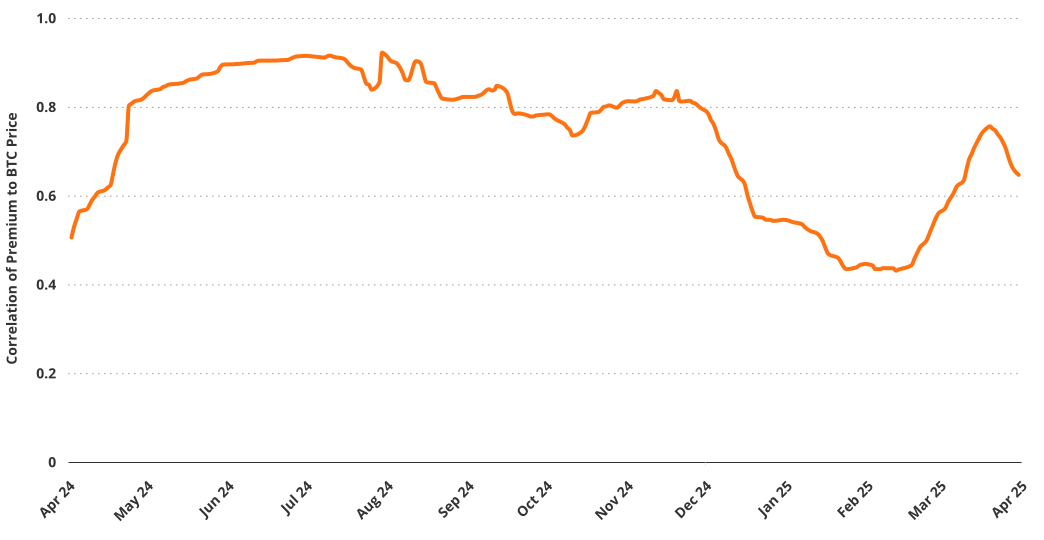
Source: VanEck Research, data as of 3/26/2025. Past performance does not guarantee future results. This is not a recommendation to buy or sell any securities mentioned.
Funding the Bitcoin Treasury Strategy
In October 2024, Strategy unveiled the “21/21” capital plan, aiming to raise $42 billion to purchase Bitcoin by selling $21 billion of MSTR equity and $21 billion in fixed income securities by 2027. According to the original plan, Strategy intended to sell $5 billion of equity in 2025, $7 billion in 2026, and $9 billion in 2027, and sell fixed income securities at a similar pace of $5 billion, $7 billion, and $9 billion in 2025, 2026, and 2027. These debt issuances were designed to maintain a leverage ratio between 20-30%. Michael Saylor has referred to this as “intelligent leverage,” emphasizing its strategic purpose of acquiring a “dominant digital asset” rather than speculation.
Benefiting from a significant crypto bull market following the launch of the 21/21 plan, Strategy had sold all $21 billion worth of MSTR stock under its At-The-Market (ATM) program by May 2025. In the fixed-income market, Saylor has sold $5 billion in convertible notes, $875 million in STRK convertible preferred stock, and $850 million in non-convertible preferred stock. During the earnings call on May 1, 2025, the company announced an expansion of the financing program to $84 billion, including a new $21 billion MSTR ATM program, the existing $21 billion STRK ATM, and an additional $14 billion in new convertible debt offerings.
42/42 Capital Raising Plan – 32% Complete

Source: Strategy, data as of 5/7/2025. Past performance does not guarantee future results. This is not a recommendation to buy or sell any securities mentioned.
With Bitcoin trading around $95,000 and Strategy holding approximately 555,450 BTC, we estimate Saylor’s leverage ratio ((Debt + Pref)/(Market Cap)) to be approximately 9%. This leverage ratio is the lowest it has been since 2020. Given Saylor’s relatively low leverage ratio and his preference for debt that is “convertible, unsecured and non-recourse,” it is likely that more capital will be raised through convertible debt offerings in the near future.
Funding BTC Purchases by Harvesting Volatility
| 2030 Convertible Notes A | 800 | 5.34 | 0.000 | ITM | Mar-2030 | 149.80 |
| 2031 Convertible Notes | 604 | 2.60 | 0.875 | ITM | Mar-2031 | 232.70 |
| 2032 Convertible Notes | 800 | 3.92 | 2.250 | ITM | Jun-2032 | 204.30 |
| 2028 Convertible Notes | 1010 | 5.51 | 0.625 | ITM | Sep-2028 | 183.20 |
| 2029 Convertible Notes | 3000 | 4.46 | 0.000 | ITM | Dec-2029 | 672.40 |
| 2030 Convertible Notes B | 2000 | 4.61 | 0.625 | ITM | Mar-2030 | 433.40 |
| STRK Convertible Preferred Stock | 744 | 0.00 | 8.000 | ITM | Perpetual | 1,000 |
| STRF Perpetual Preferred | 711 | N/A | 10.000 | N/A | Perpetual | N/A |
Source: Strategy, 2025, data as of 3/25/2025. Past performance does not guarantee future results. This is not a recommendation to buy or sell any securities mentioned.
MSTR’s stock is highly volatile due to its leverage to Bitcoin, and this leverage is likely to increase as Strategy finances more Bitcoin purchases. Most investors view taking on additional leverage to purchase volatile assets like Bitcoin unfavorably, demanding a high interest rate. Strategy addresses this by issuing convertible bonds and convertible preferred stock, which derive significant value from the embedded option features within these securities.
Sophisticated investors prefer these issuances because they allow them to engage in activities like convertible stock arbitrage. In this trading strategy, experienced investors buy convertible bonds against shorting MSTR stock and/or MSTR options to profit from discrepancies in realized volatility, implied volatility, and other components of option pricing models.
This trading dynamic helps Strategy lower its interest payments on debt. Because of the high demand for highly volatile convertible securities, Strategy can promise investors very low future interest rate payments. A complex relationship exists between Strategy’s capital markets strategy and the market appetite of potential investors.
Strategy ATM (At-the-Market) Offering Program Updates
| 2025 Common ATM | – | – | $21 billion of MSTR Shares |
| Securities Offered: Class A Common Stock. $0.001 par value per share (“MSTR Shares”) Size: $21 billion Established: May 1, 2025 |
|||
| 2024 Common ATM(2) | 353,825 MSTR Shares | 128.5 | – |
| Securities Offered: MSTR Shares Size: $21 billion Established: October 30, 2024 |
|||
| STRK ATM | 575,392 STRK Shares | 51.8 | $20.87 billion of STRK Shares |
| Securities Offered: 8.00% series A perpetual strike preferred stock, $0.001 par value per share (“STRK Shares”) Size: $21 billion Established: March 10, 2025 |
|||
| Total | 180.3 |
Source: Strategy, data as of 5/05/2025. Past performance does not guarantee future results. This is not a recommendation to buy or sell any securities mentioned.
- Net proceeds reflect deductions for sales commissions.
- The 2024 Common ATM has been largely depleted, and the sales agreement has terminated per its terms.
This involves Strategy pricing the implied volatility, setting a strike price, and adding a redemption price to maximize the tradability of each issuance. For example, a redemption price somewhat near the current market price allows Strategy to place a ceiling on the option component of its bond. The resulting derivative behaves more like a “capped call,” with a lower delta than vanilla call options. Choosing strike prices far out of the money on the converts can also lower the value of the option component and thus the delta. Lowering the delta reduces the number of MSTR shares (or options) needed to hedge the option within the convert. Many convertible arbitrage players prefer lower delta issuances because these are less capital-intensive for trading balance sheets.
Evaluating Strategy’s Financing Sustainability
While Strategy’s core business provides some income, its Bitcoin purchases via financing create significant cash demands. Projections based on Strategy’s documents and statements indicate total debt reaching $13 billion by the end of 2025 (up from approximately $8 billion in April 2025) and $19 billion by the end of 2026. Preferred equity is also expected to grow to $7.5 billion in 2025 and $15.5 billion in 2026.
By the end of 2025, annual interest payments are forecasted to reach $48 million, rising to $87 million by 2026. Meanwhile, preferred stock (STRK) dividend payments are expected to increase from $217 million in 2025 to $904 million in 2026. These estimates are based on anticipated market demands for MSTR’s debt coupon and preferred dividend rates. While Strategy retains the option to pay STRK preference dividends in common shares, doing so would dilute existing MSTR holders, reducing Bitcoin per share.
With projected revenue of $475 million in 2025, Strategy relies on financing to cover its fixed income obligations. The ability to raise new capital depends on Bitcoin’s price. If Bitcoin’s price continues to rise, securing new capital will be easy. Between August 2024 and May 2025, Strategy grew its holdings from 226,000 BTC to 555,450 BTC by obtaining $28.7 billion in financing. Conversely, during a crypto downturn between June 2022 and December 2022, Strategy could only raise $49 million and $11 million from equity and debt sales, respectively. Given the increasing cash outflows due to new fixed income securities offerings, a bear market could prove challenging for Strategy.
MSTR is a convexity bet on BTC price
Investing in MSTR is similar to investing in call options on Bitcoin because of MSTR’s leveraged sensitivity (or “torque”) to Bitcoin price movements. However, it is more similar to attempting to dynamically replicate a call option on Bitcoin by adding leveraged exposure as the price increases. Strategy’s approach involves increasing its Bitcoin position as financing becomes available, typically when Bitcoin’s price is rising. The risk is not just price declines, but also the contraction of the premium due to challenges in financing Bitcoin purchases. This strategy also deploys capital at arguably inopportune times, i.e., when Bitcoin reaches highs.
Net Gains from ‘Naïve’ Buying Beat Strategy’s Buys
Share.