

Decoding Crypto Trades: Market Forces, Key Positions, and Price Drivers
In the world of cryptocurrency, a trading position signifies a trader’s investment or strategic bet on a digital asset.
Adopting a “long” or “short” stance reveals whether a crypto trader anticipates a specific cryptocurrency‘s
value to appreciate or depreciate, respectively. Before diving into these fundamental trading positions, it’s
essential to grasp the factors that shape the crypto market.
Envision yourself as a crypto enthusiast, actively buying and selling Bitcoin (BTC) and Ether (ETH) to capitalize on fluctuating prices. Unlike
traditional stock markets, the cryptocurrency arena operates around the clock, providing endless opportunities
while simultaneously presenting volatility-related hurdles. Factors such as regulatory announcements, global
events, technological innovations, and prevailing market sentiment collectively influence crypto prices.
For instance, the failure of a prominent crypto exchange like FTX, the
introduction of spot crypto exchange-traded funds, U.S. presidential hopefuls addressing Bitcoin, the memecoin
phenomenon, and other notable happenings can send shockwaves throughout the market, impacting trading behavior and
investor morale.
Potential traders benefit immensely from understanding the principles of supply and demand. For example, a
cryptocurrency’s limited availability can drive its price higher, whereas an abundance of supply could depress
prices.
Success requires more than just recognizing market trends; it demands technical expertise and the ability to
evaluate the value proposition inherent in various cryptocurrencies.
Crypto Market Dynamics: Navigating Long vs. Short Positions
Long and short positions are techniques utilized by traders and investors aiming to profit from fluctuations in
cryptocurrency values.
A long position involves purchasing a cryptocurrency, forecasting that its value will increase over time. This
strategy is popular among investors who trust in the enduring prospects of a given cryptocurrency. It’s the
simplest form of trading in stocks, resources or cryptocurrencies: invest when prices are lower in hope of
selling high.
For example, if you acquire Bitcoin at
$60,000, anticipating it to reach $65,000, you’re assuming a long position. Should the price
indeed rise to $65,000, you can sell your holdings and realize a profit.
Conversely, a short position involves “borrowing” cryptocurrency from a brokerage, selling it at the prevailing
market rate, and then buying it back at a lower price once it falls – returning the borrowed cryptocurrency to the
broker, all the while retaining the profit margin. This strategy is favored by traders who anticipate a price
decline.
To illustrate, if you short Bitcoin at $60,000 and its value drops to $55,000, you can repurchase it at this
discounted rate, return the borrowed Bitcoin, and pocket the difference as profit.
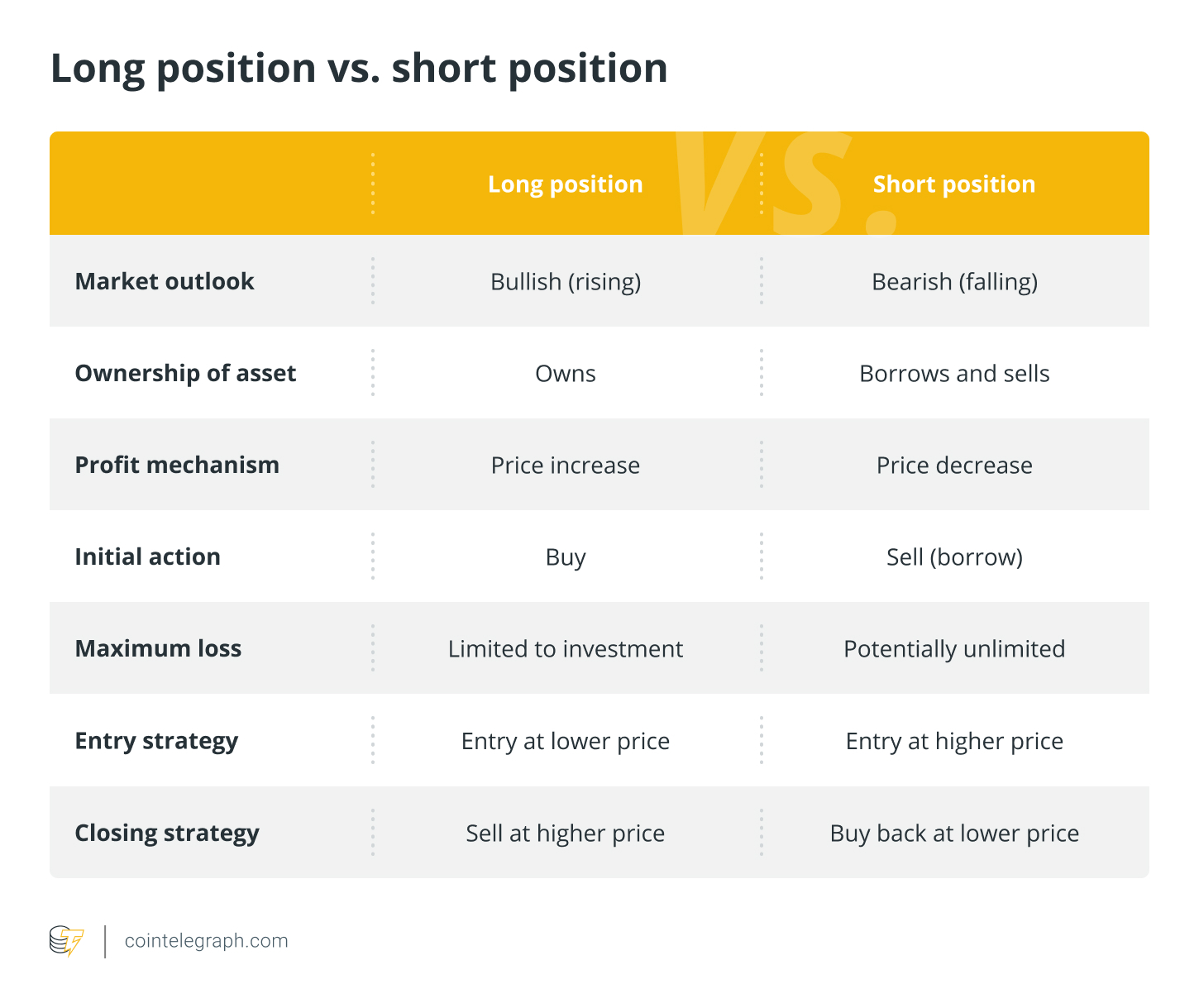
Long positions hold more chances for success, as profit has no limit since the asset’s price can rise constantly.
With short positions, profit is limited, as the price can fall to zero.
For example, a long position on BTC has virtually endless profit, because Bitcoin can rise in price constantly.
However, a short position on a memecoin limits you to earning only until that memecoin’s price falls to zero.
Both strategies contain danger. Long positions face possible loss if a cryptocurrency’s price falls, while short
positions risk damage if prices rise.
Executing Long and Short Crypto Strategies: A Step-by-Step Guide
Prior to making any investments, traders should meticulously assess their chosen cryptocurrency, considering
its foundational technology, current market trends, and historical data.
Steps to adopting a long position in crypto
Here’s a simple breakdown of how to initiate a long crypto strategy:
- Choose a crypto exchange: Identify a reputable cryptocurrency exchange or trading platform that
offers the cryptocurrency you’re interested in. Establish an account, complete the necessary Know Your Customer
(KYC) procedures, and activate two-factor authentication
(2FA) to safeguard your account. - Fund your account: To transact, deposit fiat currency or another cryptocurrency. You can fund
your crypto wallet via bank
transfers or external wallets. - Submit a buy order: Select the cryptocurrency you wish to purchase and place a buy order at the
prevailing market price or set a limit order at a specific price point. - Maintain your position: Stay informed about market movements and hold onto your position until you
realize a profitable gain, making a well-informed decision about whether to sell or hold for an extended
period.
Steps to adopting a short position in crypto
Here’s a simplified guide on how to implement a short crypto strategy:
- Select a cryptocurrency exchange: Seek out platforms that support short-selling and margin
trading. Verify that your account meets the criteria for margin trading eligibility. - Borrow the cryptocurrency: Arrange to borrow the cryptocurrency you intend to short.
- Sell the cryptocurrency: Sell the borrowed cryptocurrency at the current market value.
- Repurchase the cryptocurrency: Once the price has decreased, buy back the cryptocurrency at the
reduced price. - Return the borrowed cryptocurrency: Return the borrowed cryptocurrency amount and retain the
difference as profit.
Margin trading entails borrowing funds to amplify the magnitude of a trading position. While this tactic can
augment potential gains, it also elevates the risk of considerable losses.
To illustrate, using $2,000 of your own funds to short BTC and borrowing an additional $5,000 enables you to short
$7,000 worth of BTC. If BTC’s value declines from $10,000 to $8,000 per coin, you can repurchase 0.7 BTC for
$5,600, yielding a profit of $1,400. Conversely, if BTC surges to $12,000, you’ll need $8,400 to buy back 0.7
BTC, leading to a $1,400 loss. This strategy heightens both potential gains and losses, increasing overall
risk.
Strategic Approaches: Long and Short-Position Crypto Trading
Profiting from trades like memecoins, altcoins, BTC and other trades are achieved using strategies of long and
short positions.
Market sentiments influence investors’ attitudes and expectations regarding cryptocurrencies. Positive sentiments
often lead to rising prices, while negative sentiments tend to depress prices.
Explore common strategies employed by seasoned crypto investors when trading major cryptocurrencies such as BTC and
ETH:
- Leveraged Positions: Use borrowed funds to increase an investment’s scale. This can amplify both
gains and losses. - Futures Trading: Involves contracts to buy or sell a cryptocurrency at a fixed price on a future
date. It serves both speculative and protective purposes against price fluctuations. - Hedging: Involves positions designed to mitigate potential losses in investments. For example, a
long-term Ether investor might short Ether futures to safeguard against short-term price declines. - Options: Derivative contracts that
grant the holder the right, but not the obligation, to buy or sell a cryptocurrency at a predetermined price
before a specific expiration date. Options serve as tools for hedging against price movements or speculating on
future price changes.
Adopting long or short positions in memecoins or altcoins follows the same principles as major cryptocurrencies like
Bitcoin but necessitates a keen awareness of each asset’s distinct characteristics and market dynamics.
Some commonly employed strategies in memecoin trading encompass:
- Trend Following: Assuming long positions in upward trends and short positions in downward trends.
- Offset: Expecting prices to revert to their mean after significant movements.
- Arbitrage: Capitalizing on price discrepancies across various decentralized and centralized
exchanges.
Comprehending these concepts and strategies enhances your capacity to make informed decisions in the cryptocurrency
market, balancing potential rewards with the inherent risks involved.
Examining the Risks: Long and Short Trading in Crypto
Both long and short trading come with risks. Understanding them before trading is key.
Long Trading Risks:
- Price Drops: Crypto may change a lot, and money can be lost if price declines.
- Liquidation: Loss of investments may occur if a borrowed sum is used, and price declines too
much. - Tied-Up Capital: Trading binds your money. If assets don’t increase in price, other choices may
be missed.
Short Trading Risks:
- Unlimited Losses: Prices may rise with no limit, increasing the losses.
- Margin Calls: Payment needed to maintain position if price rises.
- Extra Costs: Additional fees and interest may reduce profits or increase losses.
- Surprise Market Moves: Market changes and good news make exiting position hard.
Given the risks and crypto market nature, research carefully, understand market dynamics, and only invest affordably.