
Key Points
Google is entering the blockchain arena with a new Layer-1 network designed for financial markets, a move that some industry observers believe could challenge Ethereum’s dominance. However, major players like Stripe, Tether, and Circle are also exploring similar blockchain initiatives.
Tech giant Google has revealed its Google Cloud Universal Ledger (GCUL), a blockchain L1 network focused on payment infrastructure. This development has ignited discussions about the potential impact on Ethereum’s [ETH] position in the evolving landscape of stablecoins and tokenization. The GCUL chain is promoted as a fast and cost-effective solution for stablecoins, diverse payment methods, and applications within capital markets.
The market response has been immediate, with many considering this a possible challenge to Ethereum’s current leading role as the preferred settlement layer for future financial markets.
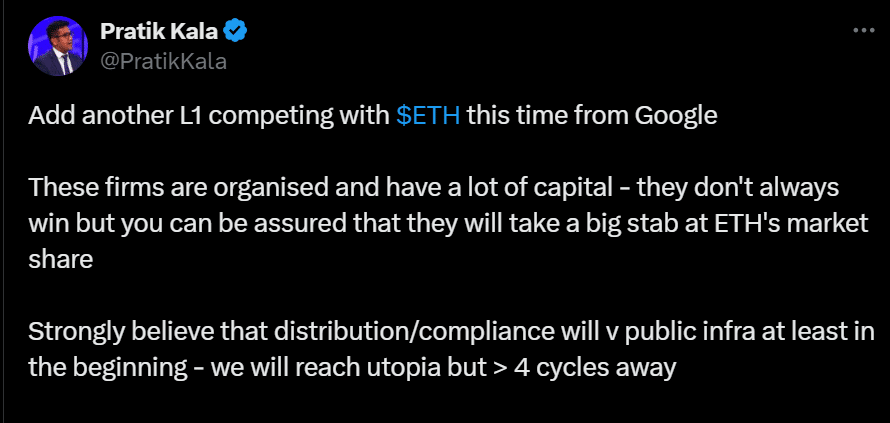
Pratik Kala, Head of Research at Apollo Crypto, suggests this development increases pressure on Ethereum from other companies like Stripe, Circle, and Tether who are also exploring the potential of their own blockchain networks.
“These well-funded and organized firms might not always succeed, but they will undoubtedly make significant attempts to capture Ethereum’s market share.”
Could Ethereum’s Market Position Be Threatened?
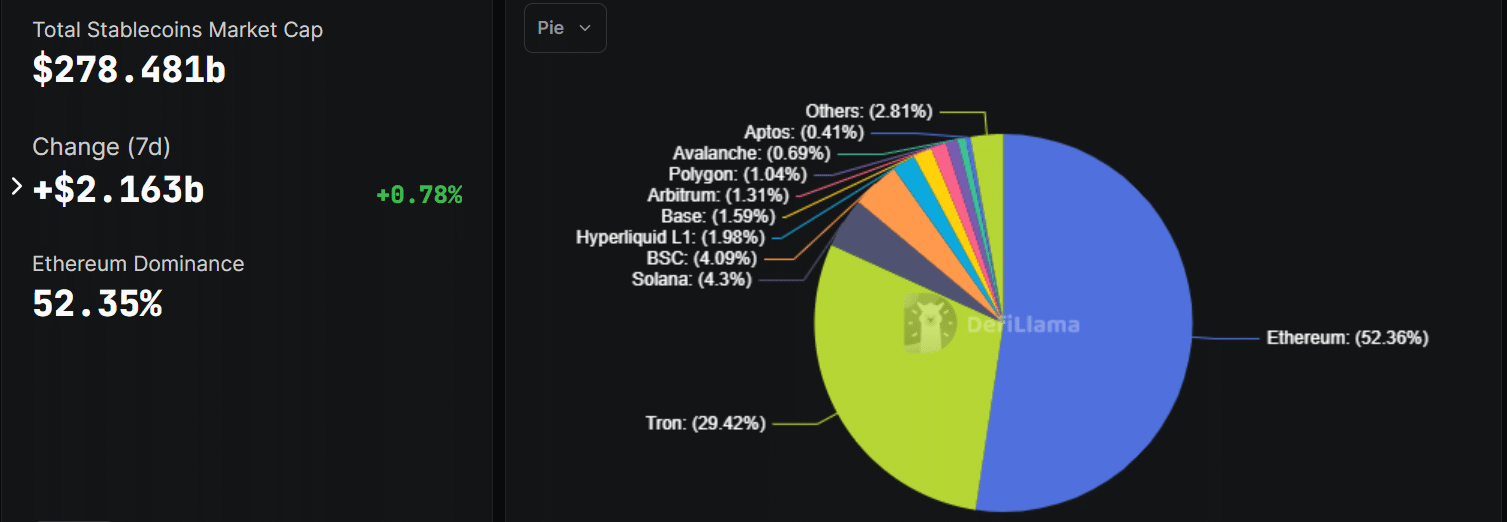
As of August 2025, Ethereum held a substantial 52% share of total stablecoin settlements, equating to over $145 billion, according to data provided by DeFiLlama.
Tron [TRX] held the second-largest position, capturing a 29% market share with approximately $82 billion in stablecoin settlements.
Source: DeFiLlama
Solana [SOL] and BNB Chain closely competed for third place, each holding approximately $11 billion or a 4% market share.
This data confirms Ethereum’s strong lead in the stablecoin settlement arena at the time this article was written.
This dominance is a driving force behind the revitalized Ethereum treasury initiatives, with participants like BitMine aiming to benefit from the anticipated surge in stablecoin adoption that is expected to favor ETH.
Beyond stablecoins, the industry anticipates a growing movement of stocks and other real-world assets onto blockchain platforms, and Google’s latest move indicates they are strategically positioning themselves to capitalize on this trend.
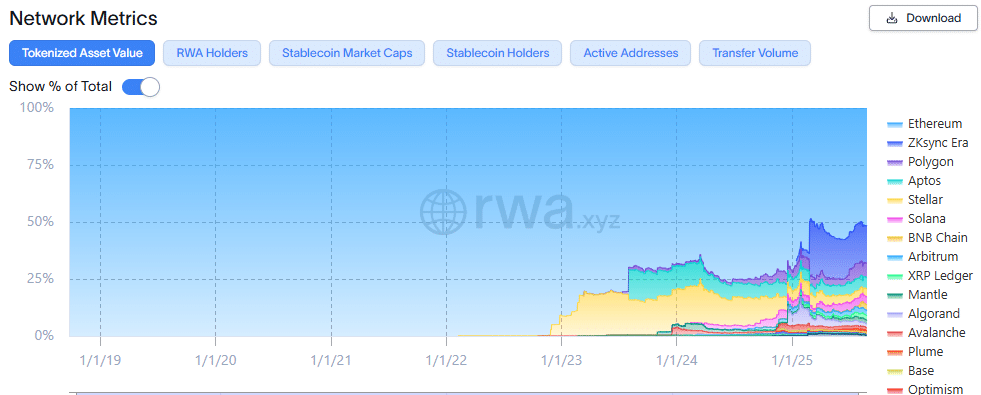
Data from RWA indicates that Ethereum also leads in the tokenized market segment, holding a 52% share valued at over $7 billion, as of 2025.
Source: RWA
Paxos product manager, Chuk Okpalugo, offered a contrasting view, minimizing the potential impact of Google’s new chain on Ethereum, stating that it will operate as a ‘permissioned’ network and will be incompatible with stablecoins.
“It is primarily a private, permissioned payments network designed for tokenized commercial bank deposits, promoting the adoption of deposits on its network rather than relying on stablecoins.”
Despite Okpalugo’s perspective, Kala’s warning remains relevant, given the trend of major stablecoin issuers pushing to develop their independent blockchain networks.
Google’s blockchain is currently in a private testnet phase, with a public launch expected in the coming months.
Concurrently, Standard Chartered has forecasted that the price of ETH could reach $7,500 by the end of 2025, viewing the recent market correction as an opportune entry point for investors.
The bank identifies the expanding crypto treasury trend as a significant factor driving this projection.