
The latest edition of Crypto for Advisors features insights from Samantha Bohbot, a partner and chief growth officer at RockawayX. Bohbot offers a comprehensive overview of decentralized finance (DeFi), highlighting the distinct roles of Bitcoin, Ethereum, and Solana within the DeFi ecosystem.
Additionally, in the “Ask an Expert” segment, Kevin Tam provides expert commentary on institutional investment trends in crypto ETFs, spotlighting significant global developments.
Webinar Announcement: Mark your calendars for September 9th at 11:00am ET! Join Michelle Noyes from AIMA and Andy Baehr from CoinDesk Indices for a discussion on building a robust and sustainable crypto business amidst market fluctuations. Register now: https://aima-org.zoom.us/webinar/register/4917558078322/WN_3jAGIrqMTK2z7e74q5bkWg#/registration
Event Announcement: CoinDesk presents Policy & Regulation, a conference in Washington D.C. on September 10th. The event features leading figures from the SEC, Treasury, House, Senate, and OCC, alongside exclusive roundtables and unparalleled networking prospects. Use code COINDESK15 for a 15% discount on registration. Details available at: http://go.coindesk.com/4oV08AA.
Beyond Bitcoin: Exploring Ethereum, Solana, and On-Chain Economies
While Bitcoin remains a central topic in the cryptocurrency world as the dominant digital asset, the evolving crypto market offers numerous attractive avenues for investors.
Beyond Bitcoin, blockchain technology supports diverse applications that engage users globally, generate substantial revenue, and showcase impressive growth.
Integrating Global Finance On-Chain
Tokenized real-world assets (RWAs) represent the creation and trading of traditional assets, such as stocks, bonds, commodities, and alternative investments, on blockchain platforms. This approach brings significant benefits, including near-instantaneous trade settlement, broader accessibility for participants worldwide (subject to issuer policies), and enhanced transaction transparency, facilitating easier tracking and automation.
Currently, nearly $300 billion in assets are tokenized and active on-chain. Boston Consulting Group projects the market to reach $600 billion by year-end and expand to $19 trillion by 2030. Recent RWA implementations highlight the transformative potential of blockchains for conventional markets.
Blockchains act as marketplaces bridging traditional assets with on-chain applications and exhibit typical marketplace dynamics, where issuers seek platforms with active user bases, and users gravitate toward platforms offering innovative products.
Ethereum served as the initial platform. Stablecoins like USDC and USDT debuted on Ethereum, establishing its dominance in tokenized dollars and the largest share of RWA value today.
Solana is a major contender for RWA activity, and recent launches illustrate the potential of blockchains to quickly reshape established markets. Kamino Finance, a top Solana lending platform, allows users to borrow against xStocks, tokenized stocks of companies like Apple and Tesla. Since xStocks became available across blockchains on June 30, Solana has accounted for approximately 93% of the daily trading volume.
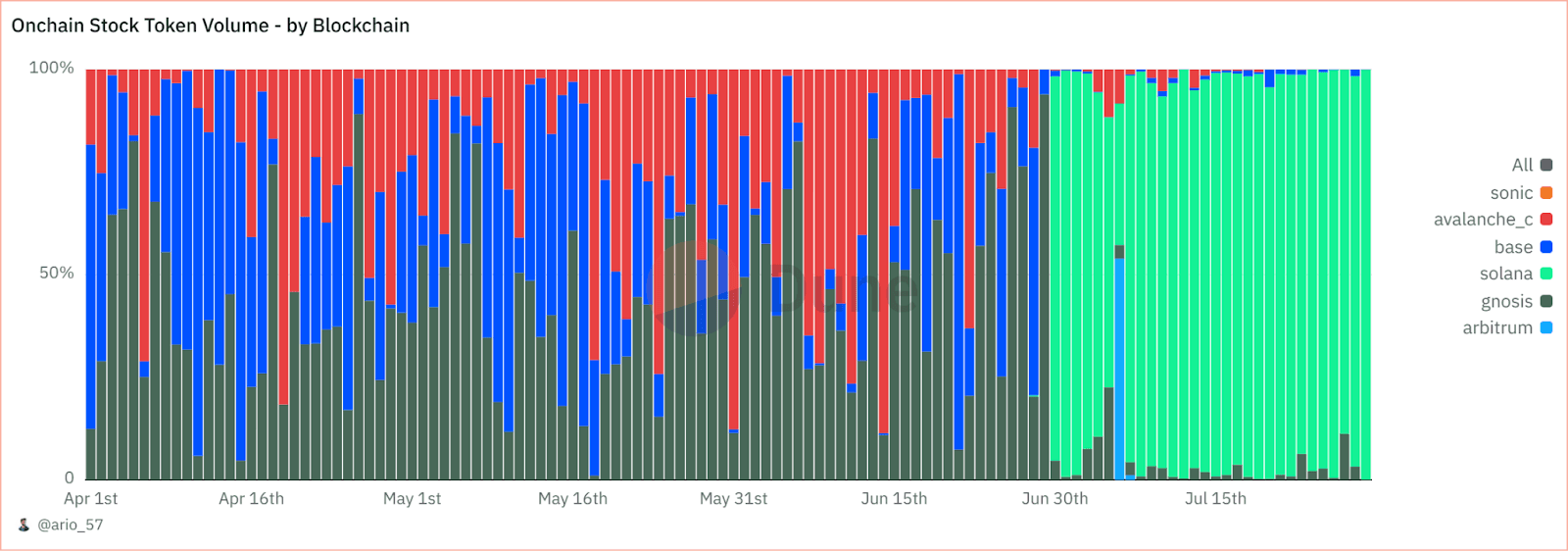
On-chain stock token volume by blockchain | Source: Dune Analytics
Solana’s leading position in global developer activity and active user base (more than double that of its nearest competitor) gives it a competitive advantage in attracting asset issuers. Successful onboarding and the unveiling of new on-chain products will further solidify this activity.
More broadly, DeFi continues to evolve, featuring more varied on-chain products and offerings designed for institutional investors. Builders create products that combine stablecoins, RWAs, and yield generation to appeal to varying risk profiles of sophisticated portfolios.
Ethereum currently leads with over $94 billion in total value locked (TVL) and thousands of protocols. While its deep liquidity is an advantage, the DeFi space encompasses more than just TVL.
The total value locked (TVL) in Solana’s DeFi protocols recently exceeded $10 billion. Indicating authentic and valuable use, Solana’s applications generate more on-chain fee revenue collectively than all other blockchains. Thanks to its high speed and low costs, Solana is establishing itself as DeFi’s active trading center, frequently surpassing Ethereum in decentralized exchange (DEX) trading volumes.
Beyond Bitcoin’s role as “digital gold,” both Ethereum and Solana have become essential digital infrastructures, each offering unique advantages.
Ethereum is the original open-source computer, the foundation for decentralized application coding and the launchpad for foundational institutional ventures.
Solana is gaining momentum in DeFi and stands as the most actively used blockchain. Its a hub for innovative DeFi products. Like Ethereum’s native ETH token, Solana’s SOL token offers exposure to the entire ecosystem, eliminating the need for investors to choose specific application winners and allowing them to participate in overall growth.
The long-term success of both Ethereum and Solana hinges on hosting applications that deliver tangible value and ultimately revolutionize traditional financial systems. If they can achieve this, current prices may prove to be attractive entry points for investors.
– Samantha Bohbot, partner and chief growth officer, RockawayX
Ask an Expert
Q. After a year of institutional investment in crypto ETFs, how are Canadian banks and pension funds approaching Bitcoin?
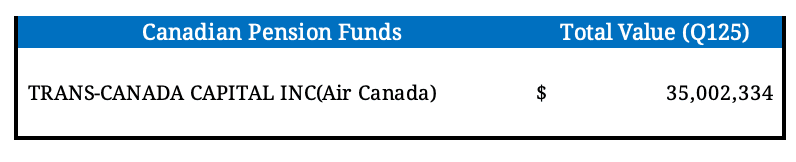
A. Recent 13F filings reveal that Trans-Canada Capital, based in Montreal, has made significant investments in digital assets. As one of the largest corporate pension plans in Canada, it manages pension assets for Air Canada. The pension fund has allocated $55 million to a spot bitcoin ETF.
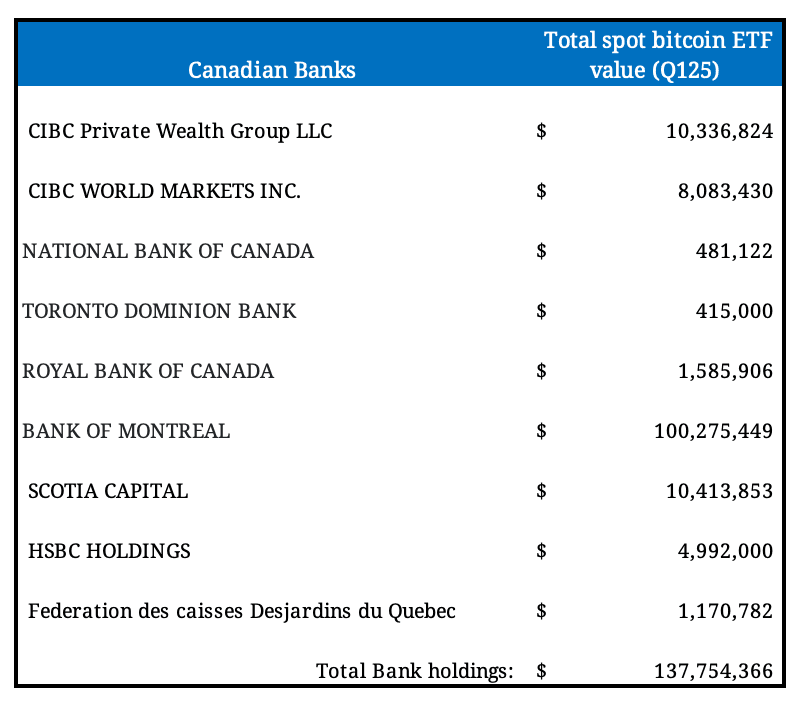
Institutional adoption of Bitcoin has accelerated over the past year, fueled by clearer regulations, the introduction of spot ETFs, and increasing recognition of Bitcoin as a strategic asset. Schedule 1 banks in Canada hold over $139 million in bitcoin exchange-traded funds, reflecting growing institutional interest and long-term investment strategies.
Q. How might institutional accumulation impact Bitcoin’s market dynamics?
A. Last year, ETFs purchased about 500,000 bitcoin, while the Bitcoin network generated 164,250 new bitcoin through its proof-of-work system. This indicates that ETF demand alone was three times the supply. Further, public and private companies acquired 250,000 bitcoins. As governments explore including bitcoin in their strategic reserves, more entities are considering adding bitcoin to their corporate holdings.
Q. How will the Financial Conduct Authority (FCA)’s approval of retail access to crypto ETNs in the U.K. accelerate retail and institutional acceptance?
A. This is a landmark moment for crypto products targeting the retail market and represents a significant change in the U.K.’s regulatory position on digital assets. This decision reverses the FCA’s 2020 ban on crypto exchange-traded notes. ETNs will be required to trade on an FCA-approved exchange. The U.K. is adapting its strategy toward crypto as the government aims to stimulate economic growth and support the digital asset sector. This move sends a positive message to institutional investors, indicating that the U.K. is becoming a competitive force in the global crypto arena.
– Kevin Tam, digital asset research specialist