

The desire to become a millionaire quickly has been a driving force since the dawn of currency. From historical market crazes to modern cryptocurrency booms, many investments have promised instant riches. However, when balancing risk and potential reward, a more measured investment approach might prove more effective.
While precisely timing the market is often seen as crucial, it’s notoriously difficult to achieve. A more conservative, yet demonstrably effective, investing method is dollar-cost averaging (DCA).
DCA involves investing a consistent dollar amount into an asset at regular intervals over a set period. This strategy aims to lessen the impact of market volatility by spreading out purchase orders. Buying at both lower and higher prices, it becomes especially appealing for assets known for their price swings, like Bitcoin (BTC).
DCA into Bitcoin generates significant returns
Investing $50 each week, totaling $200 monthly, in Bitcoin starting in July 2019 would have yielded impressive results, reaching a 345.9% return by January 2024. An initial investment of just over $13,000 would have grown to a total value of approximately $58,193.
In contrast, investing in gold during the same period would have produced a more modest 24.9% return, while the Dow Jones Industrial Average (DJI) would have generated returns less than 1% higher than gold.
Apple stock saw a significant 64.4% increase across that same timeline, resulting in a total DCA strategy value of $21,400.
It’s important to acknowledge that Bitcoin’s price volatility has been significantly higher compared to more traditional asset classes. For example, between 2020 and 2021, Bitcoin’s closing price climbed to $46,387 by December 31, 2021, a remarkable 543.1% surge.
However, this rapid climb was followed by a sharp downturn, falling by over 65% from November 2021 to November 2022, highlighting the dramatic price swings often seen in the cryptocurrency market.
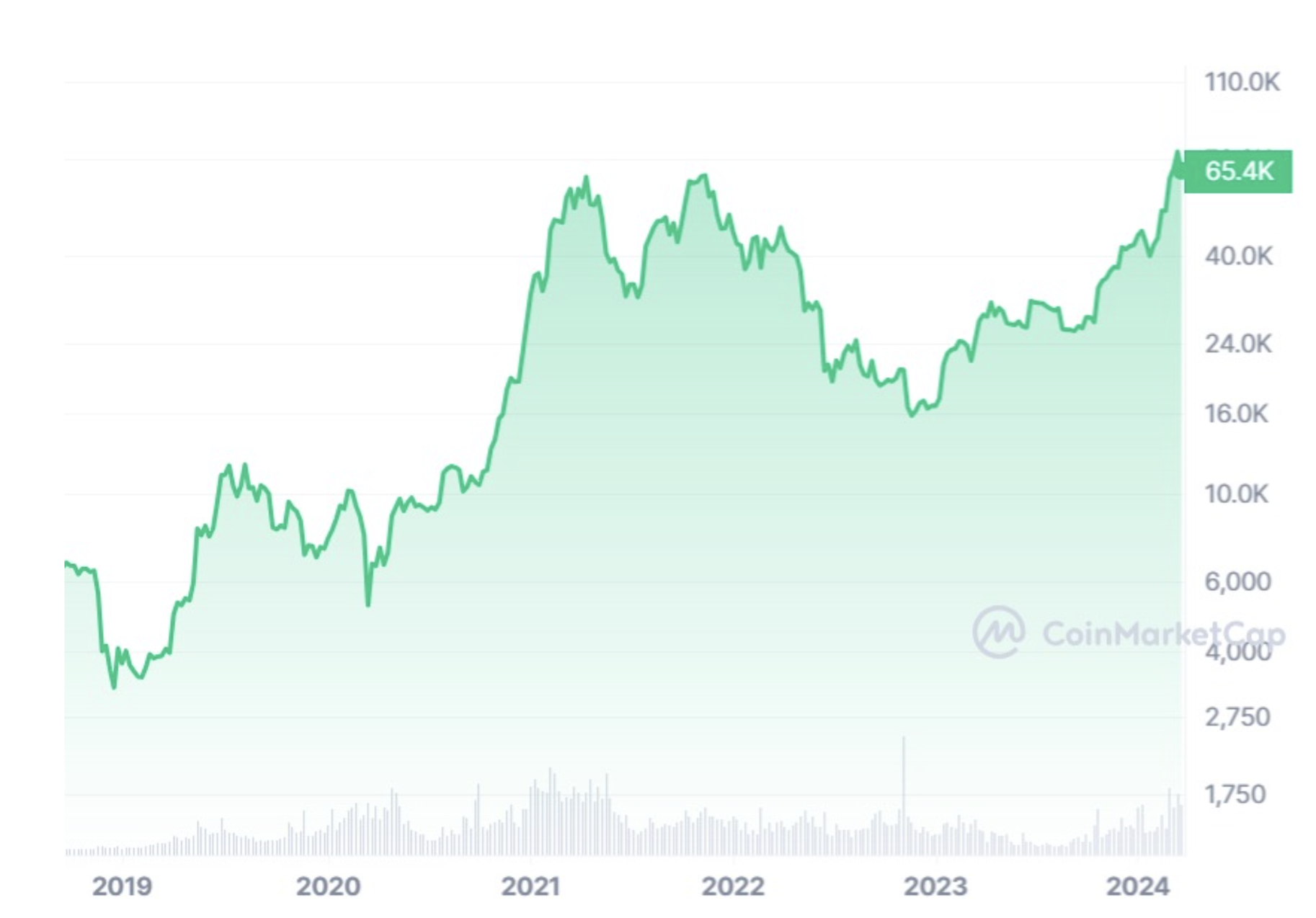
Bitcoin’s volatile nature, along with its unpredictable recovery patterns, may have made it difficult for investors to maintain their positions during that time. While DCA can be a beneficial strategy, it relies greatly on the investor’s confidence in the long-term potential of the asset they’ve chosen.
DCA: A more manageable path to accumulating BTC
Dollar-cost averaging is potentially well-suited for investors new to the field, and seeking to diversify portfolios and navigate the often turbulent landscape of cryptocurrency investment. By consistently investing a fixed amount, such as $50 weekly, irrespective of current market conditions, investors can distribute their purchases over time more effectively.
This strategy reduces the impact of rapid price changes, allowing investors to potentially benefit from the asset’s long-term growth. As stated by CoinShares chairman Daniel Masters, in comments to Cointelegraph:
“Given annualized volatility estimates around 75%, we can expect BTC’s price trajectory to feature numerous short-term peaks and valleys. Dollar-cost averaging is a low-stress approach to building a position that reflects a variety of short-term market dynamics, including both undervalued and overvalued periods, while minimizing the risk associated with concentrating investments at a single point in time.”
For those new to investment, DCA provides a simple and straightforward entry point. Rather than attempting to perfectly time market entry with a large, single investment – a daunting and inherently risky proposition – DCA enables investors to gradually build their holdings over time.
The best Bitcoin investment approach largely depends on an individual’s tolerance for risk, however DCA can be a great way to accumulate BTC during the next period of increasing prices.
This article is for informational purposes only and does not constitute financial advice. Investing involves risk, and readers should conduct their own thorough research before making any investment decisions.