

The following is a contributed piece and analysis provided by Vincent Maliepaard, Head of Marketing at Sentora.
The year 2025 has proven pivotal for
XRP, showcasing both significant value increases and fundamental changes to its overall purpose. In July, the digital asset achieved a record valuation of $3.58, partly fueled by key legal victories. Beyond just price movements, Ripple’s introduction of the RLUSD stablecoin has seen notable adoption, and the XRP network is now heavily investing in broadening its presence within the decentralized finance (DeFi) sphere.
XRP’s substantial progress was initially enabled when the SEC ended its legal case against Ripple. This removed considerable regulatory obstacles which had dampened institutional interest for an extended period. This legal outcome, combined with the Trump administration’s supportive cryptocurrency policies, including the GENIUS Act, acted as a catalyst for a wider market rally across the digital asset landscape.
The token has also gained due to a calculated reappraisal as large institutional investors shifted funds toward previously overlooked, large-cap cryptocurrencies. These investors recognized XRP as a legitimate foundation for capital, rather than merely a speculative trading asset.
This viewpoint was strengthened by Ripple’s launch of the RLUSD stablecoin in late 2024. The coin rapidly grew to a $600 million market capitalization, demonstrating practical utility in driving further acceptance. Ecosystem growth has been further supported with the introduction of the XRPL EVM sidechain, boosting cross-chain compatibility and smart contract capabilities. Anticipation is also growing regarding the potential approval of an XRP ETF, which could further boost institutional adoption.
Let’s examine XRP’s expansion, the increasing activity, key figures within the XRP landscape, and its DeFi advancements.
XRP’s Growth and Momentum
Analysis of XRP ownership reveals a well-established institutional ownership structure, mirroring traditional financial assets. The top 10 wallets control roughly 41% of the circulating supply, expanding to 50% among the top 20 holders and exceeding 70% within the top 100. This concentration suggests significant institutional allocation rather than retail speculation, solidifying XRP’s shift into an institutional-grade asset.
The cryptocurrency’s transformation from an underperformer in previous cycles to a favored asset was substantially validated by Coinbase’s integration. In July, the exchange launched cbXRP, a wrapped token supported 1:1 by XRP, specifically designed for cross-chain use. This infrastructural development quickly unlocked novel uses, with Moonwell becoming the leading DeFi platform to support cbXRP. This enables platform users to lend and borrow the wrapped token within Moonwell’s ecosystem.
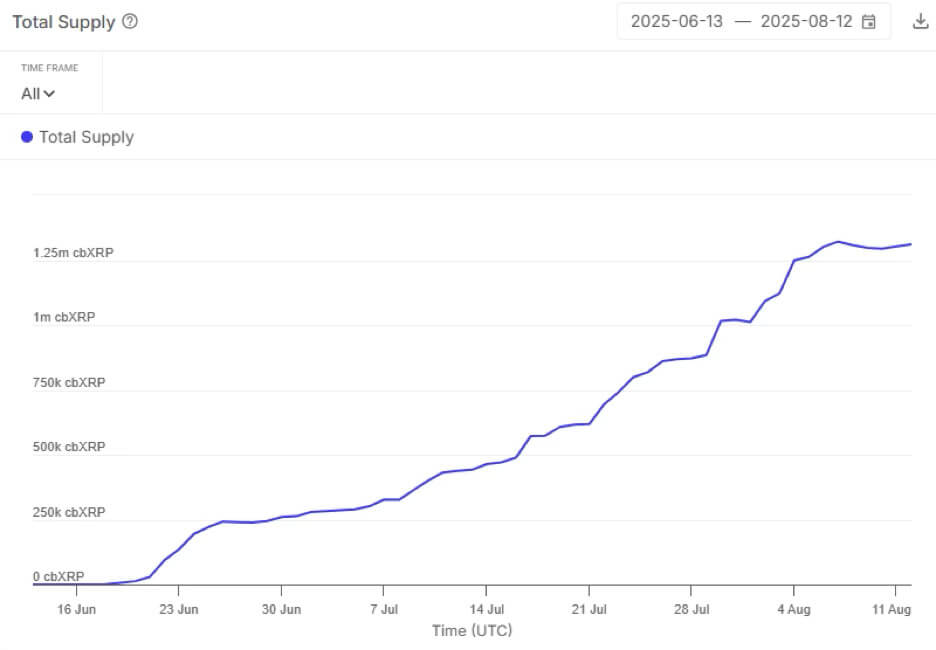
The growth of cbXRP on Moonwell has been consistent, gradually increasing to over $1.2 million in liquidity since its launch in June. While this figure is less than the multi-billion dollar figures frequently associated with XRP, it represents a significant step in XRP’s DeFi integrations.

These advancements highlight a fundamental change in how major exchanges and DeFi protocols view XRP, shifting beyond basic trading options. The combined factors of high institutional ownership, improved technical infrastructure through wrapped tokens, and growing lending markets indicates XRP’s increasing adoption as capital increasingly acknowledges its functionality for cross-border transactions and as an institutional-grade digital asset.
Expanding into DeFi
The move of XRP into decentralized finance is a natural evolution for a blockchain which, according to Gabriel Halm of
Sentora, has “successfully cemented itself as a digital payment network,” making DeFi integration “an intuitive progression towards developing a full financial ecosystem for XRP.” This growth addresses a vital gap in XRP’s functionality, as the token historically lacked essential DeFi components.
Flare Network
has emerged as a key infrastructure provider for XRPFi, with the introduction of
FAssets
— which will allow XRP holders to convert tokens to FXRP, a wrapped variant of XRP. This operates through a non-custodial, secure framework which utilizes smart contracts for cross-chain verification.
Upcoming Yield Opportunities for XRP in DeFi
While users can currently gain a modest yield (around 0.1%) by providing cbXRP on Moonwell, significantly higher returns could be available with the anticipated launch of the
Firelight Protocol
on Flare.
Firelight seeks to bring e
conomic security and yield generation
to the XRP ecosystem, similar to how EigenLayer has boosted staking yield for Ether. By employing staked XRP for economic security, Firelight’s framework may enable innovative DeFi applications—such as
on-chain insurance
—that were previously unachievable.
As Hugo Philion, Co-Founder of Flare Network, stated:
“Firelight offers on-chain XRP yield opportunities for both institutions and retail holders, improving capital efficiency for XRP and further boosting its utility.”
Looking Ahead
XRP’s narrative is changing from simple short-term price fluctuations to deep long-term progress. The combination of legal clarity, institutional adoption, and DeFi expansion, driven by platforms like Base, Moonwell, Flare, and Firelight, expands XRP’s use and potentially positions it as a yield-generating asset.
While it might not yet dominate in DeFi, these developments have the potential to strengthen XRP’s role as a connector between traditional finance and emerging on-chain opportunities.