
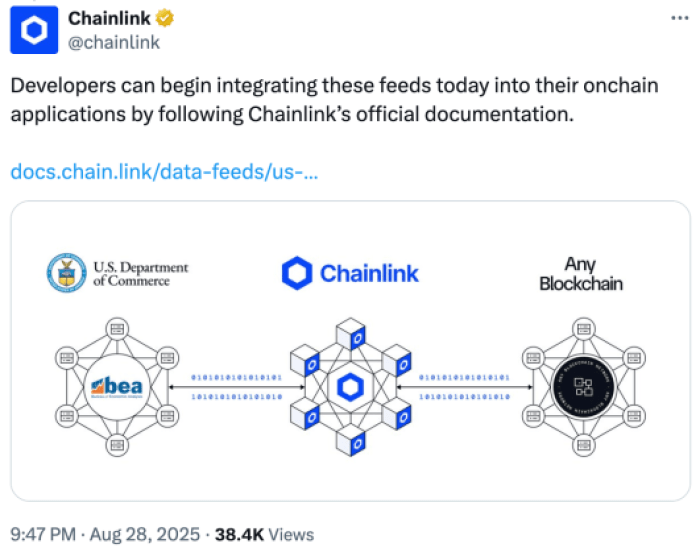
In a significant move, the United States government has broadened its involvement in Decentralized Finance (DeFi) by making key economic indicators accessible directly on blockchains. This initiative involves a collaboration with Pyth and Chainlink, leading providers of oracle services.
This development underscores the increasing acceptance of blockchain solutions and marks a progression in the evolution of the cryptocurrency sector.
Simultaneously, as digital currencies gain wider appeal and network traffic intensifies, efforts to develop Layer-2 (L2) blockchain technologies are accelerating to alleviate bottlenecks and improve transaction speeds.
One such project, Bitcoin Hyper ($HYPER), is poised to create a streamlined experience within the Bitcoin network, enabling rapid and cost-effective transactions. Its ongoing pre-sale has already garnered considerable attention, attracting over $12.6 million in investment.
Transforming Crypto with On-Chain Economic Data
The U.S. Department of Commerce recently made macroeconomic datasets available across ten distinct blockchain platforms, including Bitcoin, Ethereum, and Solana. This was made possible through partnerships with Pyth and Chainlink, two prominent oracle networks.
Both Pyth and Chainlink announced this collaboration through their official channels, including websites and social media.
The data now available on-chain includes annual percentage changes for:
- Gross Domestic Product (GDP) level,
- Personal Consumption Expenditures (PCE) Price Index level,
- Real Final Sales to Private Domestic Purchasers level.
Blockchains, by their nature, operate within isolated digital ecosystems. Oracles like Pyth and Chainlink bridge this gap, securely and verifiably supplying external information to these networks.
By feeding real-world data, such as the aforementioned U.S. macroeconomic indicators, into blockchains, these oracles enable advanced applications, including the creation of automated trading systems responsive to inflation levels.
The U.S. government’s decision to publish macroeconomic data on-chain has the potential to significantly impact market dynamics, empowering traders to react more effectively to economic signals and refine their investment strategies.
This initiative represents another key moment in the evolution of blockchain technology. Now that a solid foundation is in place, there is growing opportunity for projects focusing on enhancing efficiency, security, and overall capabilities within the blockchain ecosystem.
Bitcoin Hyper ($HYPER) represents this wave of innovation within the crypto space. This project is building a Layer-2 solution to scale Bitcoin, the widely popular cryptocurrency.
Bitcoin Hyper ($HYPER): Spearheading the Future of Bitcoin
Bitcoin Hyper ($HYPER) aims to improve upon existing blockchain technology.
While the Bitcoin blockchain excels in security, it faces challenges related to transaction speed and cost. Bitcoin Hyper’s Layer-2 aims to alleviate these by serving as a high-speed pathway for Bitcoin transactions, improving upon the limitations of the Bitcoin Layer-1.
Furthermore, the L2 can potentially broaden Bitcoin’s utility in ways that were not feasible before. For example, Bitcoin has limited programmability when compared with platforms like Ethereum and Solana.
Hyper introduces smart modifications, such as Solana Virtual Machine (SVM) integration, to bridge the technological differences between existing and modern blockchain technologies.
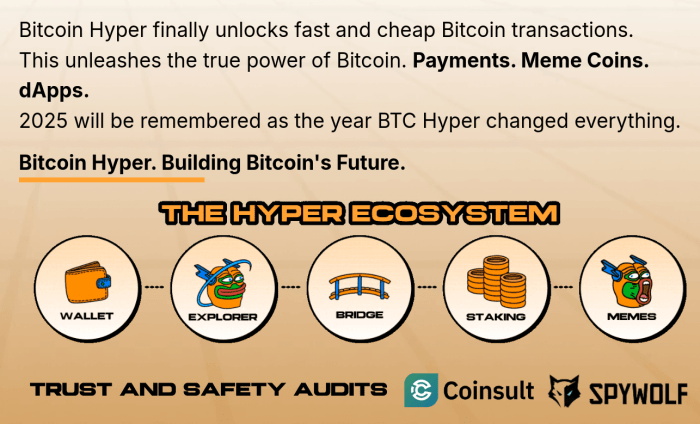
The Bitcoin Hyper ecosystem comprises three core elements: the Bitcoin L1, the SVM-powered Hyper L2, and a canonical bridge.
Here’s an overview of how they function together:
- First, users deposit $BTC into an address managed by the Hyper canonical bridge.
- This action automatically mints wrapped $BTC ($wBTC) for cross-chain usage on the Hyper L2.
- The value of $wBTC is continuously synchronized between the L1 and L2.
- On the L2, users can utilize their $wBTC to engage with decentralized applications (dApps) and DeFi protocols.
- To transfer $BTC back to the L1, users simply withdraw it to their Bitcoin wallet address.
Transactions on the L2 benefit from the speed and cost-efficiency of the Solana Virtual Machine.
If you are looking for more details, the “What is Bitcoin Hyper” page provides additional details on the project roadmap, audits, tokenomics, and overall assessment of the project’s legitimacy.
Visit the Bitcoin Hyper official website here.
Bitcoin Hyper’s Pre-Sale: Surpassing $12.6 Million
The Bitcoin Hyper team is conducting a pre-sale of its $HYPER token to support its development efforts.
The pre-sale has already raised over $12.6 million, positioning it as a top performer among pre-sales in 2025.
Offered at $0.012825, the token grants access to network gas, on-chain features, and governance rights after the L2 launch.
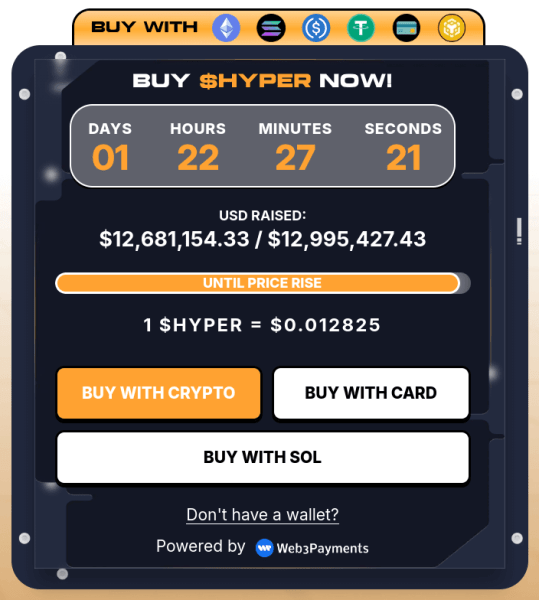
Early participants can also stake their tokens during the pre-sale period for an 88% APY.
According to Bitcoin Hyper price predictions, $HYPER could potentially reach $0.32 by the end of 2025, which would be a 2395% increase over its current pre-sale price.
Buying tokens is straightforward, with Bitcoin Hyper accepting credit/debit cards, and cryptocurrency. Refer to the “How to Buy Bitcoin Hyper” guide for step-by-step instructions.
Participate in the Bitcoin Hyper pre-sale today.
The Future of Crypto is Here
The increased adoption of blockchain technology by the U.S. government indicates a new era for the cryptocurrency economy. Making macroeconomic data available on-chain has the potential to revolutionize trading strategies and access to data.
Similarly, Bitcoin Hyper ($HYPER) aims to reshape how Bitcoin is utilized.
$HYPER offers lasting utility through staking rewards, gas fees, and participation in governance. Its Layer-2 capabilities also unlocks applications that were not previously possible for Bitcoin’s Layer-1, giving the token high-growth potential in 2025 and beyond.
Disclaimer: This is not financial advice. Conduct thorough research, and remember that the crypto market is inherently high-risk.
Disclaimer: For information purposes only. Past performance is not indicative of future results.