

Reason to trust
<div class="trust__content">
  <div class="trust__list">
    <div class="trust__list-item">
      <svg xmlns="http://www.w3.org/2000/svg" width="12" height="12" viewbox="0 0 12 12" fill="currentColor" class="trust__list-item-icon"><path d="M10.2492 0.703125L4.75078 7.95234L1.5 4.70391L0 6.20391L4.99922 11.2031L12 2.20312L10.2492 0.703125Z"/></svg>
      <p>Strict editorial policy that focuses on accuracy, relevance, and impartiality</p>
    </div>

    <div class="trust__list-item">
      <svg xmlns="http://www.w3.org/2000/svg" width="12" height="12" viewbox="0 0 12 12" fill="currentColor" class="trust__list-item-icon"><path d="M10.2492 0.703125L4.75078 7.95234L1.5 4.70391L0 6.20391L4.99922 11.2031L12 2.20312L10.2492 0.703125Z"/></svg>

      <p>Created by industry experts and meticulously reviewed</p>
    </div>

    <div class="trust__list-item">
      <svg xmlns="http://www.w3.org/2000/svg" width="12" height="12" viewbox="0 0 12 12" fill="currentColor" class="trust__list-item-icon"><path d="M10.2492 0.703125L4.75078 7.95234L1.5 4.70391L0 6.20391L4.99922 11.2031L12 2.20312L10.2492 0.703125Z"/></svg>

      <p>The highest standards in reporting and publishing</p>
    </div>
  </div>

  <div class="trust__accordion">
    <div class="trust__accordion-item">
      <div class="trust__accordion-item-content">
        <p>Strict editorial policy that focuses on accuracy, relevance, and impartiality</p>
      </div>
    </div>

    <div class="trust__accordion-item">
      <div class="trust__accordion-item-content">
        <p>Morbi pretium leo et nisl aliquam mollis. Quisque arcu lorem, ultricies quis pellentesque nec, ullamcorper eu odio.</p>
      </div>
    </div>
  </div>
</div>
Joseph Lubin, Ethereum’s co-creator and the CEO of ConsenSys, sparked significant discussion about ETH on August 30th by sharing a detailed vision. His argument centers on the idea that major financial institutions will eventually shift their fundamental operations to the Ethereum blockchain. Lubin projects that ETH could see a “100x” increase from its current value, ultimately surpassing Bitcoin’s monetary base.
Lubin expressed full agreement with Tom @fundstrat’s analysis, laying out a future where prominent financial entities engage in staking, operate validators, and manage Layer 2 and Layer 3 solutions. These firms, according to Lubin, will also gain exposure to DeFi and develop smart contract software for various agreements, processes, and financial tools.
Related Reading
He specifically named JPMorgan as a bank that has been heavily involved with Ethereum technology since “2014-2015.” Lubin remarked, “My only disagreement with Tom’s perspective is that he isn’t bullish enough… The truth is, it’s impossible to be *too* bullish.”
Lubin’s Vision for Ethereum’s Future
Lubin also addressed a common concern regarding scaling limitations, asserting that “the idea of Layer 2 solutions taking away from Layer 1’s value will soon be disproven.” He highlighted ConsenSys’ Linea network and the recently announced “Proof-of-Burn” initiative as examples of collaborative efforts that could bolster Ethereum’s underlying economic framework rather than weakening it.
The second part of Lubin’s outlook focused on transforming Ethereum’s burn mechanism into a tradable asset called BETH, which was introduced last week by the Ethereum Community Foundation (ECF). In subsequent posts, Lubin encouraged the Ethereum community to explore all the implications of tokenizing and specifically accounting for burned ETH. He even suggested an experimental incentive: “Would you be willing to burn a small amount of ETH for a feature on [@BanklessHQ]? … Would some of you send some BETH to @BanklessHQ?” Beyond these publicity ideas, he outlined possible uses for governance and creating demand: “Will BETH become more valuable as it gains influence and voting rights in different areas?”
The ECF’s BETH design utilizes an unchangeable ERC-20 token that is minted at a 1:1 ratio when ETH is verifiably burned. The smart contract sends ETH to the designated burn address and then creates BETH for the depositor. The total supply of BETH equals the total amount of burned ETH and it has no admin keys or path for redemption back into ETH. As such, burning ETH, rather than creating it, produces a new asset aligned with scarcity. The reference implementation and contract address have been made public by ECF, along with an explanatory blog post.
Related Reading
Lubin then speculated about the potential for derivative layers built on top of BETH—”BBETH, BBBETH, etc.”—as context-specific assets. He drew a parallel to the early “colored coins” on Bitcoin, but with a key difference: these “shades of BETH” would operate natively within Ethereum’s token standards and infrastructure. This would eliminate the need for off-chain recognition that hindered the first-generation experiments. Lubin wrote that one could consider [BBETH/BBBETH] as a more sophisticated element of ‘cracked ETH’ and more scarce… suggesting games and other environments with limited resources as potential testbeds.
The near-term market outlook came from Fundstrat’s Tom Lee, whose recent public remarks have been notably positive regarding Ethereum’s institutional growth. Lee believes that Wall Street’s operational infrastructure is migrating to blockchains, that ETFs and staking provide compliant investment options, and that Ethereum could be the “biggest macro trade over the next ten to fifteen years.” Lubin noted that he and Lee “occasionally speak” to align strategy in areas of common interest, while “competing in highly differentiated ways.”
At the time of reporting, ETH was trading around $4,399.
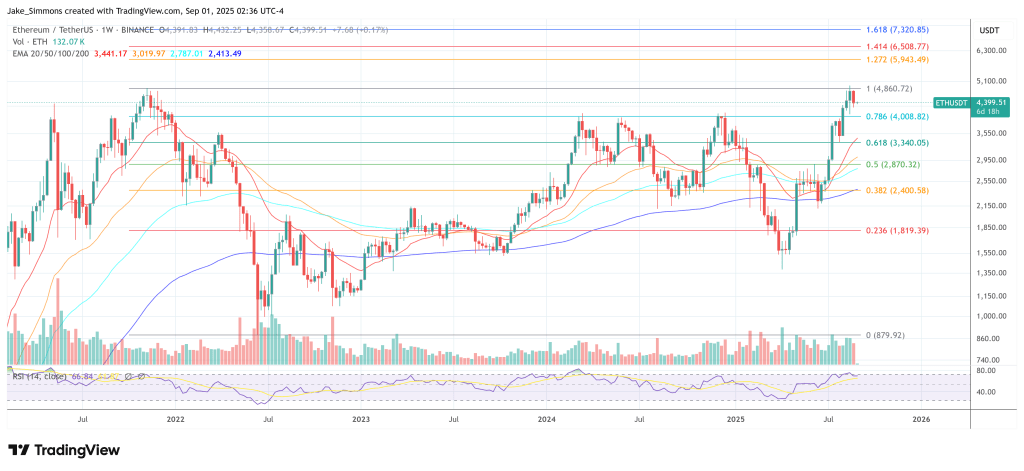
Featured image created with DALL.E, chart from TradingView.com