

Disclaimer: This content is provided by a third-party source and is for informational purposes only. Readers are advised to conduct their own due diligence before making any decisions based on this information.
The frenzy surrounding meme cryptocurrencies may be experiencing a slowdown. The intense, carefree atmosphere observed earlier in the year is diminishing, suggesting that hype alone may no longer be sufficient to sustain these digital assets.
Despite a general decrease in trading activity, a specific project is gaining significant traction. Pepenode (PEPENODE), a newly launched meme coin, has successfully secured $500,000 during its pre-sale phase, demonstrating considerable interest from retail investors.
What sets this crypto apart is its distinctiveness in offering more than just a token featuring a humorous amphibian mascot. Pepenode includes an engaging system that provides its community with tangible activities, marking a shift from solely relying on speculation, potentially contributing to its long-term viability.
Unlocking Pepenode’s “Mine-to-Earn” Mechanics
The term “crypto mining” might bring to mind images of noisy, costly computer setups. However, Pepenode operates entirely virtually, removing the necessity for any such investments.
By participating in Pepenode, investors become “managers” of a virtual production facility, focused solely on generating more crypto. Owners use their PEPENODE tokens to acquire and manage various virtual Miner Nodes in their facility. These Nodes, in turn, create token-based rewards.
The core gameplay involves strategically placing these Nodes to optimize output. This clever, user-friendly process is garnering attention from analysts such as Jacob Bury, who has drawn comparisons between PEPENODE and the original PEPE token and suggested the potential for tenfold growth.
The platform includes a burning mechanism where a portion of the tokens used for upgrades is permanently removed from circulation. This mechanism is designed to create scarcity and potentially drive PEPENODE’s value over time as engagement and construction increase.
PEPENODE’s Successful $500K Presale Launch
Presales are about gaining early access, and Pepenode’s has been crafted with fairness in mind. No preferential deals are offered to venture capitalists or insiders, giving all participants equal initial terms.
The project’s successful raise of over $500,000 reflects the appeal of its Mine-to-Earn system, especially in the current market conditions. With a price increase approaching in less than a day, there is a limited window to secure PEPENODE tokens at $0.0010366 each.
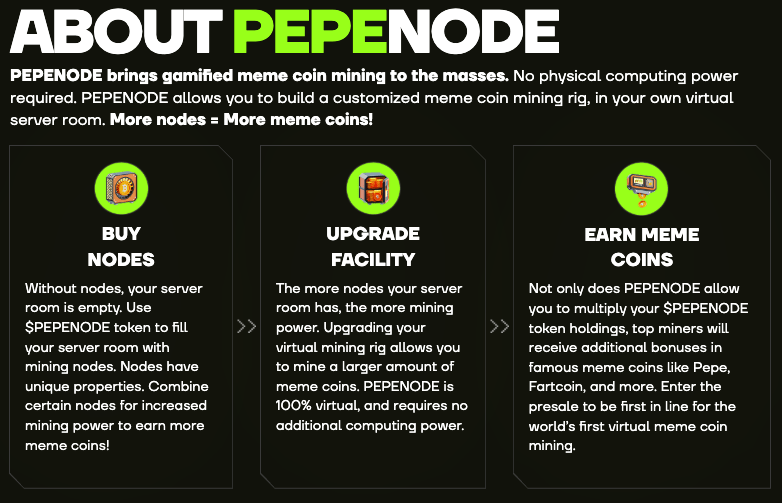
Token holders can immediately begin mining after purchase. All progress made and nodes set up will be retained. Launch day can be met with an optimized setup, ready to produce tokens.
Furthermore, there’s an attractive staking initiative for early participants, offering a current annual yield of 3,187%, which has drawn over 247 million PEPENODE tokens.
Is PEPENODE a Top Crypto Investment in September?
The Achilles’ heel of many meme coins is their dependency on buzz. Initial excitement driven by launches on exchanges often wanes, and reliance on social media causes booms to turn into busts.
Pepenode aims to differentiate itself. The Mine-to-Earn setup gives users an ongoing incentive to actively participate. There’s also the added benefit of being able to share strategic tips or compete on leaderboards.
This approach transforms the PEPENODE token into a functional asset instead of just a speculative one. The game itself creates ongoing demand.
This can provide a more stable base if the market experiences instability. The switch from “hoping” to “actively building” is a key factor to Pepenode’s success so far.
Disclaimer: This platform presents this article’s content as is, offering no express or implied guarantees. We are not liable for inaccuracies or omissions. Furthermore, we bear no responsibility for the reliability, completeness, legality, or any other aspect of the provided information. Address any concerns, copyright issues, or complaints regarding the article to the specified content provider.