

Key Insights:
-
Analysis of Bitcoin’s On-Chain Cost Basis indicates stronger buyer sentiment compared to Ethereum’s weaker buying activity.
-
Netflow data from leading exchanges like Coinbase and Binance suggests a potential shift toward renewed accumulation of Bitcoin.
-
For a confirmed uptrend, Bitcoin needs to surpass $113,650; failure to do so could lead to a price decline toward $100,000.
The Bitcoin (BTC) market is displaying indications of a possible upward surge. Data from Glassnode reveals a notable difference in the Cost Basis Distribution (CBD) between BTC and Ether (ETH). The CBD is an on-chain metric showing price points with significant buying or selling activity. Bitcoin’s spot market reveals more frequent trading within recent price ranges, while ETH activity is less dense.
This high activity may indicate strong buyer confidence. Historically, this type of support has proven more reliable than momentum driven by futures trading.
Exchange transaction patterns reinforce this analysis. A CryptoQuant analysis highlights a marked increase in net inflows on Coinbase between August 25th and 31st, following the 30-day SMA reaching its lowest point since early 2023. Such sharp recoveries from prolonged lows often suggest a change in the liquidity environment, driven by settlement changes or increasing activity.
Concurrently, Binance’s 30-day SMA netflow peaked on July 25th and August 25th, reaching its highest level since July 2024. Historically, such levels have aligned with phases of renewed accumulation before the rise of new local highs.
The combined low point on Coinbase and high point on Binance indicates a potential redistribution of Bitcoin reserves, potentially creating favorable conditions for price increases.
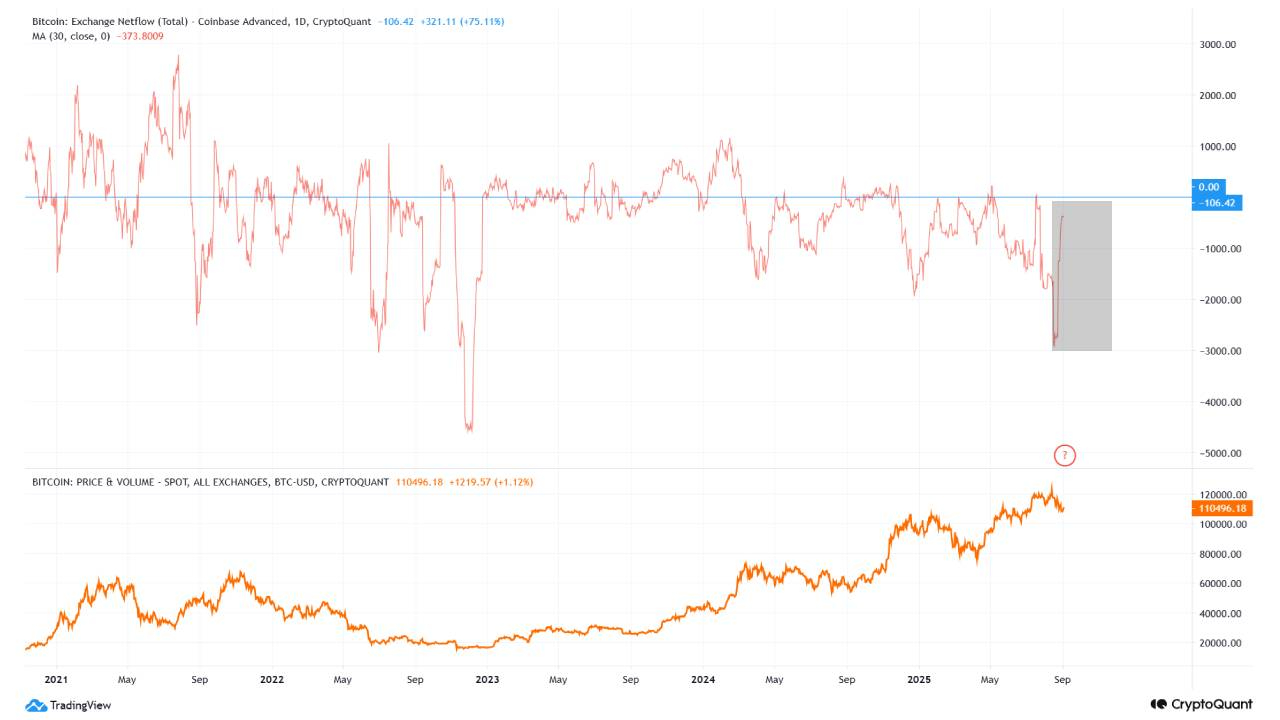
Increased spending or profit-taking by long-term Bitcoin holders (LTH) has also intensified recently, as reflected in the rising 14-day SMA. However, this activity remains within typical cyclical ranges and significantly below the peaks observed in October-November 2024, suggesting controlled distribution rather than aggressive selling.
Related: How High Could Bitcoin Climb as Gold Reaches New Highs Above $3.5K?
Bitcoin Targets Key Breakout Point at $113,600
Bitcoin (BTC) demonstrated resilience this week, recovering from a low of $107,300 on Monday. This price closely aligns with Bitcoin’s short-term realized price, indicating possible price support. Bitcoin rebounded strongly from this low, surpassing Monday’s high of $109,900 during Tuesday’s New York trading session.
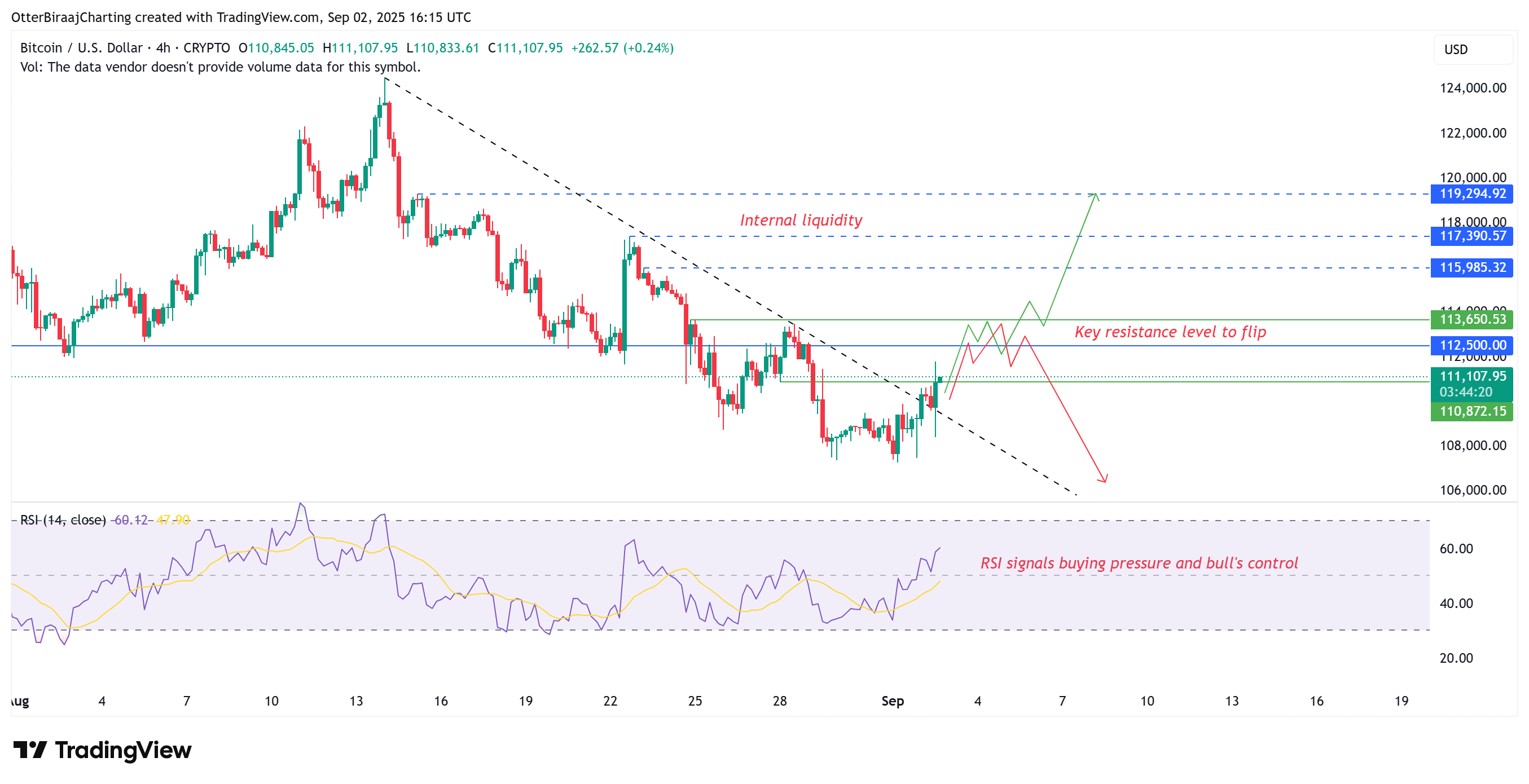
This movement follows a two-week correction period, with shorter timeframes (15-minute and 1-hour charts) showing bullish indicators. On the 4-hour chart, the relative strength index (RSI) has moved above 50, further strengthening the bullish outlook.
For the recovery to persist, Bitcoin must overcome immediate resistance levels between $112,500 and $113,650. A sustained close above $113,650 would confirm a bullish change in market structure on the daily chart and invalidate the downward trendline that has limited price increases over the past two weeks. This breakthrough could pave the way toward liquidity targets at $116,300, $117,500, and potentially $119,500.
However, traders should exercise caution due to September’s historical tendency toward bearish market conditions. A failed breakout or continued weakness below $113,650 would leave BTC vulnerable, potentially leading to a decline towards the order block between $105,000 and $100,000.
Related: Bitcoin Bulls Push Toward $112K as Gold Sets New Record Highs
This article is for informational purposes only and does not constitute financial advice. Trading and investing involve substantial risk, and readers should consult with a qualified financial advisor before making any decisions.