

While many cryptocurrency traders meticulously analyze charts filled with Fibonacci sequences and Bollinger Bands, an increasing number are exploring the potential of crypto astrology to forecast price movements.
The “psychic services” sector, which includes astrology and similar practices, is a substantial $2.2 billion market in the United States alone. Projections indicate it could grow into a $22.8 billion industry by 2031.
A recent study by the Pew Research Center, surveying 9,593 adults in the U.S., revealed that about 28% consulted astrology at least once during 2024. Furthermore, social media platforms are awash with individuals who assert their capacity to tap into a “higher consciousness” for success in both the stock and crypto markets.
However, crypto astrology does face skepticism.
Craig Cobb, a seasoned crypto day trader and technical analyst, stated he would never consider using astrology for trading decisions.
“I would absolutely never base a trade on astrology or lunar phases,” Cobb said, preferring to spend his time fishing during a full moon.
“Ever since markets existed, people have sought ways to profit, from technical analysis to astrology, fundamental analysis, you name it,” Cobb added, whose livelihood depends on technical analysis-based strategies.
Despite the skepticism, some traders believe in its potential. Can astrology and other divinatory methods truly predict crypto prices or offer valuable insights to inform trading strategies?
Crypto Astrologers Believe So
The moon’s gravitational force influences ocean tides, and astrology expands on this notion, suggesting the positions of celestial bodies like planets and stars cause energy shifts that affect human behaviour.
Since financial markets, including cryptocurrency markets, are shaped by billions of individuals with diverse emotions, needs, and aspirations, proponents believe financial astrology can effectively forecast market changes.
Crypto Damus, a prominent figure in crypto astrology with a substantial following on X, claimed to have accurately forecasted Bitcoin’s three major peaks in 2024 and the subsequent summer sell-off, solely by observing planetary alignments.
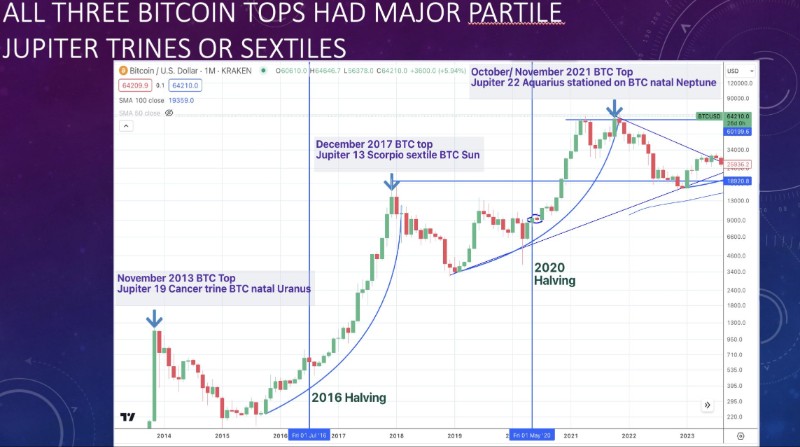
More recently, he stated he predicted the Bitcoin downturn in early 2025 by monitoring Saturn’s position relative to Bitcoin’s birth chart, among other factors.
“Saturn is seen as a serious, fear-inducing planet in financial astrology, indicating bearish market conditions,” Damus explained.
Conversely, Jupiter, the brightest planet representing abundance, can signal market tops.
“It definitely works if you know how to use it.”
While skeptics may dismiss these claims, some evidence suggests a correlation between celestial events and market behavior.
A study from the University of Michigan in 2006 found stock returns were lower around the time of a full moon by 3-5% annually across 48 nations.
Researchers noted that this lunar effect wasn’t influenced by macroeconomic events or global crises, and was unrelated to calendar events like holidays or days of the week.
The researchers acknowledged that the study began with a hypothesis they sought to validate with data, meaning the correlation might be random.


Another study from the University of Portsmouth in 2013 also pointed to a possible link between lunar cycles and market performance.
Damus argues that moon phases are just a fraction of astrology’s potential.
“People acknowledge the moon’s influence on tides, but question the influence of Pluto,” he observes.
“So, it’s not about gravity or measurable forces. It’s something at a quantum physics level, a ‘spooky action at a distance,’ if you will.”
Using Astrology in Crypto Price Prediction
Assuming there’s some validity to astrology, what’s the method for predicting crypto prices?
One technique involves creating a “natal chart” for a particular cryptocurrency.
A natal chart shows the positions of planets and stars at the exact time and location of birth, or in this case, the creation of the coin.
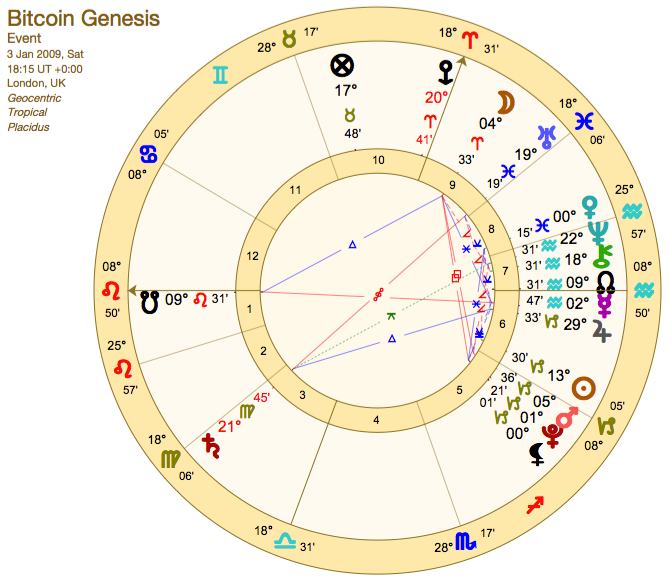
“They might analyze the natal chart from the date a stock went live and track the moving planets,” explains Ralph Hamelmann, a psychic life coach.
For crypto astrology, the natal chart might use the cryptocurrency’s genesis block timestamp (Bitcoin’s is Jan. 3, 2009).
Astrologers use an ephemeris, a tool to calculate the positions of celestial bodies over time, since these positions are generally predictable, explains Hamelmann.
By comparing this data with historical market trends, crypto astrology practitioners aim to find planetary correlations with real-world market events, supposedly revealing whether Bitcoin is entering a boom or a bust.
Is it All Hype?
Skeptics claim there’s no strong evidence suggesting astrology is any more accurate than chance. People have used unusual market prediction methods for years, like tarot cards or AI bots. Remember the crypto-trading hamster?
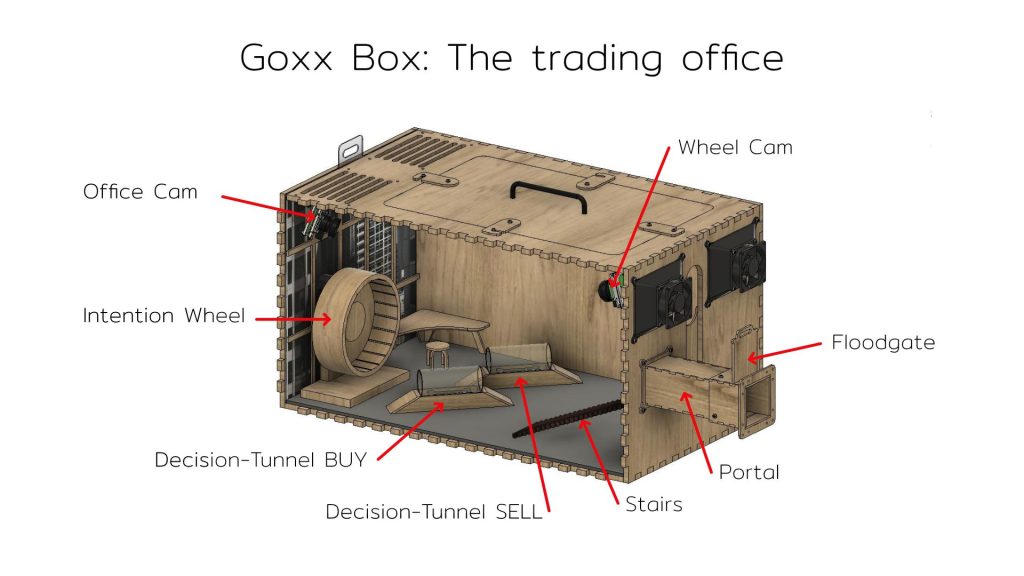
Mr. Goxx, a hamster from Germany, became famous after his crypto trading outperformed the S&P 500 and Warren Buffett in 2021.
The hamster chose which cryptocurrencies to trade by running on his wheel, which selected cryptocurrencies from a pre-set list. He then chose to buy or sell by entering one of two tunnels in his cage, triggering sensors that automatically placed the orders.

Despite his random selection, Mr. Goxx did well, achieving a portfolio growth of 46.6% by September 2021.
One could argue that anyone could appear brilliant during a crypto bull market when everything is rising in value.
Sadly, Mr. Goxx passed away on November 24, 2021, following a five-month trading career. His replacement, Mr. Goxx 2.0, performed worse, with a negative 25.57% return in a few months.
The Ancient Roots of Astrology
Astrology proponents claim it’s a centuries-old practice, with evidence tracing back as far as 3,000 BC.
Crypto Damus concedes that it may seem illogical, but believers are certain of its validity.
“There’s no real rational explanation for why astrology works.”
Damus claims planetary alignments’ relationship to real-world events stem from “meaningful coincidences” outside cause and effect – drawing on the Swiss psychiatrist Carl Jung’s concept of “synchronicity.”
“It’s not a coincidence. Seemingly unrelated events are meaningfully connected on a deeper mystical level,” he explains.
Read also
However, the absence of a clear cause-and-effect relationship leads many to reject the idea outright, he says.
“They dismiss it as nonsense, which is unfortunate. You don’t ‘believe’ or ‘not believe’ in astrology. It relies on empirical data: watching planetary positions and Earth events.”
“The correlations are happening, whether you notice them or not. Astrological configurations and their effect are real.”
“The question isn’t belief; it’s whether you’re open-minded enough to explore it yourself. It’s not faith-based like religion; it’s about your curiosity.”
John Pierpont Morgan, the banker, supposedly used astrology, and is rumored to have said, “Millionaires don’t use astrology, billionaires do.” (Though some say the quote is unverified.)
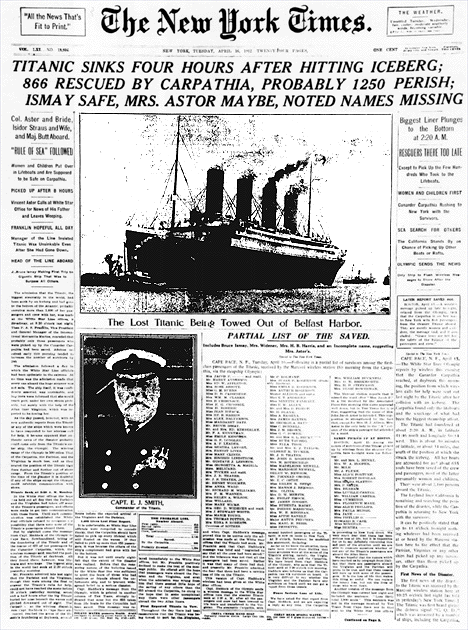
Another rumor claims an astrologer advised Morgan against traveling on the Titanic, giving him an extra year before his death in 1913.
Any Strategy is Better Than None
While technical analyst Cobb doesn’t foresee using astrology, he admits disciplined financial astrologers are likely more successful than the majority of traders.
“This has nothing to do with my opinions about astrology’s validity,” Cobb explains.
“Simply having a disciplined approach to the market gives you a huge edge over those chasing quick wins.”
This echoes Douglas Adams’ idea in “Hitchhiker’s Guide to the Galaxy” that astrology provides a framework for thinking, and could equally involve “ducks and drakes” as planetary orbits.
“It helps define the problem. The more arbitrary and detailed the rules, the better, like sprinkling graphite dust to reveal hidden indentations. The dust is just a tool for revealing underlying patterns.”
Cobb notes the market offers only “buy” or “sell” choices.
“So, how do you pick? You can use technical analysis, astrology, tarot cards, you name it. There are endless ways to approach it.”
“Managing risk is essential to survive in the markets.”
Don’t Bet Everything on Astrology
Crypto Damus cautions that astrology shouldn’t be your sole strategy.
“We don’t rely on only astrology; it’s another technical indicator. We use standard technical analysis too.”
“Fed policies—rate hikes or cuts—might be more relevant than astrology,” he states.
Astrology simply provides additional context, like a “secret ingredient.”
“When technical and astrological signals align, whether bullish or bearish, you gain confidence to increase your stake and risk,” he concludes.
Subscribe
The most engaging reads in blockchain. Delivered once a
week.


Felix Ng
Felix Ng first began writing about the blockchain industry through the lens of a gambling industry journalist and editor in 2015. He has since moved into covering the blockchain space full-time. He is most interested in innovative blockchain technology aimed at solving real-world challenges.
Read also

Binance’s CZ must stay in US, Elon Musk seeks $1B for AI, and other news: Hodler’s Digest, Dec. 3-9
Binance’s CZ will have to wait for his sentencing in the United States, the U.S. Congress passed a bill supporting blockchain, and Elon Musk’s xAI seeks $1 billion in capital.

GBTC drops BTC stake by 21%, Celsius exits bankruptcy, and more: Hodler’s Digest, Jan. 28 – Feb. 3