
Somnia emerges as a cutting-edge blockchain solution, addressing the common
challenges of speed and scaling found in existing networks. It’s engineered
to handle over 400,000 transactions every second, achieving near-instant
finality. Conceived by Improbable, Somnia aspires to seamlessly merge
virtual environments with real-world economics.
This article dives into Somnia, exploring its mechanics, essential
attributes, and practical uses with the SOMO digital token.
What is Somnia?
Somnia isn’t simply another blockchain; it represents a robust network
purpose-built to support real-time, dynamic applications at the internet’s
vast scale. It was crafted to remedy the shortcomings of current blockchain
platforms, particularly concerning transaction velocity and capacity.
Improbable, the innovator behind Somnia, seeks to enable smooth integration
between virtual worlds and the traditional economy, thus establishing a more
connected and productive digital domain.
Source: Somnia Network
The Somnia network provides a wide variety of metrics, including the ability
to process over 400,000 transactions per second with near-instant
confirmation. This positions it as a significant contender in the
blockchain sector, where efficiency and speed are paramount.
Somnia tackles the inherent limitations of current blockchain technology,
ensuring it deals with great transaction volumes efficiently and at a low
cost. Essentially, Somnia desires to be the blockchain that finally
connects virtual and real-world economies.
How Does Somnia Work?
The foundation of Somnia’s superior performance rests on several
technological advances that distinguish it from typical blockchain systems.
Among the most notable features is its unique framework, designed to manage
up to 400,000 transactions per second with rapid finality and minimal
costs.
This architecture uses a blend of MultiStream consensus, compiled bytecode,
and the ICEdb database to achieve unparalleled degrees of efficiency and
scalability.
MultiStream Consensus
Somnia uses a MultiStream consensus model that revolutionizes how
transactions are processed on the blockchain. Key features of this model
include:
-
Validators manage their own independent chains, operating without the need
for constant consensus verification. -
Validators can update transaction data asynchronously, significantly
boosting Somnia’s overall network performance. -
Data from individual validator chains is aggregated into a separate
consensus chain, further enhancing processing efficiency.
Not only does it boost validator efficiency, but also supports parallel
processing, which is crucial for achieving high throughput and sub-second
finality.
In essence, the MultiStream consensus model enables Somnia to process
multiple transaction streams simultaneously, making it a truly
high-performance blockchain.
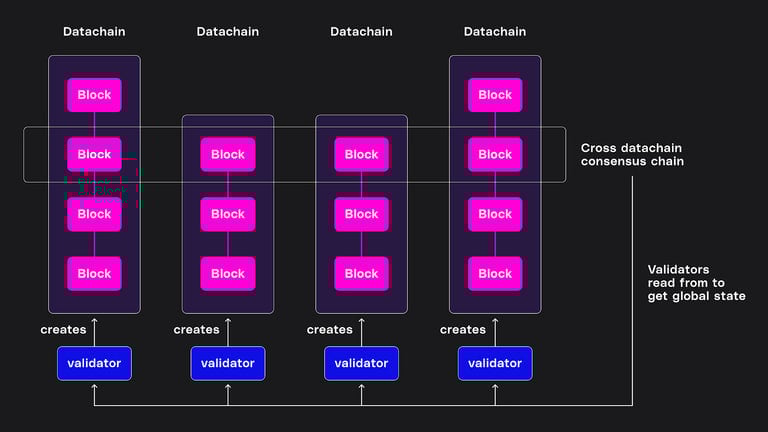
Somnia MultiStream Consensus
Compiled Bytecode
Another key innovation in Somnia’s architecture is the use of compiled
bytecode. Somnia transforms Ethereum Virtual Machine (EVM) bytecode into
highly optimized native CPU code, dramatically enhancing execution speed.
This means that smart contracts on Somnia can run at speeds closer to native
execution, improving efficiency and reducing unnecessary operations.
ICEdb Database
The ICEdb database is another critical component of Somnia’s
high-performance architecture. Key features of ICEdb include:
- Designed specifically for fast read/write operations
- Average read/write times between 15 to 100 nanoseconds
- Optimized for simultaneous read and write tasks
- Significantly speeds up transaction processing
Additionally, ICEdb provides a gas pricing advantage based on actual
resource consumption, making transactions more economical. This dynamic gas
pricing model reflects actual resource usage, ensuring that developers and
users benefit from lower transaction costs.
Key Features of Somnia
Somnia’s architecture is designed to achieve performance levels that
surpass traditional high-performance blockchains, aiming specifically at
real-time consumer applications. The network’s ultra-fast processing and
sub-second finality enable enterprise-grade real-time applications,
achieving execution speeds close to those required for high performance.
Among the key features that contribute to Somnia’s performance are high
throughput and scalability, low transaction fees, and EVM compatibility.
High Throughput and Scalability
One of Somnia’s most impressive capabilities is its high throughput, with
the network able to process over 400,000 transactions per second. Key
points include:
-
During early testing, Somnia achieved transaction processing speeds that
exceeded 400,000 transactions per second. - Handle millions of transactions per second in real-world scenarios.
- The high throughput is made possible by the MultiStream consensus protocol.
-
The MultiStream protocol processes multiple transaction streams in
parallel.
The translation of EVM bytecode into highly optimized native code further
enhances execution speeds, ensuring that the network can scale to meet the
demands of millions of users simultaneously. Scalability is another
cornerstone of Somnia’s design. The network’s architecture allows it to
scale horizontally, adapting to increased demand without compromising
performance.
This ensures that Somnia can maintain top performance and cost efficiency,
even under extreme demand conditions. The combination of high throughput
and blockchain scalability makes Somnia a high-performance blockchain that
is well-suited for mass adoption and real-time applications.
Low Transaction Fees
Somnia’s dynamic pricing model for transaction fees is another key feature
that sets it apart from traditional blockchains, highlighting the difference
in its approach. Key aspects include:
- Implementation of sub-cent fees, making transactions highly cost-effective.
- Dynamic adjustment of fees based on network demand.
-
Incentivization for developers to build scalable applications that can
handle high transaction volumes.
Low transaction fees are designed to attract a wide range of users and
applications, enhancing Somnia’s scalability and performance.
EVM Compatibility
EVM compatibility is a crucial feature for developers looking to migrate
existing Ethereum applications to Somnia. This compatibility allows
developers to easily port their applications without extensive code
rewrites, leveraging tools like Thirdweb to build applications on Somnia.
Supporting all EVM networks allows developers to use familiar frameworks
and tools, ensuring a smooth transition to Somnia’s high-performance
blockchain.
Real-World Applications of Somnia
Somnia’s high-performance infrastructure opens up a world of possibilities
for various real-world applications. The network’s architecture is
optimized for sectors such as gaming, metaverse experiences, and
decentralized finance (DeFi), providing the technological backbone for an
inclusive virtual society.
Whether it’s supporting high-frequency trading or facilitating large-scale
virtual environments, Somnia aims to revolutionize how digital assets and
applications are managed and experienced.

On-Chain Gaming
Somnia is at the forefront of supporting Web3 gaming projects, offering a
robust platform for games that require real-time performance and on-chain
ownership. From dice-based games to AI-driven quiz platforms, Somnia’s
infrastructure handles high transaction volumes and ensures seamless
gameplay.
Metaverse Experiences
The metaverse represents a new frontier in digital interaction, and Somnia
is well-equipped to power these large-scale virtual worlds. The platform
facilitates environments that can accommodate thousands of concurrent users,
enabling seamless transfer of assets, avatars, experiences, and history.
These features are vital for boosting user engagement and providing a
richer, more immersive metaverse experience. By providing the
infrastructure for social platforms and virtual environments, Somnia aims to
become the backbone of the metaverse.
DeFi
Somnia also plays a significant role in the DeFi space, enhancing
applications with high speed and low fees. The network’s on-chain limit
order books provide price discovery and order matching functionalities
similar to those of centralized exchanges, offering a seamless user
experience.
Additionally, volume discounts apply with gas prices decreasing up to 90%
for applications operating at 400+ transactions per second (TPS), making
DeFi operations more economical. This combination of high performance and
cost efficiency positions Somnia as a leading platform for decentralized
finance.
Somnia Ecosystem and Tokenomics
The Somnia ecosystem is built around its native utility token, SOMI, which
serves as the foundation of its economic system. With a total supply of 1
billion tokens, SOMI is allocated across various segments. The role is to
guarantee the network is well-funded and stakeholders are motivated to
deliver to its growth, which brings numerous benefits for its security and
mitigates risk.
Moreover, the economic model includes dynamic gas pricing and a deflationary
token structure, further enhancing the network’s sustainability and
attractiveness.
SOMI Token Allocation
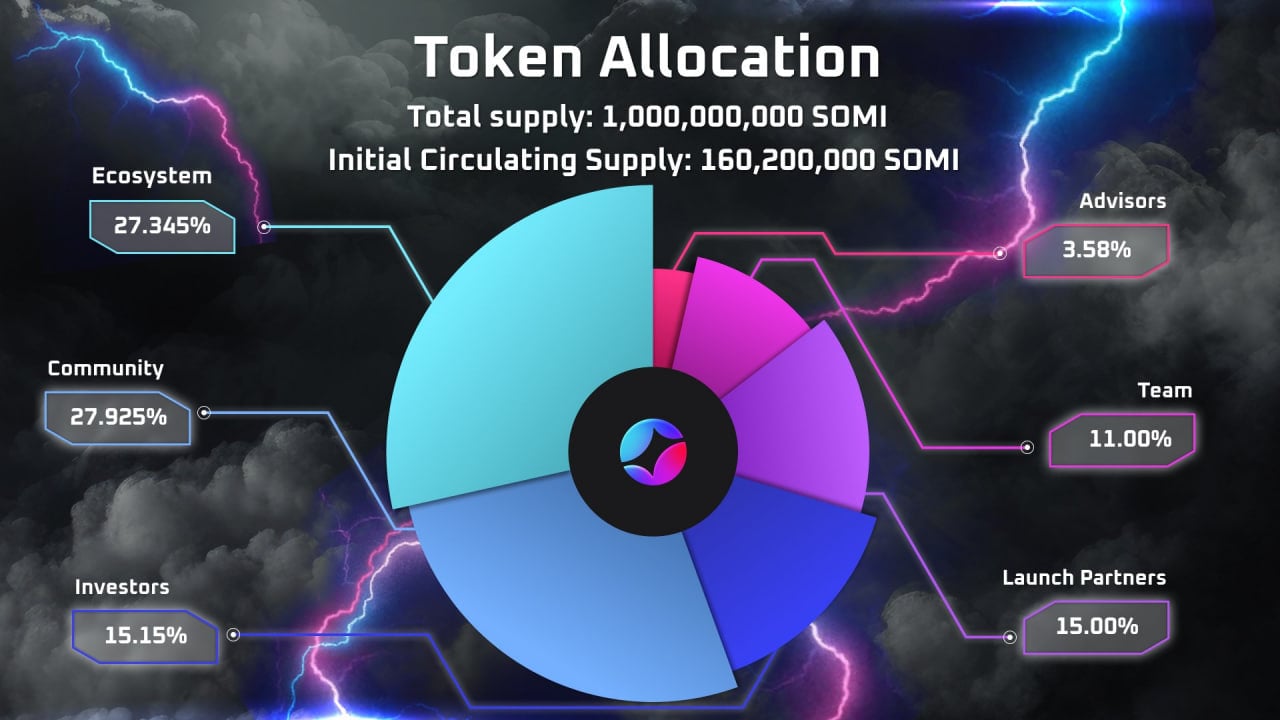
Source: Somnia
SOMI token distribution is designed to support the long-term growth and
stability of the Somnia network. The allocations are as follows:
- Community: 27.925%
- Ecosystem: 27.345%
- Team: 11%
- Advisors: 3.58%
- Launch partners: 15%
- Investors: 15.15%
A 48-month unlock schedule ensures a gradual and controlled release,
supporting community activations, incentive programs, and liquidity to help
maintaining a balanced and sustainable ecosystem.
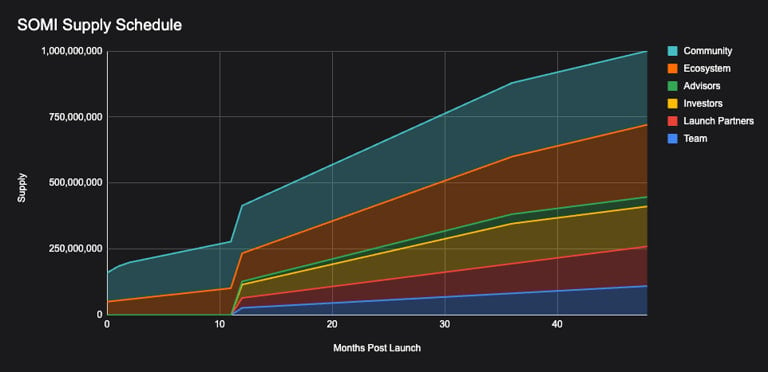
SOMI Token Unlock Schedule
Staking and Network Security
Security is a top priority for the Somnia network, which employs a
delegated proof-of-stake consensus mechanism to ensure robust protection
against attacks. The network launches with 100 globally distributed
validator nodes, enhancing both security and decentralization.
These nodes are carefully selected based on hardware specs that optimize
performance and security, keeping the network robust and efficient. Explain
hardware specs Software optimization Make it simpler.
Governance Participation
Governance within the Somnia ecosystem is designed to be inclusive and
transparent, allowing SOMI holders to influence decisions through a
structured system involving multiple councils and assemblies. This framework
aims to achieve fair decision-making and mitigate dominance by any single
entity, ensuring that the network remains decentralized and community-driven.
Stakeholders are encouraged to participate actively, contributing to the
network’s long-term success and sustainability.
Economic Incentives
Somnia employs a deflationary token model designed to incentivize growth
within the network. SOMI tokens are required for gas fees, with a dynamic
pricing model that adjusts based on network demand. This approach not only
enhances the economic sustainability of the network but also ensures that
users and developers benefit from lower transaction costs and increased
value over time.
Building on Somnia
Building on Somnia is made easy thanks to its full compatibility with
Ethereum development tools. Developers can use familiar frameworks and
tools like Thirdweb to deploy smart contracts on the Somnia network.
Thirdweb provides a comprehensive Web3 development framework that enables
easy connection of apps or games to Somnia, offering functionalities that
enhance the developer experience. This includes deploying smart contracts
efficiently, managing applications, and analyzing performance after
deployment.
The Somnia Playground, introduced during the Betanet phase, allows users to
create virtual spaces and deploy NFTs, further expanding the possibilities
for developers and users alike. This platform provides a sandbox
environment where developers can experiment and innovate, leveraging the
high performance and scalability of the Somnia network.
Offering robust tools and a supportive ecosystem, Somnia seeks to serve a
thriving program community of developers and innovators.
Learn more:
Somnia Network (SOMI) Will be Listed on Binance HODLder Airdrops!
Roadmap and Future Plans
Somnia’s development roadmap is a well-structured journey divided into three
key phases:
-
Bootstrap Phase: Foundational infrastructure is established with control
remaining in the Foundation Board. This phase ensures that the network’s
core functionalities are stable and secure. - Transition Phase: (Details not provided in the input)
- Mature Phase: (Details not provided in the input)
Each phase is designed to progressively establish and enhance the network’s
infrastructure and develop governance to measure effectiveness.
As Somnia progresses into the Transition Phase, governance participation is
introduced, allowing stakeholders to submit proposals and vote on key
decisions. This phase gradually shifts control from the foundation to the
community, fostering greater decentralization.
The Mature Phase focuses on achieving full decentralization, with control
fully delegated to governance groups. Significant milestones include:
- Betanet launch in Q2 2024, showcasing Somnia’s capabilities
- Testnet phase in Q1 2025, with over 60 projects onboarded
- Mainnet launch planned for the second half of 2025, marking a major milestone in Somnia’s ambitious journey
Competitive Landscape
In the competitive landscape of high-performance blockchains, Somnia sets itself apart with:
- Superior performance tailored for real-time applications.
- A strategic balance between performance and sufficient decentralization, unlike other blockchains like Solana and Aptos that focus on maximizing decentralization.
- Transaction processing capabilities exceeding 400,000 transactions per second under testing conditions, surpassing its competitors.
Furthermore, Somnia’s complete compatibility with existing Ethereum applications provides a seamless transition for developers. This feature, combined with its high throughput and low latency, makes it an attractive option for mass-consumer applications.
Competing with notable players such as Solana, Aptos, Sui, and various Ethereum Layer 2 solutions, Somnia’s unique combination of performance, compatibility, and economic sustainability positions it as a formidable contender in the blockchain space.
Where to Buy SOMI Tokens
SOMI tokens, the native utility of the Somnia network, are available on major exchanges like Binance, BingX, Bybit, and MEXC. Users can buy SOMI tokens using various payment methods such as credit/debit cards and bank transfers, making it accessible to a broad range of investors.
For enhanced security during trading, enable Two-Factor Authentication (2FA) on your exchange account. The user-friendly trading interfaces on these exchanges feature components like order books and price charts, ensuring a smooth and efficient trading experience.
Summary
Somnia represents a significant leap forward in the blockchain industry, offering a high-performance, scalable, and cost-efficient solution designed to meet the demands of real-time applications. With its unique architecture featuring MultiStream consensus, compiled bytecode, and the ICEdb database, Somnia achieves transaction processing speeds and scalability that surpass traditional blockchains. Its key features, including high throughput, low transaction fees, and EVM compatibility, make it an ideal platform for developers and users alike.
As Somnia continues to evolve, its roadmap and future plans highlight a clear path towards full decentralization and further technological advancements. By offering a robust ecosystem and economic model, including the innovative SOMI tokenomics, Somnia is poised to revolutionize industries ranging from gaming to finance. With its impressive capabilities and ambitious vision, Somnia is set to become a cornerstone in the blockchain ecosystem, driving innovation and real-world applications.
Frequently Asked Questions
What is Somnia?
Somnia is a high-performance blockchain network tailored for real-time, stateful applications, offering low fees and EVM compatibility while efficiently managing high transaction volumes.
How Does Somnia Achieve High Performance?
Somnia achieves high performance through its unique architecture, which includes MultiStream consensus, compiled bytecode, and the ICEdb database for efficient transaction processing. This combination allows for rapid transaction speeds.
What are the Key Features of Somnia?
Somnia offers high throughput and scalability, low transaction fees, and EVM compatibility, facilitating the easy migration of Ethereum applications for developers. These features collectively enhance user experience and operational efficiency.
What are Some Real-world Applications of Somnia?
Somnia has real-world applications in on-chain gaming, metaverse experiences, and decentralized finance (DeFi), offering essential infrastructure for these industries. Its versatility supports the evolution of digital interactions and financial systems.
Where Can I Buy SOMI Tokens?
You can buy SOMI tokens on major cryptocurrency exchanges such as Binance, BingX, Bybit, and MEXC, utilizing various payment methods.
What is Somnia’s X Account?
This is Somnia Official X account.