
Source: Odaily Planet Daily ( @OdailyChina )
Authored by Wenser ( @wenser2010 )
The Securities and Exchange Commission (SEC) and the Commodity Futures Trading Commission (CFTC) of the United States released two joint announcements on September 5th.
One statement indicated a stronger cooperative approach between the two agencies to bolster the advancement of digital assets, decentralized finance (DeFi), prediction markets, perpetual contracts, and portfolio margining. The aim is to improve the attractiveness of the U.S. market through streamlined regulations, bridging existing gaps, extending trading hours, and employing innovative exemptions. The second announcement detailed plans for a joint roundtable discussion on September 29th. Scheduled topics include harmonizing definitions for products and trading venues, simplifying reporting and data standards, refining capital and profitability frameworks, and exploring coordinated innovation waivers leveraging each agency’s existing powers.
As key regulatory bodies within the American financial system, the SEC and CFTC’s collaborative efforts suggest potential shifts in the U.S. crypto regulatory landscape. This article provides a concise examination of these developments and their potential repercussions.
US SEC and CFTC Collaboration: A Drive to Bolster American Capital Markets
Both joint releases from the SEC and CFTC emphasized “ensuring the United States maintains its leadership in global capital markets,” indicating that the primary intention behind this collaborative regulation aligns with the “America First” philosophy. The main impacts of this joint regulatory effort are likely to manifest in the following areas:
1. Opening Doors to Crypto Trading Platforms in the U.S. Market
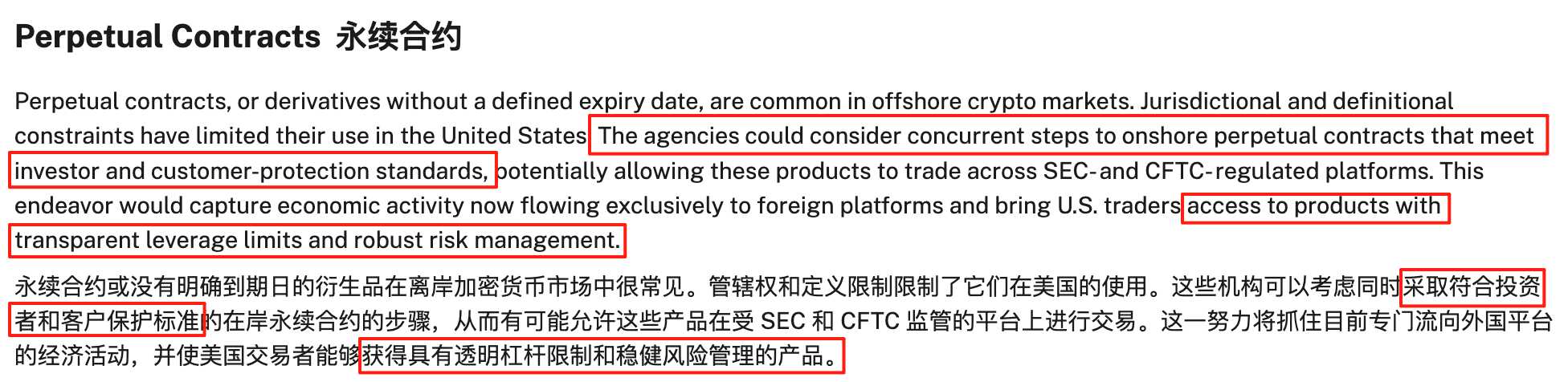
Based on previous reports and the joint statement, the US CFTC is considering issuing guidance clarifying registration processes for international trading platforms. Additionally, the prediction market, Polymarket, has secured CFTC approval to relaunch in the U.S. market. The SEC and CFTC are also considering introducing perpetual swaps in the U.S. market, allowing traders to access products previously primarily available outside the US on local platforms. Furthermore, they intend to examine areas like 24/7 marketplaces, forecasting exchanges, optimized portfolio margins, and innovation exemptions within the DeFi space.
This suggests a departure from previous “closed-door” policies concerning cryptocurrencies. The U.S. government now appears poised to fully open the American market, with a strategy to attract numerous crypto trading platforms to contribute to the U.S. crypto economic system.
2. Attracting Increased International Capital Flow
The CFTC’s initiative to clarify registration for Foreign Boards of Trade (FBOTs) aims not only to draw trading platforms and other industry infrastructure to the U.S. but also to stimulate a significant influx of capital and liquidity from both domestic and international crypto users. This expansion would benefit U.S.-based crypto firms such as Gemini, Kraken, and Coinbase, enabling them to reach a larger global user base and tap into greater liquidity.
As Caroline D. Pham, Acting Chair of the CFTC, has stated, “This represents a chance to ‘bring home’ crypto activities previously redirected overseas because of law enforcement actions during the Biden administration, while reinforcing the regulatory framework established in the 1990s. For U.S. traders, this means greater legal access to worldwide liquidity, and for the crypto industry, it marks a step toward clearer regulations, driven by the Trump administration’s ‘Crypto Sprint Strategy.'”
3. Reducing Regulatory Costs and Enhancing Enforcement Efficiency
Under current U.S. law, the SEC and CFTC both act as financial regulatory bodies, yet their jurisdictions differ. The SEC was established to enforce laws such as the Securities Act of 1933 and the Securities Exchange Act of 1934, focusing on securities markets, investor protection, and disclosure requirements, with penalties ranging from civil fines to injunctions and criminal referrals. Conversely, the CFTC regulates commodity futures and derivatives markets under the Commodity Exchange Act (CEA), emphasizing risk management and anti-manipulation, especially in leveraged trading and high-risk derivatives. This collaboration promises to better define the responsibilities of each agency, lower regulatory expenses, and boost enforcement effectiveness, truly delivering “to each their due.”
4. Promoting Innovation While Strengthening Risk Management
The potential introduction of new policies and favorable measures will likely catalyze innovation among U.S. crypto enterprises. The potential creation of innovation exemptions for 24/7 trading, portfolio margining, and DeFi are particularly promising, as they could inject fresh impetus into DeFi development within the American financial sector. Simultaneously, the agencies have stressed adherence to “investor and customer protection standards,” hinting at future policies that could further bolster risk management and curb market manipulation. In the long run, such measures could reduce the instances of price manipulation and speculation currently prevalent in the crypto market.
Beyond Crypto IPOs: Derivatives Poised to Become the Next Frontier in the U.S.
Following significant IPOs of crypto industry leaders, like the crypto asset management firm Galaxy, stablecoin issuer Circle, and the crypto trading platform Bullish, the joint regulatory announcement by the SEC and CFTC suggests that crypto derivatives and DeFi may be the next areas of innovation in the U.S. crypto landscape.
In the past, strict U.S. regulations led numerous cryptocurrency exchanges and projects to avoid the U.S. user market. The SEC and CFTC’s joint statement signals a potential shift in regulatory approach, encouraging rapid growth and prosperity within the U.S. crypto financial market. This involves introducing more innovative products that meet exemption requirements based on careful risk management and robust investor protection.
On one hand, “U.S.-based crypto projects” such as WLFI, Uniswap, Solana, and Moonpay may benefit from further expansion and supportive regulatory policies.
On the other hand, cryptocurrency index funds and related entities like Coinbase, Gemini, Kraken, Kalshi, Polymarket, Bitcoin Spot ETFs, and Ethereum Spot ETFs stand to gain from a greater number of active traders and a fresh wave of liquidity.
Notably, this cooperative regulatory strategy may provide the U.S. financial market with the opportunity to tap into the liquidity of traditional financial markets through the crypto economy. Conventional investment firms, including traditional index funds, state pension funds, and university endowments, are anticipated to increase their crypto asset allocations as a result.
Coupled with Nasdaq’s announcement of stricter regulations on listed companies holding cryptocurrency reserves, achieving the “dual benefit of cryptocurrency and stock” through backdoor listings is becoming increasingly challenging. The emphasis is now shifting toward fostering innovation in standardized and innovative crypto-financial products, and attracting new liquidity.
Furthermore, despite meeting all requirements for inclusion in the S&P 500, MicroStrategy, the “first BTC holding stock,” was not selected. CFTC Acting Chairman Caroline Pham previously described this as the “Uberization of Bitcoin,” signifying the integration of digital assets into the U.S. economic system to the point where they become difficult to eliminate. This highlights the CFTC’s acknowledgment of the significance of crypto concept stocks.
Unlike the Internet, which has permeated almost every aspect of life, the cryptocurrency industry primarily remains confined to financial investments. However, with the development of PayFi, DeFi, prediction markets, and tokenization markets, the crypto economy will become more mainstream through ETF investment.
Key Dates for U.S. CFTC Regulatory Actions:
On August 21st, Acting CFTC Chairwoman Caroline D. Pham announced the commencement of the next phase of the CFTC’s Crypto Sprint initiative. This phase aims to implement the recommendations from the President’s Digital Asset Markets Task Force report. The focus is on fostering digital asset spot trading at the federal level, aligning with the SEC’s “Crypto Project,” and supporting the Trump administration’s push for U.S. leadership in the crypto sector.
On September 5th, the U.S. CFTC and SEC jointly issued a statement indicating their intention to promote joint oversight of cryptocurrencies and derivatives.
A joint CFTC-SEC roundtable will be held on September 29th at the SEC’s headquarters located at 100 NE F Street in Washington, D.C. The roundtable is accessible to the public and will be streamed live on the SEC website. A recording of the session will be made available on the SEC’s website. More information on the agenda and attendees can be found here .
According to prior comments made by Caroline D. Pham, Acting Chairperson of the U.S. CFTC, the CFTC will actively solicit feedback from relevant parties, covering areas such as leverage, margin, and retail financing transactions. The CFTC will also provide a channel for public submission of opinions, open until October 20th.