

2025 is shaping up to be a potentially pivotal year for cryptocurrencies, with Bitcoin taking center stage.
On Monday, coinciding with the start of “Crypto Week” in the House of Representatives, Bitcoin briefly surged past the $123,000 mark. This occurred as Congress passed significant legislation aimed at regulating stablecoins, a development that fueled growth throughout the broader digital asset market, pushing it beyond $4 trillion by Friday. Throughout the week, after initial climb, the leading cryptocurrency experienced a slight cooling off period as some investors looked to meme coins and other altcoins for potential gains.
Despite the recent gains seen in alternative cryptocurrencies, Bitcoin remains the dominant force in the digital currency ecosystem, representing roughly 63% of the total market capitalization.

Sherwood News
Unwavering Leadership
Bitcoin last held a similar position of market strength between 2018 and 2020, after the Initial Coin Offering (ICO) bubble burst in 2017, leading investors to sell off their altcoin holdings. The rise was also aided by large companies like Tesla and PayPal integrating Bitcoin as a payment option, adding legitimacy to the digital asset.
As the perception of Bitcoin as a safe haven grew, its availability reduced as long-term investors chose to maintain their positions, anticipating gains following a “halving” event scheduled for mid-2020.
However, current trends indicate a shift away from individual retail investors driving Bitcoin’s latest rally.
Becoming More Stable
As the price of Bitcoin exhibits less volatility, resembling established securities like the Magnificent 7, institutional investors have significantly increased their investments. For example, MicroStrategy, known for its Bitcoin treasury holdings, now controls assets worth $73 billion in Bitcoin, while spot Bitcoin ETFs have attracted approximately $50 billion in investments since 2024, according to Deutsche Bank.
In total, institutions currently possess close to one-third of the total Bitcoin supply.
As fund managers increasingly allocate capital to riskier asset classes, with a three-month risk appetite peaking since 2001, Bitcoin seemingly occupies a favorable position for institutions, acting as a high-beta asset that retains the perceived safety of a haven.
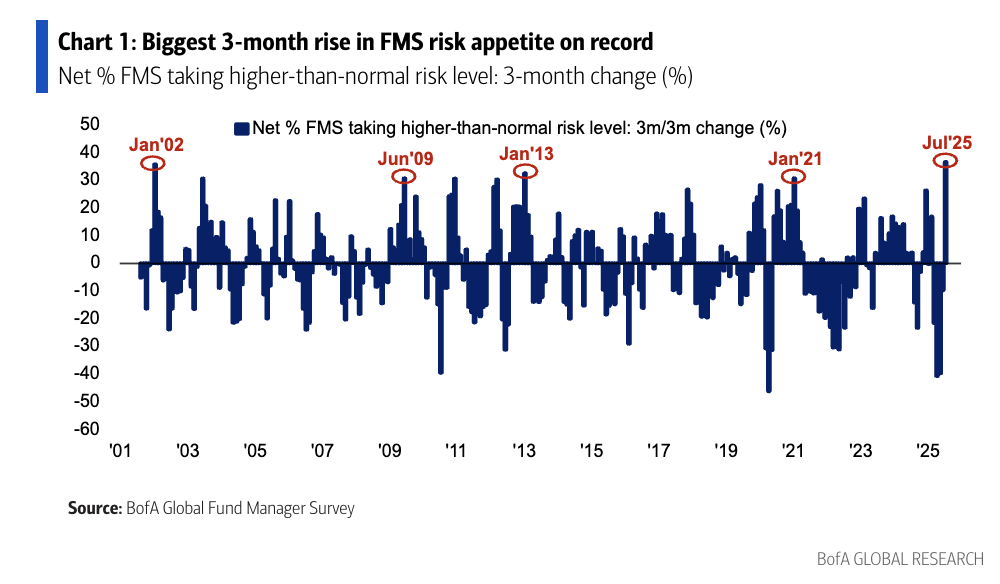
Bank of America Global Research
The Primary Driver
The overall boost is not uniformly felt across the crypto market. A study by Coinbase-EY Parthenon indicates that new demand is almost entirely focused on Bitcoin and Ethereum, with the majority of institutions surveyed holding the two largest cryptocurrencies (97% and 86%, respectively). Even those showing interest in other cryptocurrencies typically hold only one or two in addition to Bitcoin and Ether.

Sherwood News
Ethereum has benefitted from some attention via inflows to spot ETFs and an ethereum-based treasury experiment, rising more than 20% in the last five days; it still needs more to reach its all-time high from 2021, remaining approximately 25% below that peak.
The Ascendancy of Institutional Capital
In the early days of Bitcoin, around 2010, the exchange of 10,000 BTC for two pizzas symbolized the cryptocurrency’s role as an alternative for those critical of traditional banking systems and corporate financial power.
Now, after 15 years and substantial gains, institutional investors are appearing to reshape Bitcoin’s trajectory, potentially overshadowing the influence of early individual supporters.