

The rise of artificial intelligence (AI) is impacting various sectors, but its potential in the cryptocurrency world is particularly significant.
This is largely fueled by the development of AI-powered agents capable of streamlining cryptocurrency trading activities. These agents can handle tasks such as market research, chart analysis, strategy implementation, and more, automatically.
Smart Crypto Automation with AI Agents
While still a developing technology, traders are now utilizing AI models to identify cryptocurrency signals, analyze market dynamics, and swiftly capitalize on emerging opportunities.
An AI agent is essentially a digital tool programmed to execute intricate, multi-stage operations. It can conduct thorough research and autonomously take specific actions to achieve pre-set objectives.
AI Trading Assistant Is Live!
Crypto traders, forget about manually analyzing Crypto charts & searching for patterns. Now, there’s an AI for that!
We developed a mathematical #AI model designed to do Technical Analysis, detect chart patterns & more.
Let’s take a dive
pic.twitter.com/kjQV7bV1X2
— ChainGPT (@Chain_GPT) December 6, 2023

David Sneider, the mind behind Lit Protocol, highlights that AI agents, often powered by sophisticated technologies such as large language models, machine learning, or rule-based systems, function as independent operators. These systems can comprehend data, analyze it, and execute actions on behalf of individuals or organizations.
Sneider explains that unlike static programs, an AI agent possesses the ability to:
- Define Objectives: For instance, “increase profits,” “manage emails,” or “adjust investment allocations.”
- Strategize and Decide: Choose between different methodologies and tools, and execute actions in the market using APIs, smart contracts, and integrated applications.
- Evolve and Improve: Continuously learn and refine its performance based on the outcomes of its actions.
“In practice, AI agents often act as intermediaries between users and complex systems, transforming user instructions into automated processes,” says Sneider.
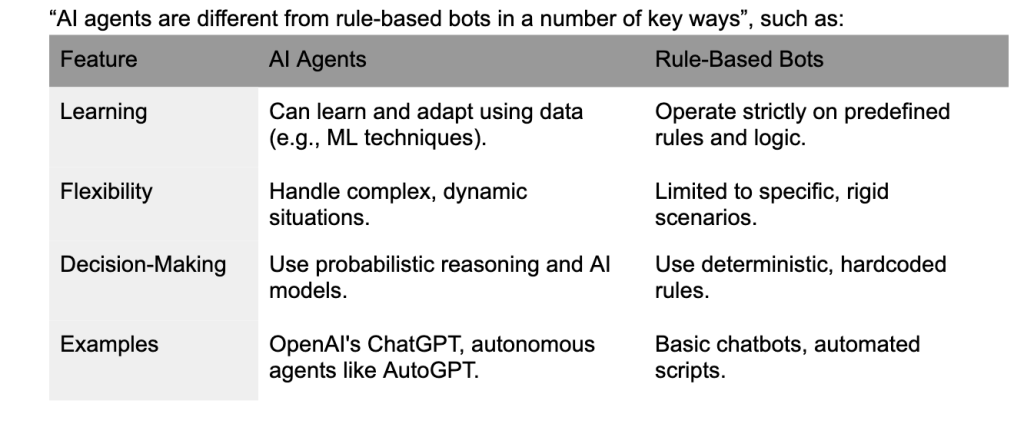
AI Agents Compared to Logic-Based Bots
Sneider further clarifies that while there are some similarities between AI agents and traditional rule-based bots, the primary distinction lies in the agent’s capacity for dynamic decision-making, as opposed to the pre-programmed, rigid logic of rule-based bots.
For example, rule-based bots operate on a “If this, then that” principle.
Shamir Ozery, the CEO and founder of Ensemble, a platform focusing on AI agent applications, illustrates this with an example:
“Track the price of ETH on the Base network. If its short-term momentum turns positive and the gas price is low, proceed to…”
Sneider emphasizes that it’s the agent’s capacity to perceive, analyze, and adapt that differentiates it from basic rule-based bots. This capability is a key reason why AI agents are currently gaining widespread attention in the crypto market.
Sneider suggests that the growing power and precision of large language models are driving their evolution beyond simple chatbots and search engine replacements, equipping them with the tools to handle intricate operational tasks.
Current Crypto Applications of AI Agents
Sneider notes that, currently, AI Agents are primarily employed to boost productivity, enhance customer service, improve financial analysis, and refine cryptocurrency strategies.
He specifically identifies three main categories of emerging products utilizing AI agents in the crypto space.
“Firstly, AI agents are proving useful as research assistants, aiding users in understanding the crypto market. These agents focus on providing insights and information rather than engaging in active trading.”
Secondly, Sneider points out that AI-powered chatbots are now capable of executing real-time transactions utilizing a user’s self-custody key.
“In this application, the agent acts as a substitute for a Web3 browser, enabling users to instruct the agent to ‘Purchase $50 of ETH,’ with the user then approving the transaction in real-time through a signed message,” Sneider details.
Lastly, Sneider mentions that certain AI agents can implement trading strategies with minimal human intervention, often called “human out of the loop” (HOOL). In this scenario, users can provide instructions to the agent and/or deposit funds, allowing the agent to autonomously manage and execute transactions.
“In all these uses, the agents analyze market data and use that data to make informed decisions. However, it is only in the third case—when agents directly trade—that they execute transactions on behalf of the user,” Sneider clarifies.
AI-driven crypto trading tools are also making decentralized finance (DeFi) more user-friendly. For example, Marko Stokic, the AI lead at Oasis Network, tells Cryptonews that “DeFi agents” can autonomously find the most profitable yields.
Projects like Giza and ZyFAI exemplify the potential of these applications. Giza’s model uses on-chain agents to execute trades swiftly and efficiently.
Giza’s leading agent, ARMA, has already processed over 100,000 transactions and optimized over $30 million in user funds. Operating on a block-by-block basis, these autonomous agents constantly adjust their strategies to align with market conditions, eliminating the need for continuous user oversight.
Private Key Security for AI Agents
While AI agents offer potent tools for crypto trading, properly handling private key security is critical. Sneider outlines three key methods for managing this.
“The primary approach is centralized, third-party management of key information, provided by embedded wallet Software-as-a-Service (SaaS) companies. These allow users to grant authority to the application they use to digitally sign on their behalf,” explains Sneider.
While this method offers the security and safeguards provided by the custodian or embedded wallet provider, it also introduces potential security vulnerabilities and could limit agent functionalities.
Next, Sneider highlights the use of embedded safeguards within a smart contract account.
“This arrangement allows users to create a session signer (using methods like ERC-7579) to generate a secondary, limited-access sub-key that can sign transactions within specific, authorized parameters.”
He notes that the benefit of this setup is that all permissions are recorded on-chain. However, the limitation lies in the scalability of smart contract accounts, which can be costly and complex in multi-chain environments where a wallet must be maintained on each supported blockchain.
“Moreover, applying universal rules like a daily spending limit across different chains can become expensive to manage, as each chain’s smart contract account needs to track all trades made by the agent. This can result in excessive data storage on the blockchain, which is costly,” Sneider comments.
Finally, Sneider notes that a third option is leveraging a decentralized approach for managing the agent’s key pair. This is the niche where Lit Protocol plays a key role, offering a decentralized key management network.
An agent platform called “Vincent” is being built on Lit Protocol. It allows AI agent users to write permissions or safeguards on-chain, and then have the network enforce these rules (such as spending limits, approved contracts, etc.).
Sneider claims this setup provides several significant advantages.
“Firstly, agents can function across multiple chains from the outset. Secondly, the capability to perform checks/computations off-chain, like running a transaction simulation as part of the user’s safeguards, and thirdly, the ability for agent developers to call smart contract functions via APIs and MCPs, rather than having to write and directly call smart contracts,” he explains.
To provide a clearer understanding, Sneider offers an example of an agent in action:

Sneider explains that in this setup, a user deposits stablecoins, which are then automatically deposited into high-yielding vaults on Morpho. The key agent function here is optimization.
“For instance, if a user deposits USDC on Base, these funds are allocated to the highest-yielding vault. Subsequently, if a new vault becomes available using a different stablecoin on a different chain—for example, USDT on Arbitrum—the yield agent will exit the current vault, swap to USDT, bridge the funds to Arbitrum, and deploy them into the higher-yielding vault, taking gas costs into account in these automated actions,” Sneider explains.
Without this agent, a user would have to complete these steps manually while also staying informed about new yield opportunities.
Additional Considerations
Alongside private key management, a number of other issues need to be addressed when working with AI crypto trading systems.
For example, Ozery notes that AI agents can make flawed decisions or experience “hallucinations”.
“This involves misinterpreting data or overfitting backtests,” he states. “Consideration should also be given to market structure risks, compliance, and auditability.”
Stokic also points out that trust is the biggest impediment to adoption today. “Why should users entrust their funds to someone else’s AI agent?”
The Prospects of AI Agents in Crypto Trading
Despite the associated challenges, the use of AI crypto trading assistants will likely continue to grow.
Regarding progress in agent functionalities, OpenAI has indicated that this is part of a larger shift toward intelligent finance, where multiple independent assistants support real-time decision-making with human oversight.
Sneider anticipates that as AI agent management improves, automated bots will not only reside within applications but will also be able to log into applications, thus becoming the default method for automating work.
“For example, if you provide an AI agent with your Facebook password, Facebook will not be able to determine whether the user request originates from a human or an agent,” he notes.
Sneider suggests that AI crypto trading programs could become significant drivers in the usage of stablecoins, particularly for yield generation.
“Traditionally, generating yield on government-backed assets is the role of banks, which offer meager returns to users while lending out their funds through savings accounts. In the emerging crypto ecosystem, the agent that optimizes yield on stablecoins can challenge traditional savings accounts by offering superior returns, leading to agents becoming the foremost users of stablecoins.”
The post From Algorithms to Automation: How AI is Revolutionizing Cryptocurrency Trading appeared first on Cryptonews.