
A new study by Tiger Research delves into Vietnam’s evolving approach to cryptocurrency regulation. Moving away from a largely unregulated environment, the nation is now embracing controlled experimentation, setting the stage for a crypto sandbox expected by mid-2026. This analysis explores the resulting implications for businesses.
- Vietnam is shifting from a period of passively watching cryptocurrency to actively shaping its future. The government intends to launch a crypto sandbox by mid-2026, simultaneously crafting a structured regulatory system.
- Businesses taking proactive steps before the complete regulatory framework is established can position themselves as leaders in Vietnam’s formalizing crypto market.
- Recent analysis suggests that in the Vietnamese crypto market of the future, regulatory adherence, transparent operations, and the capacity to adapt swiftly will be more crucial to success than cutting-edge technology alone.
Vietnam has rapidly become a central hub in the global cryptocurrency landscape. Since 2021, it has consistently been among the top five nations in Chainalysis’ Global Crypto Adoption Index. More than 21% of Vietnamese adults own or have transacted with cryptocurrencies, and annual inflows into the Vietnamese market exceed $100 billion.
The Vietnamese crypto market is largely driven by younger generations who engage through various avenues. These include active trading on global exchanges, peer-to-peer (P2P) transactions using self-custody wallets, decentralized finance (DeFi) protocols, and GameFi platforms.
A stark contrast exists between Vietnam’s enthusiastic crypto market and its regulatory framework. The government does not recognize cryptocurrencies as legal tender, and the State Bank of Vietnam (SBV) officially forbids their use as a method of payment. However, individuals can legally own and trade crypto, creating an environment of uncertainty.
Vietnam lacks specific rules for crypto businesses. The absence of a formal licensing process for exchanges, custody providers, and stablecoin operators is hindering sector growth.
This regulatory vacuum has resulted in the Financial Action Task Force (FATF) including Vietnam on its “grey list.” This action diminishes Vietnam’s economic standing and has negative consequences. Crypto firms are relocating to countries like Singapore with clearer regulations, raising concerns about the loss of talent, investment opportunities, and overall competitiveness.
This report provides an in-depth examination of cryptocurrency industry regulations in Vietnam, including the positions of various regulatory bodies. It also explores how the Vietnamese government’s recently announced cryptocurrency regulatory initiatives will reshape the market.
Vietnam’s regulatory landscape reveals differing stances among regulatory agencies based on their distinct priorities. Therefore, understanding each agency’s role and perspective is crucial for navigating Vietnam’s cryptocurrency industry.
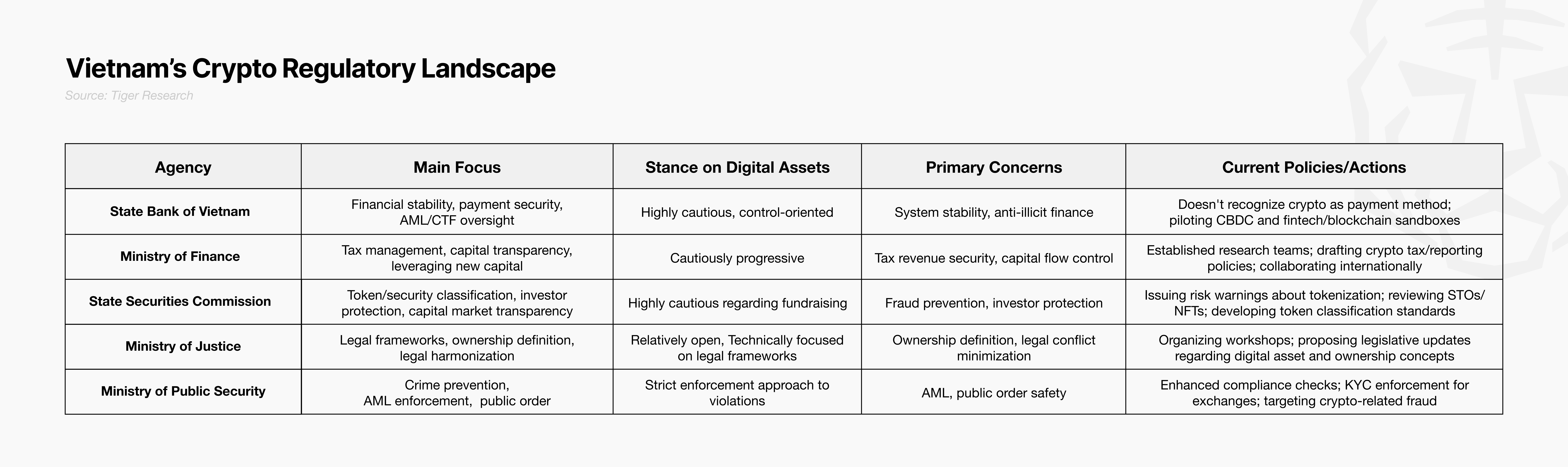
The SBV maintains the most conservative and cautious approach among Vietnamese regulators. In 2017, the SBV issued official guidance (5747/NHNN-PC) that prohibited cryptocurrencies for payments. The SBV views cryptocurrencies as potential threats to the stability of Vietnam’s financial system.
However, the SBV acknowledges the potential of blockchain technology and is exploring ways to optimize the national financial system. A Central Bank Digital Currency (CBDC) pilot project is underway from 2021 to 2025. This initiative focuses on government-controlled applications rather than opening up the broader cryptocurrency market. The SBV’s cautious stance restricts various crypto uses, contributing to ongoing regulatory uncertainty.

The Ministry of Finance (MoF) has adopted a more proactive stance on cryptocurrencies than the SBV. The MoF recently shared plans to launch a cryptocurrency sandbox pilot program with international exchanges like Bybit. Experts see this as a crucial initial step toward creating a formal crypto regulatory framework.
Since 2021, the MoF has maintained a specialized crypto working group focused on improving tax reporting, ensuring the transparency of funds, and setting standards for crypto-related investments. The group’s main goal is to effectively manage financial flows and mitigate tax evasion while still promoting cryptocurrency innovation. The MoF is actively promoting the development of licensing systems for crypto exchanges, custodians, and stablecoin issuers.
Through this approach, the MoF aims to cultivate a healthy crypto market that attracts compliant businesses while demanding strict compliance with tax, financial disclosure, and anti-money laundering (AML) standards.
The State Securities Commission (SSC), which oversees Vietnam’s capital markets, is taking a cautious approach to tokenized assets. The commission is primarily focused on determining whether specific digital assets used for investment should be classified as securities and thus subject to regulatory oversight.
The SSC is concerned about the potential for “hidden securities issuance” when crypto projects raise capital through Initial Coin Offerings (ICOs), Security Token Offerings (STOs), and DeFi products. These methods might bypass the strict disclosure requirements, investor protections, and anti-fraud measures required in traditional securities markets. This cautious approach is slowing the institutional integration of security and investment tokens in Vietnam, leading to uncertainty for projects exploring tokenization models.
The Ministry of Justice (MoJ) plays an advisory role, focusing on ensuring legal consistency for digital assets. The MoJ recommends clearly defining digital assets as a distinct asset class in Vietnam’s civil and commercial laws. This definition would provide a vital foundation for addressing ownership disputes and creating legal contracts involving tokenized assets.
The MoJ is fostering discussions with stakeholders on amending the civil code. However, compatibility challenges with existing legal frameworks and intricate interdepartmental coordination are slowing progress. Crypto businesses and investors in Vietnam face legal uncertainties in disputes over digital asset custody, theft, and liquidation due to a lack of clear ownership regulations. Despite this, some criminal court rulings have recognized cryptocurrencies as “assets with property value,” providing legal protection in certain instances.
The Ministry of Public Security (MoPS) demonstrates a firm stance against the potential for cryptocurrencies to be used for financial crimes. The MoPS is primarily focused on combating crypto-related fraud, illicit fundraising, money laundering, and tax evasion. The ministry suggests implementing stricter Know Your Customer (KYC) protocols for crypto platforms and establishing mandatory reporting systems for suspicious transactions tied to illegal activities.
Vietnam’s regulatory approach to crypto has been characterized by caution and fragmentation. Despite rapid retail adoption, policymakers have moved deliberately in creating a legal framework.
