


The planned launch of a stablecoin by Hyperliquid has become a flashpoint, triggering an intense competition among various entities.
This decentralized exchange, previously reliant on Circle’s USDC for liquidity, recently
unveiled its intention
to create its own native stablecoin, named USDH. This announcement quickly drew numerous contenders, each eager to win the opportunity to issue the token and potentially control substantial financial value.
To date, at least eight organizations have
presented their proposals,
including established firms like Paxos, Ethena, Agora, and
OpenEden.
The validators of the Hyperliquid network will ultimately decide which organization will be granted the authority to issue USDH. In the interim, speculators are using Polymarket to place bets on the likely winner.
Polymarket Bettors Predict Victory for New Market
Data from Polymarket indicates that Native Markets is the frontrunner, exhibiting the strongest odds in a market with over $1 million in trading volume at the time of this reporting.
Traders on the decentralized prediction platform initially gave Native Markets a 90% probability of securing the validator vote. However, that percentage has since declined to 84%.
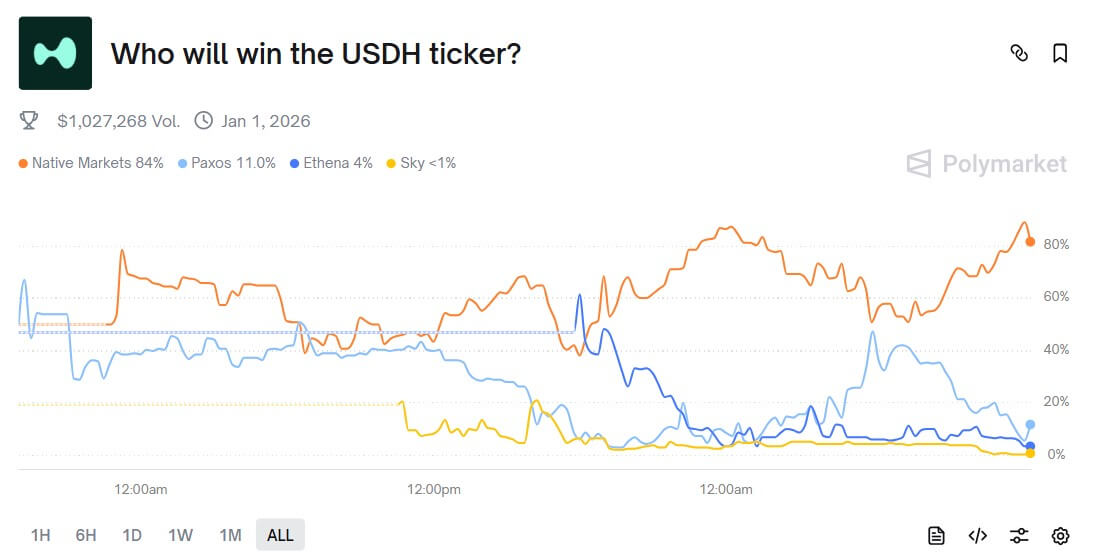
Polymarket (Source: Polymarket)
Native Markets was specifically created to bid for USDH and is under the leadership of Max Fiege, an investor active in the Hyperliquid ecosystem.
The firm’s proposal suggests a dual-reserve strategy. In this model, BlackRock would oversee off-chain assets, while on-chain reserves would be managed via Superstate, utilizing Bridge, a platform owned by Stripe.
Native Markets has also committed to dividing the yield generated from reserve assets. Half will be allocated to HYPE token buybacks, and the other half will support the expansion of USDH.
The structure of Native Markets’ proposal has generated both enthusiasm and skepticism within the community.
In Agora’s proposal, Nick Van Eck, the founder of Agora, highlighted that Native Markets’ reliance on Stripe could potentially harm Hyperliquid in the long run.
According to his statement:


5 Days to Smarter Crypto Moves
Learn how pros avoid bagholding, spot insider front-runs, and capture alpha — before it’s too late.
Brought to you by CryptoSlate
“Stripe has recently communicated their plans for Tempo, a new layer 1 blockchain. Stripe is committed to directing activity to this ecosystem from various participants. What is to stop Stripe and Bridge from steering users and perpetual futures from other financial platforms directly to Tempo, rather than Hyperliquid?”
Despite these concerns, Dragonfly Capital’s Haseeb Qureshi
suggested that Native Markets might have had prior knowledge of the request for proposals, given the speed at which their submission appeared.
He stated:
“Everyone else was hurrying over the weekend to assemble something. Consequently, this entire USDH RFP appears to have been specifically designed for Native Markets.”
However, Alex Svavenik, the CEO of Nansen,
refuted this claim, emphasizing that validators are highly involved with all bidders.
According to him, the process is significantly more competitive than critics suggest, with validators actively seeking the optimal long-term solution for Hyperliquid.
Competing Proposals Gain Traction
While Hyperliquid validators might seem to favor Native Markets, observers point to Paxos, Ethena, and Agora as contenders with more robust institutional histories.
Furthermore, these rival firms have been improving their offers, and new entrants are presenting alternative bids for the USDH stablecoin.
On Sept. 10, Paxos announced a revised
plan centered on a partnership with
PayPal.
According to the firm, this partnership would integrate USDH into PayPal and Venmo products, list HYPE on PayPal’s on-ramps, and contribute $20 million in incentives for the Hyperliquid ecosystem.
Paxos has also established strict revenue limits to ensure the community of its long-term alignment. They wrote:
“Paxos receives nothing until we reach $1 billion in TVL and will be capped at 5% after $5 billion TVL. All fees earned by Paxos before this milestone will be held in HYPE tokens.”
Commenting on the updated proposal, Max Fantle, a Paxos executive,
stated:
“PayPal and Venmo have 400M+ users. Paxos is the only neutral, regulated issuer that can unlock an entirely new institutional customer segment for Hyperliquid that no other issuer can reach.”