
The realm of Trading Card Games (TCGs) is experiencing a surge in popularity, driven by innovations like NFTs and inventive business models designed to captivate players. Let’s examine the overall TCG market and the rise of on-chain trading card games within the cryptocurrency space.
The Traditional Trading Card Game Arena
The global TCG marketplace boasts a valuation of approximately $12 billion, with projections indicating a Compound Annual Growth Rate (CAGR) of 7–8% through 2030. Key factors determine the value of these cards: rarity, similar to NFTs, and the price collectors or players are willing to pay.
Throughout card trading history, certain rare cards have commanded astronomical prices. The Pikachu Illustrator PSA 10 card, for example, fetched $5.275 million in 2021, and a Magic: The Gathering Black Lotus card sold for over $500,000.
Source: Verified Market Research
However, the traditional market faces limitations. Sellers often incur high fees (10–15%) on platforms like eBay or major auction houses. Counterfeit cards pose a risk, highlighting the importance of grading companies like PSA, Beckett, and CGC. Furthermore, reliance on third parties and lengthy payment processes can impede liquidity.
Understanding Trading Card Games
A TCG is a game widely recognized in the traditional market, available on platforms such as eBay and other significant auction sites. Players accumulate unique cards, experiencing the “gacha” thrill akin to opening a “secret box.” These cards are used to construct personalized decks for competitive play, with each card possessing specific rules for interaction.
The Rise of Pokémon TCG
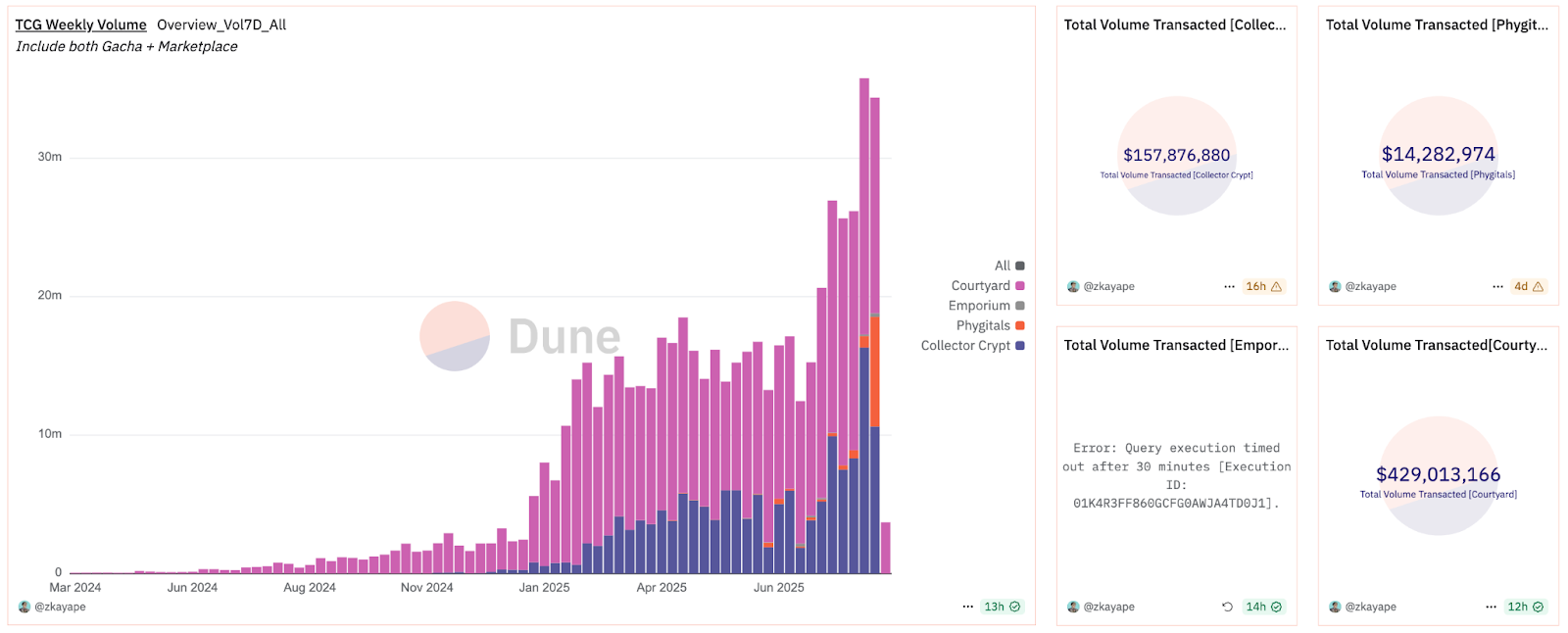
Recently, the Pokémon TCG has gained traction in the crypto space. Players utilize Pokémon cards to engage in battles within this popular card game.
Source: Dune
Features of Trading Card Games
What captivates users? TCGs offer excitement, competition, and strategic gameplay. The act of opening a random package creates a “secret box” sensation, similar to a lottery, providing a surge of surprise and anticipation. Community involvement is also crucial. Fans enjoy sharing pack openings via livestreams or at in-person events, fostering a social experience.
Gamified elements like leaderboards, tournaments, and achievements further enhance engagement. This blend of chance, community, and gameplay aligns perfectly with trends such as livestreaming, social platforms, and blockchain.
On-chain TCG Market Surges: A 5.5x Increase Since 2024
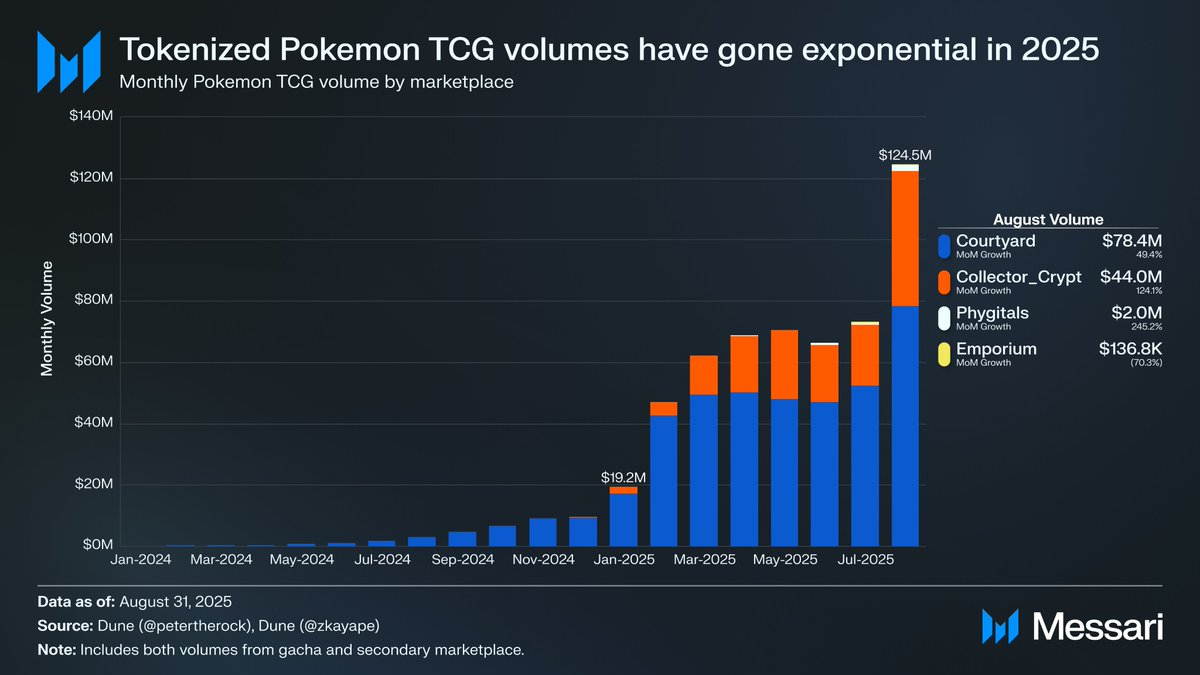
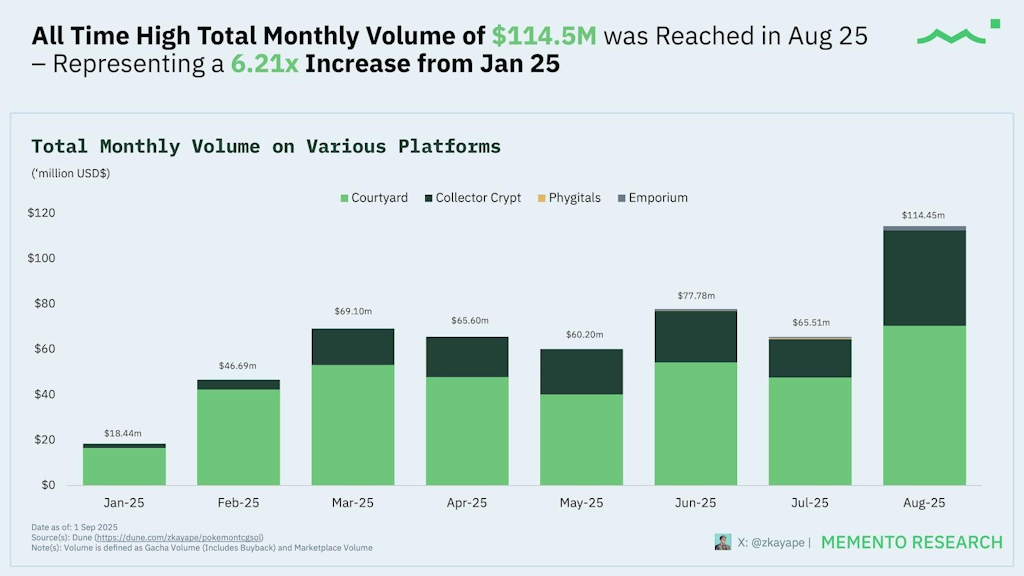
As of August 2025, the volume of tokenized Pokémon TCG NFTs has exploded, reaching $124.5 million. This represents a 5.5x increase compared to January 2024, highlighting significant growth.
Courtyard led the way with $78.4 million, followed by Collector Crypt with $44 million. Notably, Phygitals also experienced substantial growth, with a 245% month-over-month increase in August, reaching $2 million. These figures demonstrate that the integration of TCGs with blockchain technology is evolving beyond experimentation into a substantial market with considerable scale and liquidity.
Source: Messari
Key Trends Emerge: August-September 2025 Data & Milestones
Several innovative models are gaining traction, including gacha buyback systems, livestream commerce, arcade claw machines, and character tokenization. This diversification indicates a creative boom within the on-chain TCG market, with projects exploring various niches to attract and engage users. The next 6–12 months will likely see a clearer distinction, with platforms addressing IP, liquidity, and UX challenges securing market share, while others may struggle to maintain relevance.
For more: NFT Trading Cards 2025: The Ultimate Collector’s Guide
Source: Memento Research
Featured Projects in the TCG Space
Collector Crypt (Solana) – CARDS
Collector Crypt is a standout player in the on-chain TCG market, known for its robust gacha system with a buyback mechanism on the Solana network.

The CARDS token, launched in late August 2025, quickly achieved a Fully Diluted Valuation (FDV) of approximately $450 million within a week, with some reports suggesting it reached $3 billion. In its initial week, gacha revenue reached $16.6 million, while monthly trading volume increased by 124% from the previous month, reaching $44 million.
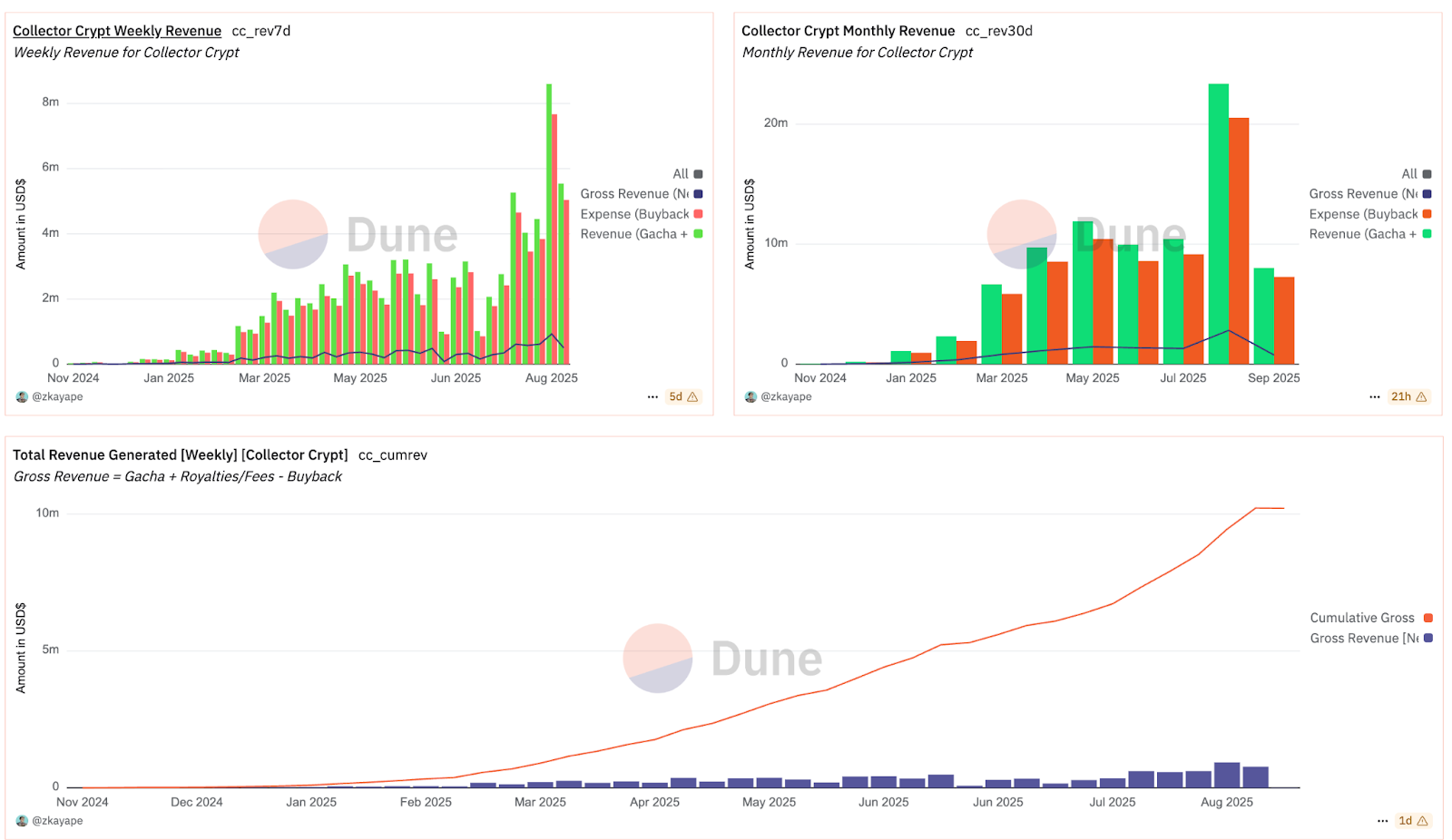
Source: Dune
Dune dashboards indicate that the overall RWA TCG sector has reached a market capitalization of $87.2 million, a 32% increase in just 24 hours. Solanafloor data reveals that TCG volume on Solana is exceeding NFT trading volume.
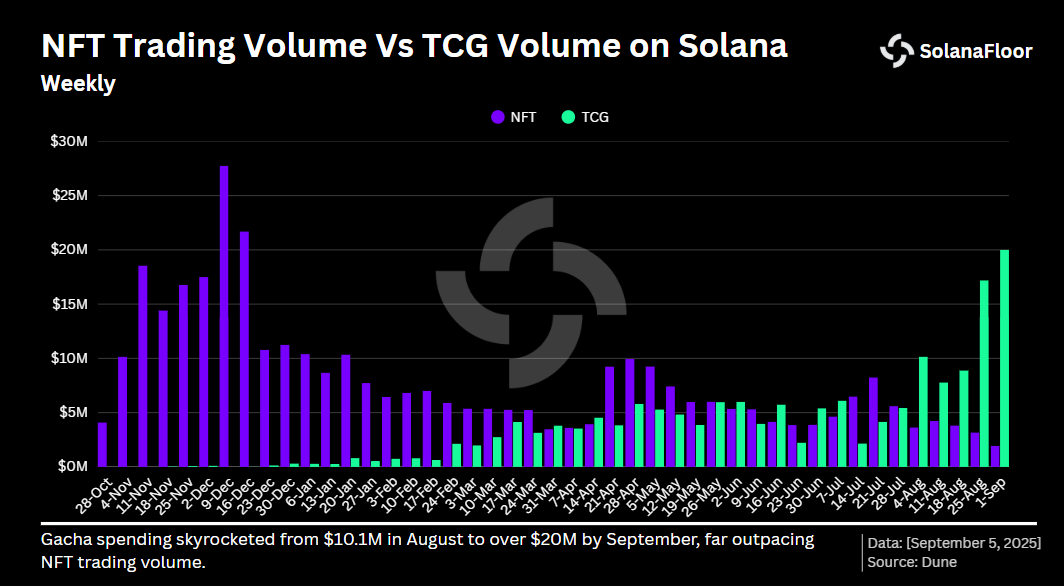
Source: SolanaFloor
Collector Crypt’s key advantage lies in its 85–90% buyback policy based on eBay/ALT prices and its plan to reinvest platform fees into acquiring more real Pokémon cards for the vault. This ensures immediate liquidity and reduces risk for collectors when opening packs.
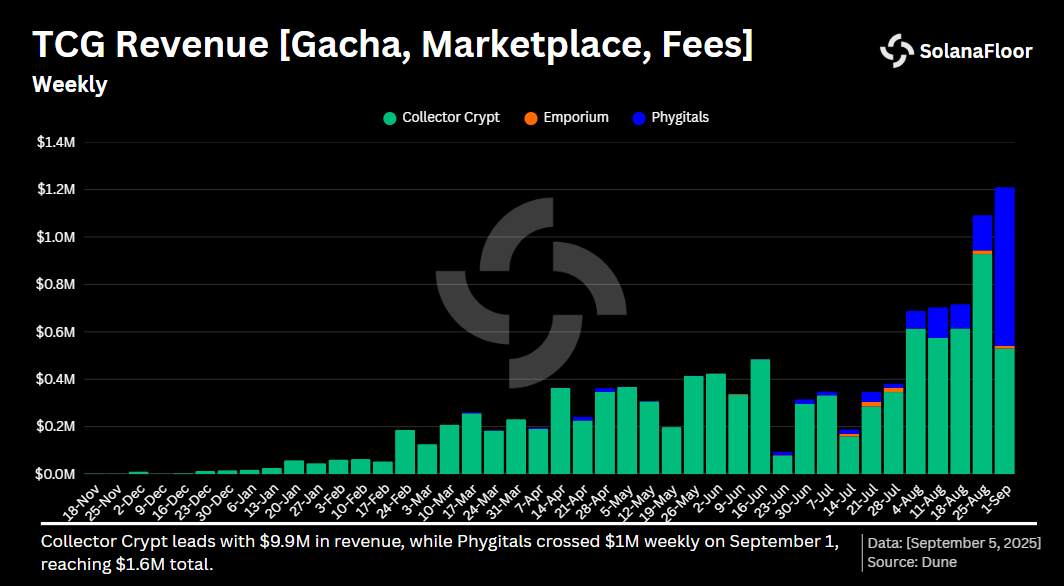
Source: SolanaFloor
Collector Crypt leads in gacha spins with $10.7 million, representing over 47% of the total market share. Its appeal stems from attracting the Web3 community with its “Pokémon on-chain” concept, transforming traditional collecting into rapid and transparent on-chain trading. However, the token price experiences significant fluctuations due to a limited circulating supply of approximately 10%, resulting in high volatility during its early stages.
Courtyard (Polygon)
Courtyard is a prominent player in the on-chain TCG ecosystem, recognized for its consistent volume and user-friendly Web2 interface. In August 2025, it achieved approximately $62 million in trading volume, its highest to date. The platform has minted over 3 million NFTs, and its collections often rank among the top NFT sales globally, even surpassing BAYC and CryptoPunks, according to CryptoSlam data.
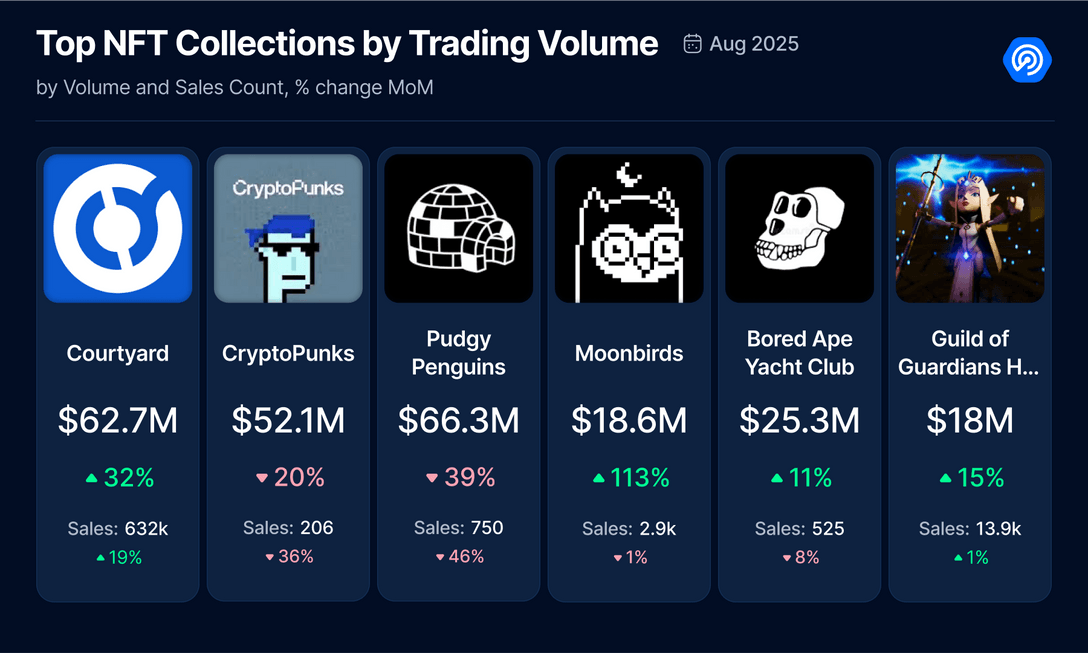
Source: DappRadar
Its strength is its clear bridge between Web2 and Web3: users can pay with credit cards and trade gas-free, while the physical Pokémon cards are safely stored at Brink’s. This makes Courtyard an ideal choice for traditional collectors who want to try blockchain. But its weakness is the lack of a strong buyback system, meaning users rely only on the secondary market if they want to resell cards.
For more: Gods Unchained: The Biggest Trading Card Blockchain Game
Dripshop Live (Ronin Network)
Dripshop Live blends livestreaming and auctions, emphasizing entertainment commerce by transforming pack openings into live shows. A key product is Jin’s Fortune Spin, a capsule-style gacha where users can open packs live, receive NFTs or slabs, and resell them instantly. This experience mixes Twitch and eBay elements, targeting Web3 gamers and streamers.
Streamers on Dripshop Live engage viewers with dynamic content, such as live pack openings and immediate card auctions. This turns collecting into a community event, fostering excitement among streamers and audiences.
Dripshop’s strength is its ability to create a strong dopamine loop. Viewers are entertained and can trade in real time, fostering a tight-knit community. However, Dripshop relies heavily on streamers. The platform’s trading volume may decline without popular creators.
Dripshop recently launched on Ronin, a Layer 2 network, and is worth watching as it develops.
Welcome to Ronin, Drip!
Pokémon cards are LIVE on Ronin Market ⚔️
Traditional and Web3 markets are merging faster than ever.
Robinhood tokenized stocks, and Circle brought stablecoins to Wall Street.
On Ronin, collecting is in our DNA.
That’s why @dripshop_live is bringing… pic.twitter.com/SsJS4hqWVv
— Ronin (@Ronin_Network) July 4, 2025
Phygitals (Solana)
Phygitals emphasizes an arcade-style experience. It garnered attention with its Pokémon 1999 Raticate claw machine, which let users “grab” rare cards. It also launched the Pokécoin Market, tokenizing each Pokémon as a coin, reflecting financialized collecting akin to projects like football.fun or pigskin.fun.
Phygitals’ strength lies in its arcade-style fun on the blockchain. However, it may not appeal to traditional collectors who value pricing stability and liquidity.
Phygitals leads in the distribution of gacha players, accumulating over 14.3k active wallets. While Collector Crypt leads in the meta, it has fewer active wallets.
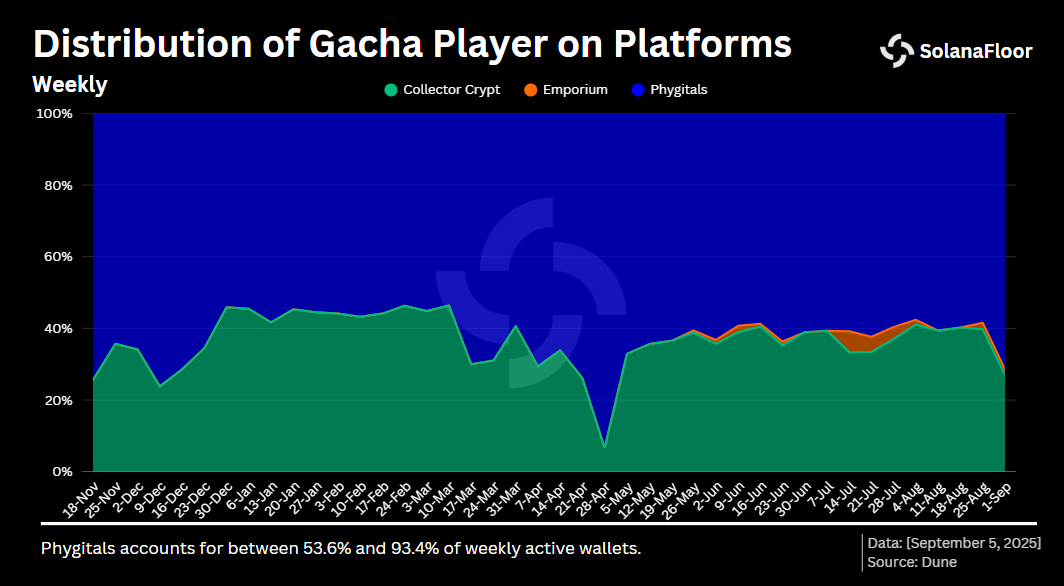
Source: SolanaFloor
rip.fun (Base)
rip.fun prioritizes livestream openings + XP farming, featuring the slogan “rip – trade – redeem.” Users can watch livestream pack openings, trade cards, and farm XP to level up. This builds a gamified loop to drive user engagement.
rip.fun fosters strong user engagement through an XP rewards system. However, no trading volume data has been shared, suggesting it may still be in testing and smaller than Collector Crypt or Courtyard.
Market Value & the “Polymarket Moment” Foresight
Bitwise’s Danny Nelson believes that “Pokémon and other TCGs are about to have a ‘Polymarket moment’,” where real-world assets explode on-chain, creating a new market. He advises that we should take tokenization seriously and view it as a new growth cycle for collectibles.
Pokémon and other TCGs are about to have their “Polymarket moment.” Here’s why you should be paying attention:
Most of crypto’s teal world asset (RWA) plays cater to well-established TradFi markets, like treasuries, real estate, gold and stocks. Sure, tokenization brings these…
— Danny Nelson (@realDannyNelson) September 3, 2025