

Key Takeaways:
-
Michael Saylor spearheaded MicroStrategy’s transformation, evolving it from a software company to the leading corporate Bitcoin holder globally.
-
Saylor’s strong belief in Bitcoin reshaped traditional corporate investment, turning market swings into chances for accumulation through a consistent, long-term purchasing strategy.
-
Despite worries about stock dilution and increasing company debt, his method established a benchmark for how institutions approach Bitcoin adoption.
-
Saylor’s investment strategy emphasizes thorough investigation, persistence, careful management of risk, and a commitment to the long-term potential of Bitcoin.
Saylor’s Journey Into Bitcoin
Starting in August 2020, Michael Saylor shifted from a typical tech industry leader into a prominent advocate for corporate involvement in the crypto space.
Saylor, recognized as the co-founder and CEO of the business-software company MicroStrategy, initiated a groundbreaking move by investing $250 million of the company’s funds into Bitcoin (BTC).
He pointed to the weakening value of the U.S. dollar and concerns about long-term inflation as the primary drivers behind this strategic decision. This was also the largest investment in Bitcoin by a publicly listed company at the time and established a new standard.
Within months, MicroStrategy significantly increased its Bitcoin holdings, adding $175 million in September, $50 million in December, and issuing $650 million in convertible notes, pushing its total Bitcoin investment above $1 billion.
He viewed Bitcoin as a “safe haven for capital,” likening it to “Manhattan in cyberspace,” describing it as a limited, secure asset.
This action was met with both praise and skepticism. Critics labeled it risky, while supporters saw it as innovative at a time when few were willing to include Bitcoin on their balance sheets. For Saylor, however, it represented a measured defense against economic uncertainties and a clear signal that digital assets would revolutionize capital strategies.
Fun Fact: Back in 2013, Saylor posted on social media that Bitcoin’s future was limited, predicting it would “follow the path of online gambling.” This old post reappeared in 2020, just as he was leading MicroStrategy to become the largest Bitcoin holder among public companies. He has since referred to it as “the most expensive tweet ever.”
Expanding MicroStrategy’s Bitcoin Holdings
From that initial investment, Saylor passionately increased MicroStrategy’s Bitcoin position. He used sophisticated financial methods to grow the holdings and reshape MicroStrategy into a “Bitcoin-focused company.”
It started during the company’s Q2 2020 earnings calls when Saylor shared intentions to explore alternative investments, including Bitcoin and gold, rather than retaining cash. He began implementing this plan with regular Bitcoin purchases, rapidly increasing the company’s holdings to tens of thousands of coins at attractive prices.
By early 2021, MicroStrategy had borrowed over $2 billion to increase its Bitcoin holdings, showcasing a bold commitment driven by strong belief rather than speculation. Saylor articulated a vision of long-term ownership, stating that MicroStrategy will hold its Bitcoin investments for at least a century.
Despite Bitcoin’s significant price fluctuations, peaking at $64,000 in 2021 from $11,000 and then falling to around $16,000 by late 2022, Saylor remained steadfast. To support his belief in Bitcoin’s superior monetary properties, his team used dollar-cost averaging to capitalize on price drops and accumulate more coins.
Saylor’s strategy proved effective: MicroStrategy’s stock value increased, often exceeding Bitcoin’s performance. By late 2024, MicroStrategy’s stock had significantly outperformed the S&P 500, and the company was increasingly seen as a crypto investment vehicle rather than a software business.
Financing Saylor’s Bitcoin Vision
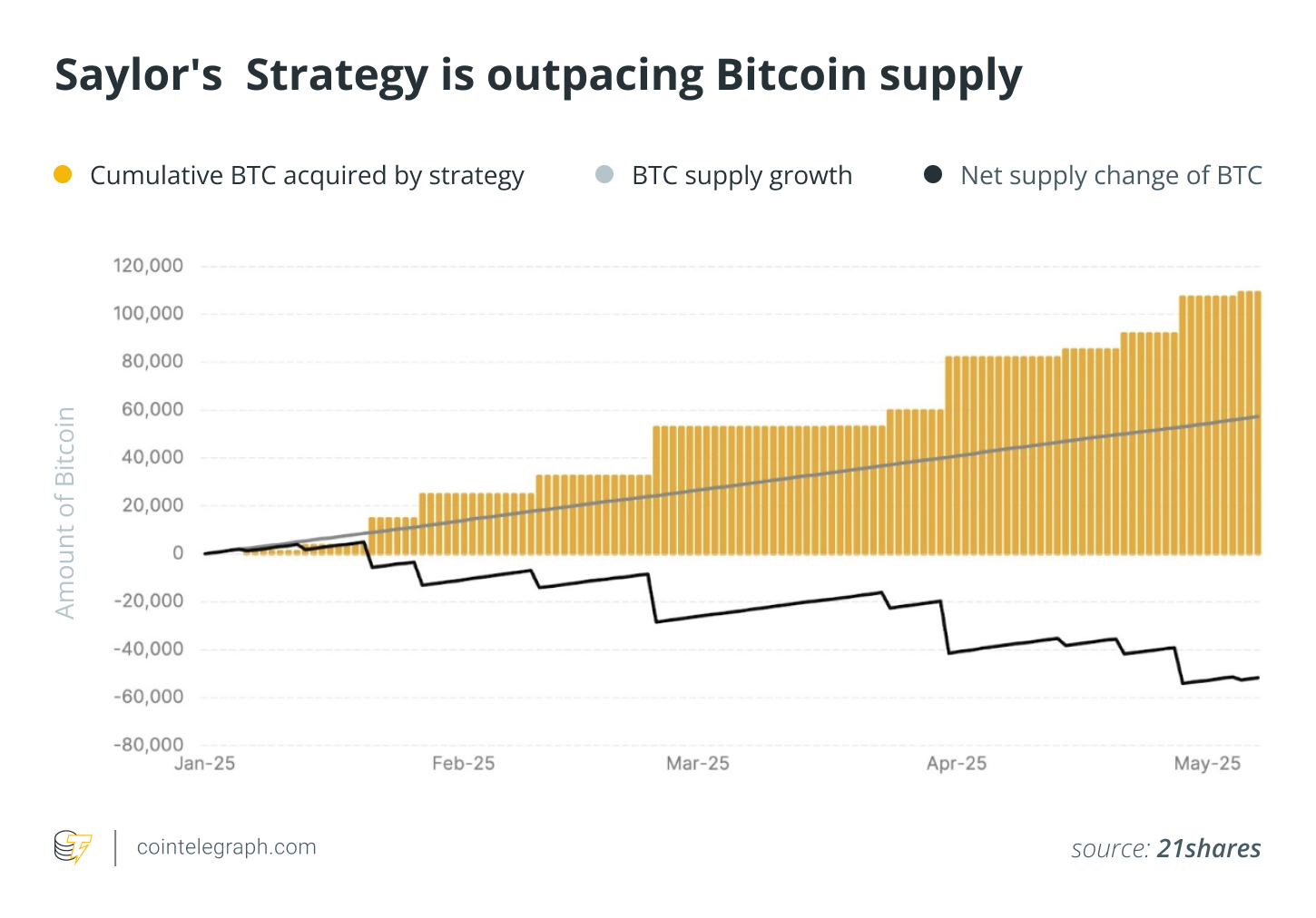
Saylor’s dedication evolved from an early investment to a major influence on corporate Bitcoin demand, impacting market dynamics through sheer scale. By early 2025, MicroStrategy controlled over 2% of Bitcoin’s total supply, amounting to approximately half a million BTC.
During the year, MicroStrategy acquired more than 150,000 BTC at average prices near $94,000, bringing its total Bitcoin holdings to a market value exceeding $50 billion.
These large investments put pressure on Bitcoin’s limited availability, leading other corporations to compete for the cryptocurrency. Saylor’s actions served as a model for other businesses to follow. In the first five months of 2025 alone, Bitcoin purchases by institutions and corporations exceeded $25 billion.
This shift altered MicroStrategy’s core identity: The impact of Bitcoin on its valuation surpassed its software revenue. The equity-raising strategy—issuing stock and debt to fund Bitcoin purchases—raised concerns about potential risks. If Bitcoin’s value declined, the company’s debt load could become unsustainable; if the company’s stock became too diluted, investor confidence could suffer.
In June 2025, MicroStrategy added 10,100 BTC through a $1.05 billion purchase, totaling nearly $42 billion spent on Bitcoin. The company’s model was now potentially replicable, but it also increased the risk of wider market instability.
Saylor’s transformation from tech CEO to leading Bitcoin investor has made him a controversial figure and has inspired others. His aggressive approach has not only changed MicroStrategy’s valuation but also the overall narrative of institutional adoption of Bitcoin.
Did you know? Saylor revealed that before committing company funds to Bitcoin, he had used his own capital to acquire 17,732 BTC, valued at nearly $175 million at the time. This personal investment strengthened his conviction to advocate for MicroStrategy’s corporate allocation.
The Future for Saylor and Bitcoin
Saylor has demonstrated no intention of scaling back. MicroStrategy continues to increase its Bitcoin holdings, financing new purchases through convertible debt and other innovative methods. With halving cycles reducing supply and increasing institutional interest, Saylor views Bitcoin not just as a store of value but as a standard for corporate treasuries.
Looking forward, key questions include whether more companies will adopt MicroStrategy’s strategy, how regulatory changes will influence corporate adoption, and whether Bitcoin’s use will be limited to balance sheets or extended to other areas of the financial system. If Saylor’s vision is correct, he may be remembered not just as a bold CEO but also as a central figure who revolutionized business financing through Bitcoin.
Lessons From Saylor’s Bitcoin Strategy
Saylor’s experience is unique, but his approach offers valuable insights for anyone considering Bitcoin:
-
Conduct Thorough Research: Saylor spent months studying Bitcoin’s underlying principles before investing. Beginners should focus on learning from reliable sources, including white papers and expert analysis, instead of succumbing to hype.
-
Adopt a Long-Term Perspective: Saylor is not focused on short-term gains. Individuals should only invest what they can afford to hold through periods of market volatility, rather than trying to predict market movements.
-
Implement Sound Risk Management: While MicroStrategy took a significant risk by borrowing to buy Bitcoin, retail investors should be more cautious, avoid excessive debt, and consider cryptocurrency as part of a diversified portfolio.
-
Maintain Conviction, But Be Adaptable: Saylor systematically planned his Bitcoin purchases, but he also increased his investment during market downturns. Dollar-cost averaging can be a useful strategy for beginners.
-
Distinguish Between Personal Beliefs and Company Strategy: Most people do not have a corporation to support their Bitcoin investments. Saylor combined his personal holdings with MicroStrategy’s assets. Individuals should clearly separate personal savings from speculative investments.
Even without Saylor’s resources, you can improve your Bitcoin investment strategy by learning from his experiences, emphasizing research, patience, and discipline.
This article is intended for informational purposes only and does not constitute investment advice. All investments involve risk, and readers should perform thorough research before making any investment decisions.