

Key Takeaways:
-
Michael Saylor fundamentally altered MicroStrategy, transitioning it from a business analytics provider to the leading corporate holder of Bitcoin worldwide.
-
Saylor’s strong belief system redefined corporate financial planning, transforming perceived market instability into an opportunity through consistent, long-term purchasing strategies using dollar-cost averaging.
-
Despite worries about stock dilution and increased debt, his strategy became the benchmark for institutional Bitcoin integration.
-
Saylor’s approach underscores the importance of in-depth research, persistence, careful risk assessment, and a commitment to long-term vision when investing in Bitcoin.
Saylor’s Embrace of Bitcoin
Beginning in August 2020, Michael Saylor transitioned from a prominent figure in the tech sector to a leading advocate for corporate adoption of cryptocurrencies.
Saylor, well-known as the co-founder and CEO of the enterprise software company MicroStrategy, made a significant move by investing $250 million of the company’s capital into Bitcoin (BTC).
His rationale centered on concerns about the declining value of the dollar and potential long-term inflation risks. This investment notably marked the largest acquisition of Bitcoin by any publicly traded entity at that time, setting a new precedent for corporate investment strategy.
Within a few months, MicroStrategy significantly increased its Bitcoin holdings: an additional $175 million in September, $50 million in December, followed by a $650 million offering of convertible notes, boosting their total Bitcoin investment to over $1 billion.
Saylor recognized Bitcoin as a means of “capital preservation,” likening it to a digitally scarce and indestructible asset, “Manhattan in cyberspace.”
This move sparked varied reactions, ranging from criticism, with skeptics deeming it risky, to praise from supporters who saw it as an innovative approach. For Saylor, it represented a strategic hedge against financial instability and signaled the impending impact of digital assets on corporate financial strategy.
Interesting Fact: Back in 2013, Saylor expressed skepticism about Bitcoin on social media, predicting its decline similar to online gambling. This earlier post resurfaced in 2020, coincidentally as he steered MicroStrategy toward becoming the largest corporate Bitcoin holder. He has since referred to this tweet as the “most expensive tweet ever.”
Saylor’s Expanding Bitcoin Portfolio
From that initial investment, Saylor intensified his commitment to Bitcoin. He implemented sophisticated financial strategies to enlarge MicroStrategy’s holdings, effectively transforming the company into a “Bitcoin treasury company.”
This shift began during the company’s July 2020 earnings calls when Saylor declared plans to explore alternative assets, including Bitcoin and gold, as stores of value instead of holding cash reserves. Subsequently, the plan was executed through quarterly Bitcoin purchases, rapidly increasing MicroStrategy’s holdings significantly at an advantageous cost basis.
By early 2021, Saylor had secured over $2 billion in loans to further expand the company’s Bitcoin position—a proactive strategy driven by strong conviction, not mere speculation. He articulated a long-term vision by affirming that MicroStrategy intends to maintain its Bitcoin investment for a minimum of 100 years.
Despite the considerable price volatility of Bitcoin, which soared to $64,000 from $11,000 in 2021 and then plummeted to nearly $16,000 by the end of 2022, Saylor maintained his resolve. Reinforcing the concept of Bitcoin’s supreme monetary structure, his team leveraged dollar-cost averaging to capitalize on price dips, consistently growing their holdings.
Saylor’s strategy paid off significantly: MicroStrategy’s stock value substantially increased, often exceeding Bitcoin’s own growth. By late 2024, MicroStrategy’s stock had dramatically outperformed the S&P 500, and the company became viewed less as a traditional software business and more as a leveraged cryptocurrency investment vehicle.
Saylor’s Approach to Bitcoin Financing
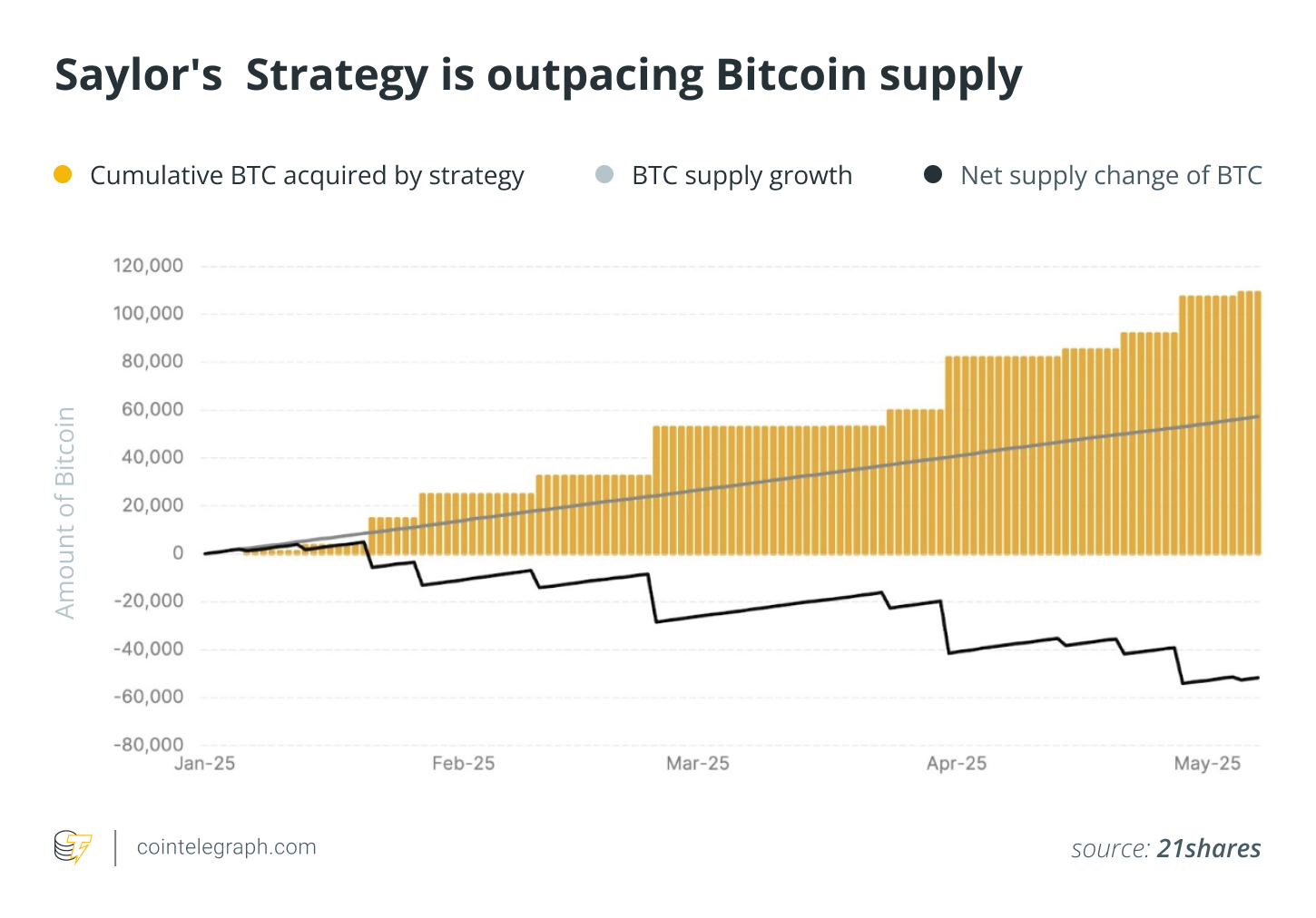
Saylor’s strong belief evolved from an initial bold move into dominating corporate Bitcoin demand, significantly impacting market dynamics through substantial scale. By the beginning of 2025, MicroStrategy controlled more than 2% of Bitcoin’s total capped supply, totaling about half a million BTC.
In 2025 alone, MicroStrategy accumulated over 150,000 BTC at an average cost near $94,000, bringing the market value of their holdings to above $50 billion.
These massive purchases are exerting downward pressure on Bitcoin’s limited supply, increasing competition for scarce coins among corporations. Saylor established a new industry standard that other firms began to emulate. In just the first five months of 2025, Bitcoin purchases by institutions and corporations surpassed $25 billion.
This growth altered MicroStrategy’s core identity: software revenues were overshadowed by the significant impact of Bitcoin on its overall valuation. The strategy of raising capital—issuing both stock and debt to finance further purchases—became a subject of scrutiny. A decline in Bitcoin’s value could potentially burden the company with heavy debt, and over-dilution of stock could erode investor confidence.
In June 2025, MicroStrategy increased its holdings with an addition of 10,100 BTC through a $1.05 billion investment, bringing its overall expenditure on Bitcoin to almost $42 billion. The company’s strategy is now replicable, albeit with increased systemic risk.
Saylor’s evolution from a tech CEO to an architect of cryptocurrency treasuries has established him as both a controversial figure and an inspiration to many. His aggressive approach has redefined not only MicroStrategy’s valuation but also the broader narrative of institutional adoption.
Interesting Fact: Saylor revealed that before shifting company assets to Bitcoin, he personally invested in 17,732 BTC, valued at nearly $175 million at the time. This personal investment provided him with the conviction needed to advocate for MicroStrategy’s substantial allocation to Bitcoin.
The Future for Saylor and Bitcoin
Saylor shows no indication of slowing down. MicroStrategy is continuing to aggressively invest in Bitcoin, including financing additional acquisitions through convertible debt and other innovative financial tools. With Bitcoin halving events increasing scarcity and growing institutional interest, Saylor is positioning Bitcoin as not just a store of value but as a standard for corporate treasuries.
Going forward, key questions remain: Will other companies follow MicroStrategy’s lead? How will regulatory frameworks influence corporate adoption? And will Bitcoin’s role be limited to balance sheets or extend to other aspects of the financial system? If Saylor’s predictions prove correct, he could be recognized as a key figure who transformed business financing through Bitcoin adoption.
Lessons from Saylor’s Bitcoin Strategy
While Saylor’s journey is unique, his approach provides insights for anyone considering investing in Bitcoin:
-
Conduct thorough research before investing: Before committing capital, Saylor spent months studying Bitcoin’s underlying technology and economic model. Novice investors should avoid hype and focus on credible sources, white papers, and reliable analysis.
-
Adopt a long-term mindset: Saylor’s objective isn’t short-term profit. Individuals should only invest what they can hold through market fluctuations, rather than attempting to time the market.
-
Prioritize risk management: MicroStrategy’s borrowing to buy Bitcoin was a daring move. Retail investors should be cautious, avoid excessive debt, and maintain cryptocurrency as a segment of a diversified portfolio.
-
Maintain conviction, but remain adaptable: Saylor methodically planned his Bitcoin purchases, increasing investments even during downturns. Dollar-cost averaging can be a valuable strategy for new investors.
-
Distinguish personal beliefs from company strategy: Not everyone can leverage corporate resources for Bitcoin investments. Saylor combined personal holdings with MicroStrategy’s treasury. It’s advisable to keep personal savings separate from speculative investments.
Even without Saylor’s financial resources, you can apply aspects of his strategy, like conducting thorough research, and practicing patience and discipline, to effectively navigate the world of Bitcoin investing.
This article should not be considered investment advice. Investing and trading always involve risks, and readers should perform their own due diligence when making financial decisions.