

Shares of Coinbase (NASDAQ: COIN), the leading cryptocurrency exchange in the United States, experienced a surge of 4.15%. This positive movement is attributed to growing investor optimism surrounding the company’s expanding involvement in the burgeoning fields of cryptocurrency, sustainable practices, and carbon offset markets.
Coinbase is actively incorporating environmentally conscious digital currency strategies. In response to the global shift towards climate-conscious finance, the platform will soon feature tokenized carbon offset credits alongside digital asset approaches that align with Environmental, Social, and Governance (ESG) principles.
This development arrives at a crucial time, as governments, businesses, and investment entities are increasingly focused on reducing carbon emissions. Within this context, blockchain technology is emerging as a critical tool, offering enhanced transparency, improved efficiency, and greater scalability for carbon markets.
Coinbase’s Role at the Confluence of Digital Currency and Climate Action
Coinbase, a prominent player in the digital asset sphere, intends to capitalize on this growing momentum. The exchange aims to bridge the gap between mainstream digital finance and innovative, sustainable financial solutions.
The stock’s upward trend follows encouraging regulatory indications from the U.S. government. Proposed regulations suggest the allowance of spot cryptocurrency trading on regulated exchanges, potentially easing existing constraints.
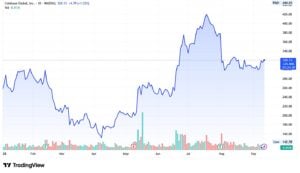
In addition, lawmakers are championing the Financial Innovation Act of 2025, designed to provide greater clarity on digital asset oversight. These announcements have boosted market sentiment, with the overall cryptocurrency market capitalization surpassing $4 trillion. This regulatory tailwind complements existing factors that support Coinbase’s long-term strategy concerning ESG and asset tokenization.
Currently, Coinbase has not introduced its own dedicated carbon-neutral blockchain endeavor explicitly branded as such.
Nonetheless, the cryptocurrency platform actively supports a diverse array of carbon-neutral and eco-friendly blockchain projects and associated tokens. This underscores the company’s commitment to sustainability within the digital asset space and aligns with wider industry efforts aimed at achieving carbon neutrality and promoting environmental responsibility. These broader trends include:
-
The adoption of energy-efficient consensus mechanisms, such as proof-of-stake or hybrid variations.
-
The integration of renewable energy sources for activities like mining and transaction validation.
-
Support for on-chain carbon offset initiatives and transparent accounting practices.
-
Collaboration with climate and blockchain experts to foster the development of carbon-neutral ecosystems.
Industry reports from 2025 frequently highlight blockchain projects with a strong focus on carbon neutrality, including platforms like Algorand, Hedera, Cardano, and Polkadot, which utilize low-energy consensus models and carbon offsetting strategies.
Coinbase primarily functions as a market facilitator, an exchange platform, and an advocate within this ecosystem, rather than directly developing or managing a carbon-neutral blockchain network.
For institutional investors who are concerned about the environmental impact of cryptocurrency, a carbon-neutral blockchain may provide a gateway for integrating ESG-compliant digital assets into their portfolios.
Carbon Credit Tokenization: Enhancing Liquidity and Building Trust
Beyond its involvement in environmentally friendly cryptocurrency, Coinbase is also expanding its reach into the tokenization of carbon credits, a sector possessing significant untapped potential. Tokenization involves the representation of tangible assets, such as verified carbon offsets, on a blockchain network. This innovative approach addresses several long-standing issues within traditional carbon markets:
- Transparency: Blockchain’s inherent ledger system ensures meticulous tracking of all carbon credits, effectively preventing the practice of double-counting.
- Liquidity: The tokenized format allows for more efficient trading of carbon credits, increasing accessibility for a broader range of participants.
- Verification: The incorporation of smart contracts and independent third-party auditing mechanisms fosters greater confidence in the integrity of carbon offsets.

Coinbase previously listed Moss’s MCO2 token, a carbon credit asset operating on the Ethereum blockchain. While trading was subsequently paused due to liquidity concerns, this trial demonstrates Coinbase’s underlying interest in ESG tokens and hints at the company’s willingness to integrate real-world environmental assets into its platform.
The broader industry is exhibiting a similar trend. Companies like JPMorgan and S&P Global are exploring the use of blockchain technology for carbon credit markets, while a number of startup ventures are actively pursuing carbon credit tokenization at scale. Early investments in relevant infrastructure and strategic partnerships could position Coinbase as a leader in the emerging market for digitized carbon assets.
Convergence of Wall Street and Web3: A $12.5B Investment in Carbon Solutions
The integration of green cryptocurrency initiatives and tokenized carbon markets is gaining significant traction, fueled by increasing institutional backing and substantial financial commitments. In the second quarter of 2025, Web3 platforms specializing in carbon infrastructure secured a total of $12.5 billion in funding, illustrating a robust confidence in blockchain’s transformative role within climate-focused markets.
Coinbase is strategically positioning itself to become the preferred platform for these emerging innovations. Recent regulatory successes and the establishment of new alliances at the 2025 State of Crypto Summit highlight the company’s broader objective: to spearhead the development of transparent, ESG-compliant digital asset strategies. Their expansion into tokenized stocks and prediction markets further reinforces this aspiration.
This strategy is particularly relevant to institutional investors, such as pension funds, asset managers, and corporations with established ESG objectives, who require access to reliable platforms that facilitate access to compliant and trustworthy tokenized carbon markets.
Coinbase’s well-established brand, strong regulatory track record, and robust infrastructure make it a suitable option for meeting this rising demand.
Shifting Perceptions: From Criticism to Climate Positive in the Cryptocurrency Sector
Coinbase’s dedication to sustainability has far-reaching implications for the broader cryptocurrency sector. By integrating environmental considerations into its product offerings, the company is reshaping the narrative surrounding blockchain, presenting it not only as a potentially energy-intensive technology but also as a tool with the capacity to drive positive climate outcomes.
Coinbase is also expanding its presence in the realm of real-world assets (RWAs), including carbon credits and tokenized equities. This diversification broadens the company’s business model. With tokenized assets approaching $300 billion in value (largely due to stablecoins), analysts predict that carbon credits and ESG-linked products will represent the next major growth area.
For cryptocurrency investors, this development opens up new potential revenue streams while introducing greater transparency and liquidity to carbon markets that have historically been opaque and fragmented.
Coinbase’s ESG Performance: Progress and Areas for Improvement
Coinbase’s ESG profile is continuously evolving. Independent evaluations indicate moderate levels of transparency while identifying opportunities for enhancement, particularly in environmental disclosure practices. While ESG rating platforms typically award Coinbase strong scores for governance, ratings related to carbon footprint reporting tend to be lower.
Coinbase can further strengthen its ESG credentials by actively promoting carbon-neutral blockchain initiatives and supporting the adoption of tokenized carbon assets. The company must also demonstrate sustained reductions in its operational emissions and provide clearer reporting to meet the expectations of regulators and institutional clients.
Relevance for Investors and Carbon Market Participants
The confluence of green cryptocurrency initiatives and tokenized carbon credits signifies more than just a niche trend; it represents the convergence of digital finance and climate action. Coinbase’s active participation in this convergence generates significant implications for various stakeholders:
- Cryptocurrency Investors: Access to ESG-compliant digital assets enables portfolio diversification and provides exposure to rapidly expanding sustainability-related sectors.
- Carbon Market Stakeholders: Tokenization offers enhanced efficiency, global accessibility, and robust verification mechanisms for carbon credit trading activities.
- Institutional Investors: Coinbase facilitates access to ESG-linked digital assets, aligning with the growing needs of sustainable finance strategies.
- Sustainable Finance Innovators: The platform’s underlying infrastructure has the potential to accelerate the adoption of green tokens across both retail and institutional markets.
Coinbase’s Strategic Embrace of Sustainability
The cryptocurrency platform’s recent stock gains suggest that investors are increasingly viewing the company as more than just a cryptocurrency exchange, but as a pivotal link between blockchain technology and sustainable finance.
Coinbase’s ongoing experimentation with carbon credit tokenization and expansion into broader tokenized asset classes positions it to capitalize on the projected market growth in the coming years, as illustrated below.

For cryptocurrency investors, the implication is clear: green cryptocurrency is transitioning into a core component of the digital finance landscape. Coinbase, with its platform catering to carbon market participants, is positioned to foster greater trust, transparency, and liquidity in environmental assets. By actively integrating ESG-aligned digital assets, the exchange stands to gain a competitive advantage in both the cryptocurrency and broader carbon markets.