


As of September 12, 2025, the total value of tokenized U.S. Treasury bonds circulating on public blockchains reached $7.42 billion. According to data compiled by
RWA.xyz, a significant portion of these assets are concentrated within issuances linked to the Ethereum network.
The introduction of Fidelity’s new
OnChain share class
further solidifies the presence of institutional players in this space. The Fidelity Treasury Digital Fund’s OnChain Class, represented on Ethereum by the
Fidelity Digital Interest Token, currently holds approximately $203.7 million. Bank of New York Mellon serves as the custodian for these assets, which are distributed among two on-chain holders.
SEC filings for the fund detail the OnChain class structure, where the official share register is maintained in traditional book-entry form by the transfer agent, while ownership details are also recorded on a public blockchain. According to RWA.xyz and fund documentation, the fund allocates at least 99.5% of its portfolio to cash and U.S. Treasuries, adhering to Rule 2a-7 regulations.
Current data reveals the scale and growth rate within this sector.
BlackRock’s
USD Institutional Digital Liquidity Fund is valued at nearly $2.20 billion. The
WisdomTree’s
Government Money Market Digital Fund holds around $832.3 million, marking a roughly 40% increase over the past 30 days, as reported by the tracker.
Franklin Templeton’s
on-chain U.S. government money fund stands at approximately $752.3 million.
Ondo’s
short-term government bond fund has a value of about $729.6 million, while its yield token,
USDY, is valued at around $690.4 million.
Circle’s
USYC holds approximately $579.1 million. These offerings are available on Ethereum and various Layer-2 scaling solutions, including Base, Optimism, and Arbitrum, as well as, in some instances, Solana, Avalanche, and Stellar.
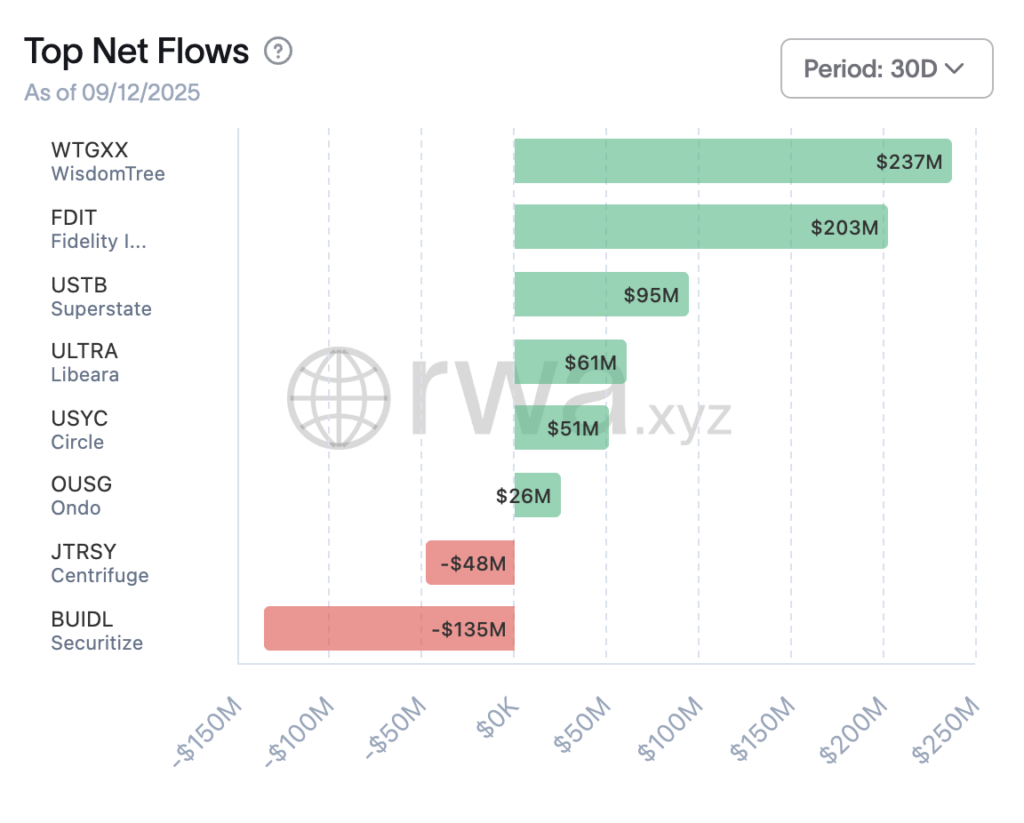
To reach $10 billion by the end of the year, the market would require an additional $2.58 billion from its current $7.42 billion base, translating to roughly $700 million per month until December. The potential capital available in traditional markets significantly exceeds this target.
According to the
Investment Company Institute, U.S. money market fund assets totaled $7.26 trillion for the week ending September 3. A reallocation of just one basis point into tokenized Treasury funds would equal about $726 million, and three basis points would amount to approximately $2.18 billion. Government funds remain the predominant category, highlighting an addressable investor base already familiar with the underlying assets.
Yield rates and on-chain transaction costs are key drivers of growth. As of September 10, three-month Treasury bill
rates
stood at 3.94%, impacting income earned across tokenized funds and influencing demand for “on-chain dollars with yield.”
Regarding settlement costs, empirical studies on Ethereum’s EIP-4844 show reduced data availability fees for rollups following the Dencun upgrade, which lowers barriers for minting, transferring, and redeeming on Layer-2 networks where many RWA tokens are active, as detailed by the
Ethereum Foundation.
Distribution channels are as important as the technology itself.
Circle’s
USDC smart contract off-ramp for BUIDL facilitates near-instant redemptions into stablecoins around the clock.
USYC can now be used as yield-bearing off-exchange collateral for
Binance’s institutional clients
through bank triparty or Ceffu custody, expanding use beyond trading and keeping assets on-chain during derivatives activities. This strengthens the appeal of tokenized cash instruments as collateral and treasury assets, not just as passive investments.


Wall Street Doesn’t Want You to See This…
Get 5 days of high-level strategies the pros use to win in crypto. Limited seats available — claim yours now.
Brought to you by CryptoSlate
Reaching $10 Billion by December: A Plausible Scenario
Should the combined value of BUIDL, WTGXX, BENJI, OUSG, and USYC grow by 8% to 10% in the next three and a half months, it would independently add approximately $600 million to $800 million to the total.
Adding a reasonable contribution from new or recently launched share classes, such as Fidelity’s OnChain Class, and potential subsequent offerings from other fund managers, the market could readily meet the remaining gap. Based on 30-day changes tracked by RWA.xyz, certain products are already growing at rates that, even if slightly reduced, support this trajectory.
In a more optimistic scenario, reaching $10.8 billion to $11.5 billion, we anticipate two additional major players entering the market or large mandate allocations in Q4, totaling $1.0 billion to $1.5 billion, coupled with consistent net inflows into existing funds.
The money market base suggests that a shift of two to three basis points from traditional products would more than cover this range, assuming qualified purchasers and professional investors are seeking on-chain settlement and round-the-clock transferability, as indicated by the
ICI weekly series.
A more conservative outcome, nearing $9.1 billion to $9.6 billion, could result if front-end yields decrease towards 3.5% and on-chain minting activity decelerates, or if tokenized fund buyers pause before year-end.
Even in this situation, the investor infrastructure continues to develop, as share classes like
Fidelity’s OnChain Class
record ownership on-chain while adhering to money market regulations and custody standards, maintaining the groundwork for future issuances.
The market is also converging on Ethereum as the primary network. RWA.xyz’s data shows that leading vehicles are predominantly available on Ethereum, with many also accessible via Layer-2 bridges. This strategic positioning, along with collateral integrations and stablecoin redemption pathways, directs volume into Ethereum’s settlement layer, even as more activity shifts to lower-cost rollups.
Key factors to monitor leading up to December include: on-chain holders and net mints tracked by RWA.xyz, new SEC filings for additional OnChain classes or series, and new collateral and custody arrangements that enable institutions to hold these tokens while maintaining risk controls.
If net mints continue at a monthly rate of $600 million to $800 million, the tracker is projected to reach $10 billion on Ethereum before the end of the year.