

Bitcoin mining firms are navigating a complex landscape, grappling with increasing computational difficulty, volatile revenues, significant upfront investment in equipment, and substantial electricity consumption. These factors compress earnings, underscoring the critical importance of efficient operations for maintaining profitability.
Insights from Everminer, Bitdeer, and CleanSpark, shared with BeInCrypto, reveal that mining companies are employing diverse tactics to overcome these obstacles. These range from refining financial strategies and streamlining operational workflows to forging new collaborative relationships with energy providers and branching out into alternative computing sectors.
Profitability Under Pressure
The Bitcoin mining sector is facing mounting challenges as network difficulty scales to unprecedented levels.
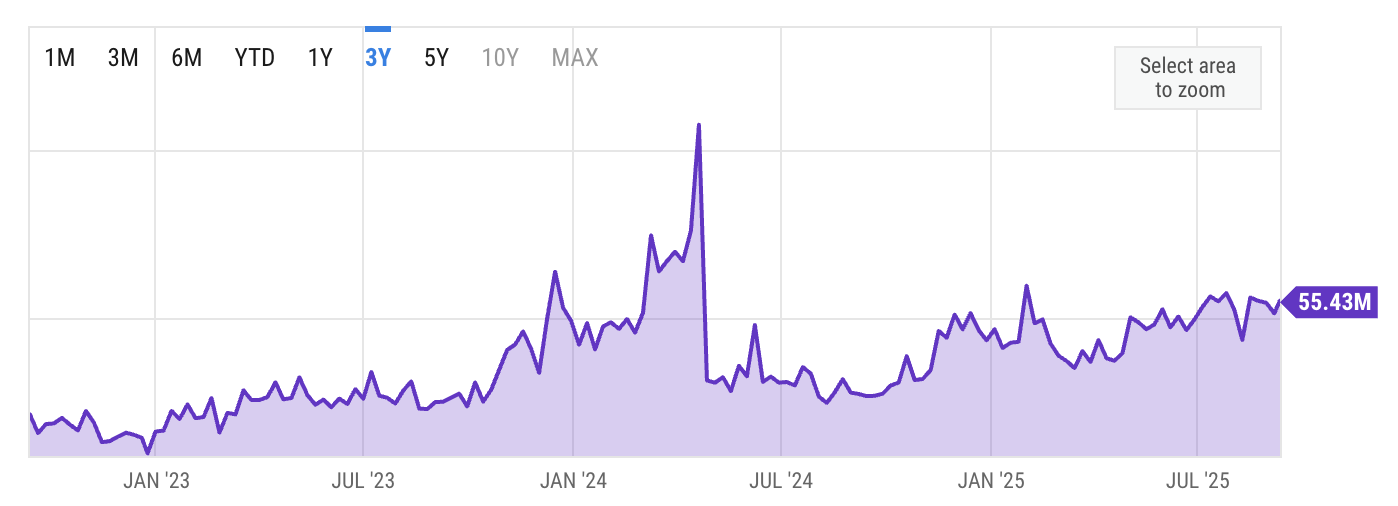
This month, the mining difficulty surged past 136 trillion, marking the fifth consecutive rise since June. This increase, driven by a greater influx of computing power into the network, coincides with a weakening of miner earnings. Hashprice, a key revenue indicator, has dipped to approximately $51, its lowest point since June.
Sponsored
Sponsored
The confluence of record difficulty and decreasing revenue is exerting considerable strain on profit margins.
Historically, September’s lackluster price performance compounds the issue, directly impacting miner rewards. This recent downturn stands in contrast to the more favorable trends observed just a month earlier in August, when miner profitability improved as Bitcoin’s value rose faster than the difficulty adjustment.
Experienced Bitcoin miners attribute the current instability to a variety of market pressures.
The Increasing Cost of Maintaining a Competitive Edge
In the increasingly competitive Bitcoin mining arena, miners differentiate themselves through strategic responses to challenges and unique approaches to scaling operations.
“We are continuously adapting to network difficulty and periodic halving events, the most recent of which occurred in early 2024. We must consistently manage Bitcoin price fluctuations, cyclical energy market dynamics, and advancements in mining hardware technology. Consequently, numerous miners have found it challenging to navigate these intricate conditions,” noted Harry Sudock, Chief Business Officer at CleanSpark, in a statement to BeInCrypto.
Long-standing miners recognize that factors such as price volatility are inherent to the Bitcoin ecosystem. As Bitcoin adoption grows and network complexity increases, they must also adapt to rapidly escalating costs.
“Equipment costs represent approximately 80% of facility [capital expenditures], while energy accounts for around 80% of [operational expenses],” explained Ross Gan, Chief Communications Officer at Bitdeer. He further stated, “The primary long-term threat is efficiency erosion: rising difficulty and diminishing block rewards render mining unsustainable for operators lacking the lowest costs for capital, energy, and hardware.”
Over time, mining operations have developed specialized operational strategies, crucial for weathering unpredictable market conditions.
Operational Strategies: From Debt Management to Fiscal Prudence
In discussing CleanSpark’s approach to financial discipline, Sudock highlighted the company’s commitment to “capital stewardship.” This approach emphasizes the responsible and strategic management of corporate assets to generate long-term shareholder value.
Sponsored
Sponsored
The company finances its operations internally, avoiding reliance on external investors or excessive debt.
“Given our strong balance sheet and prudent approach to debt, we have a flourishing business with substantial growth potential,” he stated.
To further boost its earnings, CleanSpark actively manages its Bitcoin holdings, strategically accumulating Bitcoin during profitable periods.
“We don’t simply hold our Bitcoin; we have established a dedicated digital asset management team to actively manage and efficiently monetize our holdings,” Sudock added.
Meanwhile, in response to rising cost pressures, companies like Bitdeer are pursuing vertical integration, a strategy that involves bringing the supply chain under direct oversight, from manufacturing to distribution.
“Developing and deploying proprietary ASICs and generating the power required for mining reduces capital expenditure, ensures supply security, and enhances operational flexibility,” he explained.
By controlling their supply chains, Bitcoin mining firms can reduce their reliance on external vendors.
While operational efficiency and strategic planning can mitigate many challenges, miners must also contend with external factors largely beyond their control.
The Advantages of Geographic Distribution
Bitcoin mining businesses have learned the value of diversifying their operational footprint across different regions. Regulatory environments and policies can differ substantially from country to country and even between states or provinces within the same country.
“The real threat today is policy and regulatory uncertainty. A government can abruptly change the rules, potentially freezing your hardware assets. This scenario is a nightmare—millions of dollars in equipment rapidly depreciating and difficult to relocate quickly. We have witnessed this in China in 2021, Russia in 2024, and most recently in Ethiopia,” stated Max Matrenitski, CEO of Everminer and Cyberian Mine GmbH.
Sponsored
Sponsored
This experience underscored the importance of mitigating risk through regional diversification.
“We operate facilities across multiple jurisdictions and climates. The underlying logic is simple: the US offers political stability but faces restrictions and higher costs; Ethiopia provides affordability with substantial margins but carries policy risk; Paraguay has surplus hydroelectric power and competitive sector pricing; Finland offers predictability with excellent uptime; and Siberia boasts ambient cooling and low operating expenditures, albeit with political risks. No single location should have the potential to cripple your entire business,” he added.
Beyond mitigating political risks through location, miners are now leveraging their geographic presence to become valuable partners to the energy grid.
From Energy Consumers to Strategic Grid Allies
Bitcoin miners have historically been perceived as large, continuous consumers of electricity. However, industry leaders are reshaping this perception by positioning themselves as beneficial partners for the power grid, particularly as the grid increasingly incorporates renewable energy sources.
“Contrary to popular belief, Bitcoin mining aligns well with environmentally friendly principles and offers significant advantages for a greener future and a more efficient global energy system. Mining naturally gravitates toward the lowest-cost electricity sources, which are frequently surplus renewable energy, particularly hydroelectric power. This makes it ideal for providing consistent baseload power. Consequently, miners tend to cluster around large hydroelectric dams in regions such as Siberia, Ethiopia, and Paraguay, where electricity is affordable, stable, and environmentally friendly,” Matrenitski told BeInCrypto.
This natural synergy with renewable energy and its cost-effectiveness enables miners to play a more active role in grid stabilization. Based on this mutually beneficial relationship, miners are increasingly viewed as valuable allies for the power grid.
“Reports from certain regions indicate that curtailments from miners have contributed to maintaining grid reliability. [Power grid operators such as] ERCOT and PJM are formalizing mechanisms through which miners can monetize demand response, positioning them as grid stabilizers rather than stressors. This grid integration will intensify as renewable energy capacity expands,” Gan emphasized.
If other strategies fail to shield against unfavorable market conditions, some miners are diversifying into new markets.
Sponsored
Sponsored
The Emerging Discussion: Mining vs. High-Performance Computing
While some Bitcoin mining operators are focused on refining their current operational strategies and financial models, a growing number are exploring a new frontier: diversifying into High-Performance Computing (HPC) and Artificial Intelligence (AI) services.
Miners like Bitdeer and CleanSpark view this shift as a natural extension of their existing business models.
“Mining and AI/HPC workloads require different types of data center infrastructure but can leverage the same foundational elements related to power, cooling, and grid interconnections,” Gan explained.
Sudock concurred, adding:
“HPC has significant uptime requirements and is less price sensitive than Bitcoin mining. The balance between these dynamics makes certain segments of the grid and our power portfolio well-tailored to each use case.”
This potential shift has emerged as a key strategic opportunity and a subject of intense debate within the industry.
Matrenitski argued that while both sectors consume considerable energy, their underlying business models are fundamentally distinct.
“HPC and mining are fundamentally different: they require different hardware, have different capital expenditure and operating expenditure structures, have different network demands, and have completely different unit economics… Mining relies on ASICs—highly specialized machines—while HPC utilizes GPUs, which are inefficient for Bitcoin mining,” he said.
Simply owning the computing equipment is no longer sufficient to generate a profit.
“If you have true data-center expertise—networking, cooling, enterprise support—you can secure solid hosting contracts and make it work. However, the days of easy profits are over. The profit margins lie in delivery and long-term contracts, not in simply ‘buying GPUs and profiting.’ Many will underestimate the difficulty of this business,” Matrenitski added.
Fortunately for miners, a range of strategies can be employed to navigate challenging market conditions. The most effective solution will depend on the unique business model and leadership of each company.