

A modern-day contest for financial influence is unfolding as major global economies vie for dominance in the realm of stablecoins. This relatively new form of digital money has the potential to either revolutionize or significantly disrupt how individuals, businesses, and nations conduct financial transactions.
Stablecoins are a type of cryptocurrency designed to maintain a stable value by being linked to a national currency or a commodity like gold. The core concept is that this linkage to a stable asset makes them less susceptible to the price swings often seen in other cryptocurrencies.
Imagine a “digital dollar.” These stablecoins are designed to have a one-to-one exchange rate with their traditional counterparts, with reserves held by investors as security. The goal is for these digital coins to be easily and instantly convertible into the corresponding real-world asset, regardless of location or additional expenses.
Claire Wilson, a policy analyst at the Council of Canadian Innovators, points out, “Currently, stablecoins aren’t widely used. You can’t walk into a grocery store and pay with them.”
However, she adds, “In the future, their potential for faster transactions and lower fees could lead to broader adoption.”
Following the establishment of a U.S. regulatory framework for stablecoins, China is reportedly developing similar regulations. This move could promote the international use of its currency and challenge the U.S. dollar’s global standing.
Edmonton AM
How is stablecoin influencing the White House?
Last Friday, President Trump signed the GENIUS Act into law, creating the first major regulatory framework for cryptocurrency in the United States. The legislation specifically targets stablecoins, which have become a massive part of the crypto ecosystem. Dana DiTomaso is our technology columnist.
A Developing Technology
The emergence of stablecoins dates back to 2014 with Tether, a U.S. company that pioneered the concept by linking its coin to the U.S. dollar. While not yet mainstream, stablecoins hold promise for international remittances, according to Wilson.
Advocates claim that stablecoins could reduce the costs of international money transfers, particularly benefiting immigrants who face significant fees when sending money to their families abroad.
Wilson explains, “Typically, sending money to Latin America or Africa incurs significantly higher bank fees compared to transfers between countries like Canada and Germany.”
Stablecoins utilize blockchain technology, a decentralized system for recording and validating transactions. This eliminates the need for traditional intermediaries like banks.
While this can expedite payments, critics express concern over the potential for stablecoins, and cryptocurrency in general, to be used for illicit activities because they bypass the safeguards of traditional financial systems.
Concerns also exist that stablecoins, being relatively untested, could trigger financial instability similar to a bank run. A loss of confidence in the one-to-one valuation could lead to mass withdrawals and a collapse in value, as seen with the Terra-Luna stablecoin in 2022.
Recently, major nations have begun developing regulations to govern stablecoins. The U.S. GENIUS Act, passed previously, allows private companies to issue and accept stablecoins but has faced criticism for insufficient fraud protection.
Reportedly, major companies like Amazon and Walmart, and U.S. banks such as JPMorgan Chase and Citigroup, are considering developing their own stablecoins. The EU also established its regulatory framework in 2023 with MiCA, the Markets in Crypto-Assets Regulation.
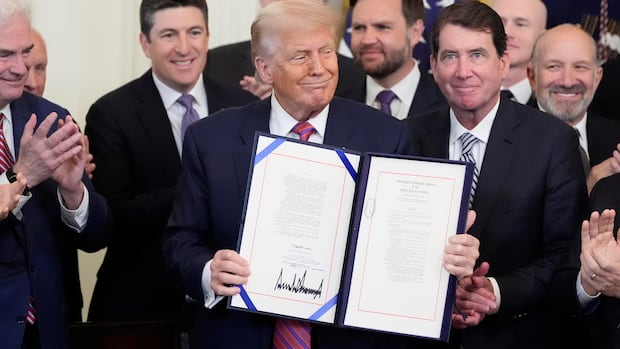
U.S. lawmakers passed the country’s first major national cryptocurrency legislation Friday. The GENIUS Act outlines a set of rules and regulations primarily affecting stablecoins — a specific type of cryptocurrency often backed by the U.S. dollar.
The Push for Stablecoin Independence
While similar, stablecoins are different from central bank-issued digital currencies (CBDCs), which are government-backed. They are also not investments such as stocks.
In Europe and the U.S., stablecoins are classified as e-money tokens under their regulatory frameworks. Canada, however, treats them as securities, a classification some believe hinders the development of stablecoins backed by Canadian assets.

Katrin Tinn, an associate professor of finance at McGill University, observes that “Canada is generally fintech-friendly but also cautious. It was among the first to examine central bank digital currencies.”
However, the Bank of Canada ceased its CBDC project last year, opting to focus on the broader evolution of payment systems through research and policy analysis.
According to research by the Bank for International Settlements, most stablecoins are currently linked to the U.S. dollar.
Wilson suggests that other countries are regulating stablecoins to protect their financial sovereignty against U.S. dollar dominance.
The U.S. dollar has long been the world’s primary reserve currency, but this status faced scrutiny earlier this year when foreign investors seemed to reduce their holdings of U.S. Treasury bonds. Treasury Secretary Scott Bessent believes stablecoins will enhance the appeal of U.S. Treasuries.
Wilson emphasizes that the widespread adoption of stablecoins backed solely by the U.S. dollar could lead to capital flight from other countries’ banking systems into U.S. reserves.
Potential Impact on the Global Economy
China made a bold move by introducing its CBDC in 2019, aiming to compete with private payment platforms like Alipay and WeChat. Christian Catalini, founder of MIT’s Cryptoeconomics Lab, suggests that China may be reconsidering CBDCs now that the U.S. has established a regulatory framework for private stablecoins.
Catalini, who was involved with Facebook’s discontinued stablecoin project, notes that “No government wants to rely on another government’s infrastructure.”
Catalini believes the U.S. has influenced global policy through organizations like SWIFT and the imposition of sanctions.
He adds, “As China’s influence grows, we can expect more technological innovation originating from the East.”
While it’s highly improbable that China’s yuan will displace the U.S. dollar as the dominant global currency, Catalini acknowledges that “stranger things have happened.”
He concludes, “Historically, major shifts in the global economic order, including wars, have led to the emergence of new dominant currencies.”