
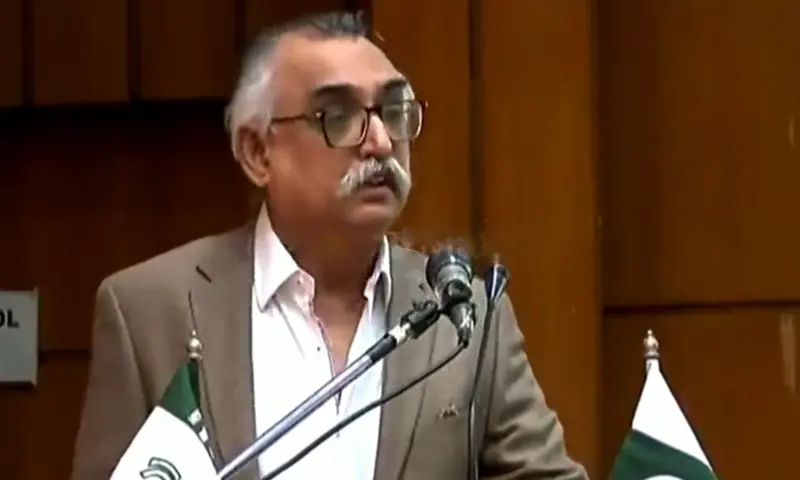
KARACHI: According to Shabbar Zaidi, a former chairman of the Federal Board of Revenue (FBR) and a prominent economist, Pakistan’s existing financial framework, characterized by stringent State Bank control over foreign exchange, presents challenges to regulating cryptocurrencies. He suggested that, despite these regulatory hurdles, virtual assets might become an alternative method similar to hawala for certain transactions.
During a discussion titled “Adopting Digital Currency and Cryptocurrency in Pakistan: Possibilities and Concerns,” organized by the Pakistan Institute of International Affairs (PIIA) on Saturday, Mr. Zaidi shed light on both the potential benefits and inherent risks associated with digital currencies.
He mentioned that legislation intended to enable cryptocurrency regulation has been passed and is currently under consideration by the parliament. He highlighted, however, the inherent regulatory difficulties presented by the decentralized nature of digital or virtual currencies.
“The core appeal of cryptocurrencies lies in their untraceable nature. You cannot regulate a currency that is inherently designed to be unregulated,” he stated. While noting the widespread adoption of cryptocurrencies in the United States, he emphasized the key distinction of a more liberal foreign exchange system. In Pakistan, commercial banks require State Bank approval for dollar transactions.
Pakistan’s system struggles to regulate virtual currencies; approximately 9 million Pakistanis are estimated to hold digital assets.
Trust and Acceptance
Mr. Zaidi estimated that around nine million Pakistani citizens are currently engaged in holding or trading virtual currencies, with Bitcoin being the most prominent. Bitcoin is a decentralized digital asset where all transactions are recorded on a blockchain, and its creation is independent of central banking authorities.
He further explained that digital currencies are already in use for transaction settlements, which includes under-invoicing in trade with China, essentially mirroring the workings of the hawala system. “The discussion is not about whether we are adopting too quickly or slowly. The fundamental challenge is that our current financial architecture is not equipped to regulate it,” he asserted.
He emphasized the importance of trust as the bedrock of any currency, drawing parallels with the historical dominance of the British pound and the current status of the US dollar. He posited that a trustworthy digital currency could potentially emerge as a globally recognized medium of exchange.
He suggested that theoretically, asset-backed cryptocurrencies could be introduced, but their adoption would likely be limited because unregulated digital assets offer a convenient pathway for converting illicit funds into legitimate ones.
Referencing international examples, he pointed out India’s formal rejection of cryptocurrencies, contrasting it with the ongoing increase in their popularity within the United States.
He also linked cryptocurrencies to political discourse in the US, alleging that the administration of former President Donald Trump supported their proliferation, in part due to resistance from the Federal Reserve. Mr. Zaidi referenced a banker’s claim that the Trump family accrued $2.4 billion in earnings through virtual currencies during their tenure.
Digitization Versus Crypto
While acknowledging the progress Pakistan has made in digitizing its financial systems, Mr. Zaidi made it clear that cryptocurrency exists in a separate sphere altogether.
“Digitization focuses on documentation and traceability. Cryptocurrency, conversely, thrives on anonymity and a lack of central control,” he elaborated.
Experts participating in the session suggested that the use of virtual currencies in Pakistan is likely to experience continued growth, especially as stringent foreign exchange controls limit alternative methods for international payments.
Published in Dawn, September 14th, 2025