


Despite a significant governance update that aims to redefine its tokenomics,
Polkadot’s DOT
token experienced a decline of almost 5% in its value over the last day.
On September 14th, the Polkadot team
announced
on X (formerly Twitter) that the community had successfully voted in favor of the
“Wish for Change” proposal. This proposal introduces a fixed maximum supply of 2.1 billion DOT tokens.
This decision marks the end of Polkadot’s previously uncapped issuance model, which led to the creation of
approximately 120 million new tokens each year.
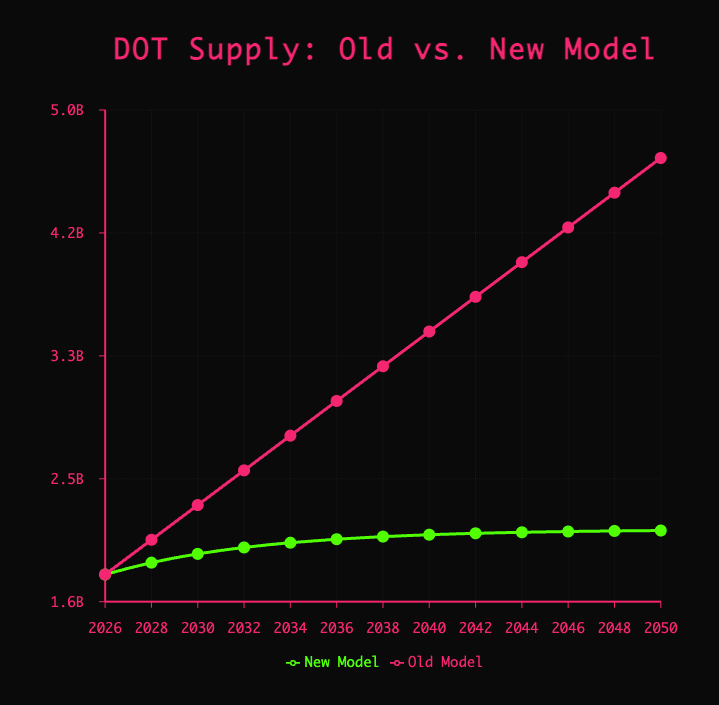
Currently, around 1.6 billion DOT tokens are circulating in the market. This means that over three-quarters,
specifically 76%, of the ultimate token supply has already been created.
Polkadot’s stated goal is to bring more stability to its long-term financial structure by establishing a token
scarcity and gradually reducing inflation’s role as a funding method. This transition reflects a broader initiative
to lessen the network’s reliance on continuous token issuance and steer the ecosystem towards generating revenue
from other sources.
DOT’s New Inflation Approach
The approved changes bring in a structured plan to reduce inflation, beginning on March 14, 2026. The revised plan
includes a two-year adjustment period where token creation is tapered off.
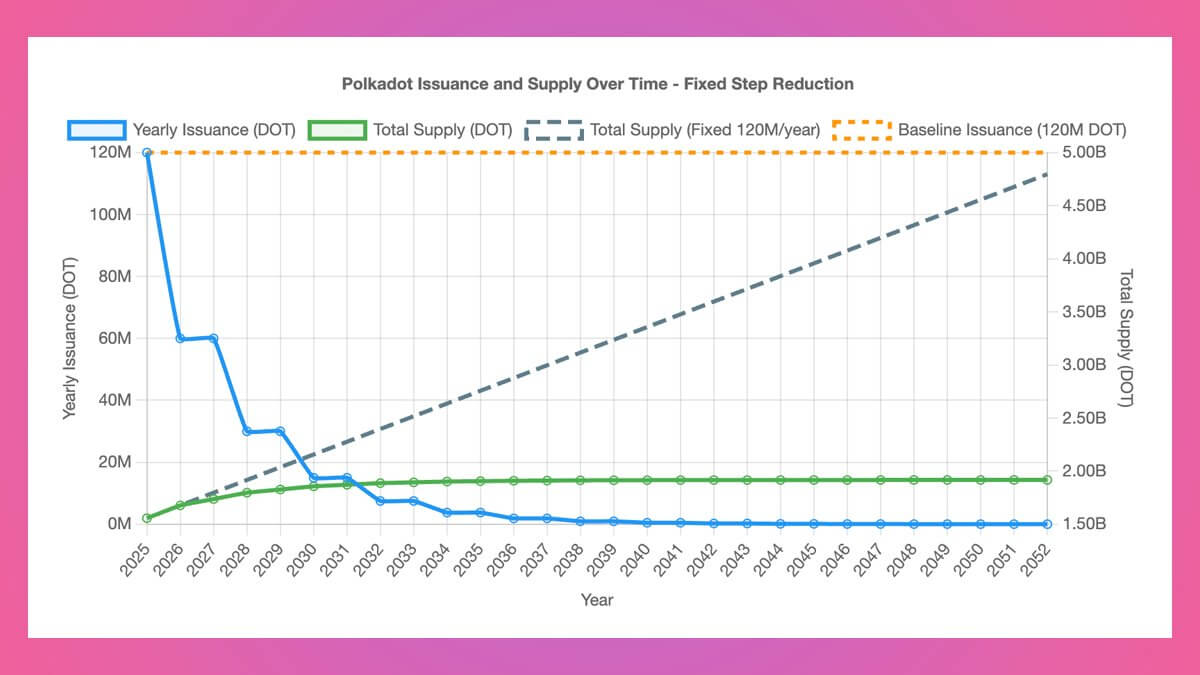
Polkadot projects that by the year 2040, roughly 1.91 billion DOT tokens will be in use, which is significantly
less than the 3.4 billion tokens that would have been circulating under the old system. It’s anticipated that the
maximum token limit will be reached around the year 2160.
To effectively manage this change, the proposal outlines three potential approaches for decreasing inflationary
pressure. One approach involves immediately reducing token emissions by more than 50% before gradually decreasing them,
while another option involves larger initial reductions, followed by a slower decline throughout the coming century.
Changes Within the Polkadot Ecosystem
This governance restructure is occurring as Polkadot actively strengthens its competitive position against rivals such
as
Ethereum
through projects like the
Polkadot
Capital Group, which is intended to form a bridge to traditional finance.
This period also sees the return of co-founder
Gavin Wood
as the CEO of
Parity Technologies, the primary development
company behind the Polkadot network.
Despite these developments, the token’s price decline has not been stopped.
Currently, DOT is trading at approximately $4.20, as indicated by CryptoSlate data, representing another decrease of
nearly 5% over the last 24 hours.
This drop adds to an already ongoing downward trend, with DOT’s value decreasing by approximately 34% since the start of
the year.
Disclaimer: CryptoSlate has received a grant from the Polkadot Foundation to produce content
about the Polkadot ecosystem. While the Foundation supports our coverage, we maintain full editorial
independence and control over the content we publish.