

Key Points to Remember:
-
ChatGPT helps speed up crypto research by analyzing information, summarizing how people feel about it, and creating templates for trading plans.
-
Traders are using it for practical things like building trading bots, understanding technical charts, and running test simulations.
-
It’s meant to help, not replace, human thinking and is most effective when used with tools like TradingView.
-
Some downsides are that it might not always have the latest real-time data, and it relies on clear instructions and human checking to be accurate.
The cryptocurrency market moves so fast and is so huge that no single person can fully understand it all. Every minute, tons of data are created from news, social media, on-chain metrics, and charts. For today’s average trader, the big challenge isn’t finding data, but making sense of it all to spot clear trading opportunities amid the constant flow of information.
This is exactly where artificial intelligence, especially a language model like ChatGPT, can go from being just a fun tool to a valuable assistant. This guide will show you how to systematically add ChatGPT to your trading process.
What Can Traders Use ChatGPT For?
Before we start, it’s important to set some rules for using ChatGPT in financial analysis. If you ignore these, you could end up with wrong conclusions and losing money.
-
The free version of ChatGPT can’t directly access live market data. However, users with ChatGPT Plus and Pro can browse the internet, giving them real-time info like current Bitcoin prices or the latest news. But its real strength is in studying and interpreting the data you give it.
-
What ChatGPT tells you is not financial advice. It’s just a tool for data analysis and understanding language. You are always responsible for your own financial decisions.
-
How useful ChatGPT is depends entirely on the quality, accuracy, and timeliness of the data you give it. Using bad data will definitely lead to bad analysis.
Creating Your ChatGPT-Based Analysis System
To get the most out of ChatGPT, you first need to become good at collecting data. Your goal is to gather good information from specialized platforms and then use ChatGPT to connect the dots. A professional setup should have these three things:
-
Reliable Price Data: This is a must. A platform like TradingView is key for getting real-time price movements, volume data, and lots of technical indicators.
-
Trusted Narrative Source: The crypto market is driven by stories and trends. Use reliable sources or specialized news services to stay up-to-date on regulations, tech upgrades, and big partnerships.
-
Fundamental Data Source: For more in-depth analysis, tools like Glassnode, Nansen, or Santiment offer valuable insights into how healthy a network is. This includes info on exchange inflows/outflows, big wallet activity, and network growth, which can often predict price changes.
With these tools, you can give ChatGPT the good data it needs to provide you with quality analysis.
Step-by-Step Guide to Finding Trading Signals with ChatGPT
This systematic process takes you from a general market overview down to a specific, well-defined trading strategy.
Step 1: Identify the Main Market Story
Crypto money tends to flow in waves, often chasing whatever story is currently popular. Is the market excited about AI tokens, tokenized real-world assets (RWAs), or the latest layer-2 scaling solution? Your first job is to use ChatGPT to find these main trends.
-
Action: Go to your news aggregator. Collect the headlines and first paragraph from the top 10-15 crypto market news stories from the last three to five days.
-
The Prompt: “Imagine you are a cryptocurrency market expert. I will give you a list of recent news headlines and summaries. You need to analyze this information and figure out the top 2-3 main market trends for August 2025. Name each trend (like ‘AI and Blockchain Working Together,’ ‘Regulatory Changes,’ ‘DeFi 2.0,’ ‘Tokenizing Real-World Assets’). For each major trend, explain why you think it’s becoming popular based on the text.”
News Items:
-
“BlackRock is applying to create a fund for tokenized treasury bonds, using Chainlink CCIP for cross-chain transactions.”
-
“Helium Network’s 5G coverage now reaches over 1,000 US cities, pushing the HNT token burn rate to new highs.”
-
“The SEC chairman suggests clearer rules for tokenized securities, boosting confidence in the RWA space.”
-
“IO.net announces a big partnership with Render Network to combine GPU resources for AI startups.”
-
“A JPMorgan Chase report says tokenizing real-world assets could be a $10 trillion market by 2030.”
-
“Filecoin sees a jump in enterprise data storage deals after a network upgrade.”
This analysis is a useful filter. Instead of randomly looking at hundreds of coins, you now have a focused list of areas where the market is paying attention and putting money.
Step 2: Check Market Sentiment with ChatGPT
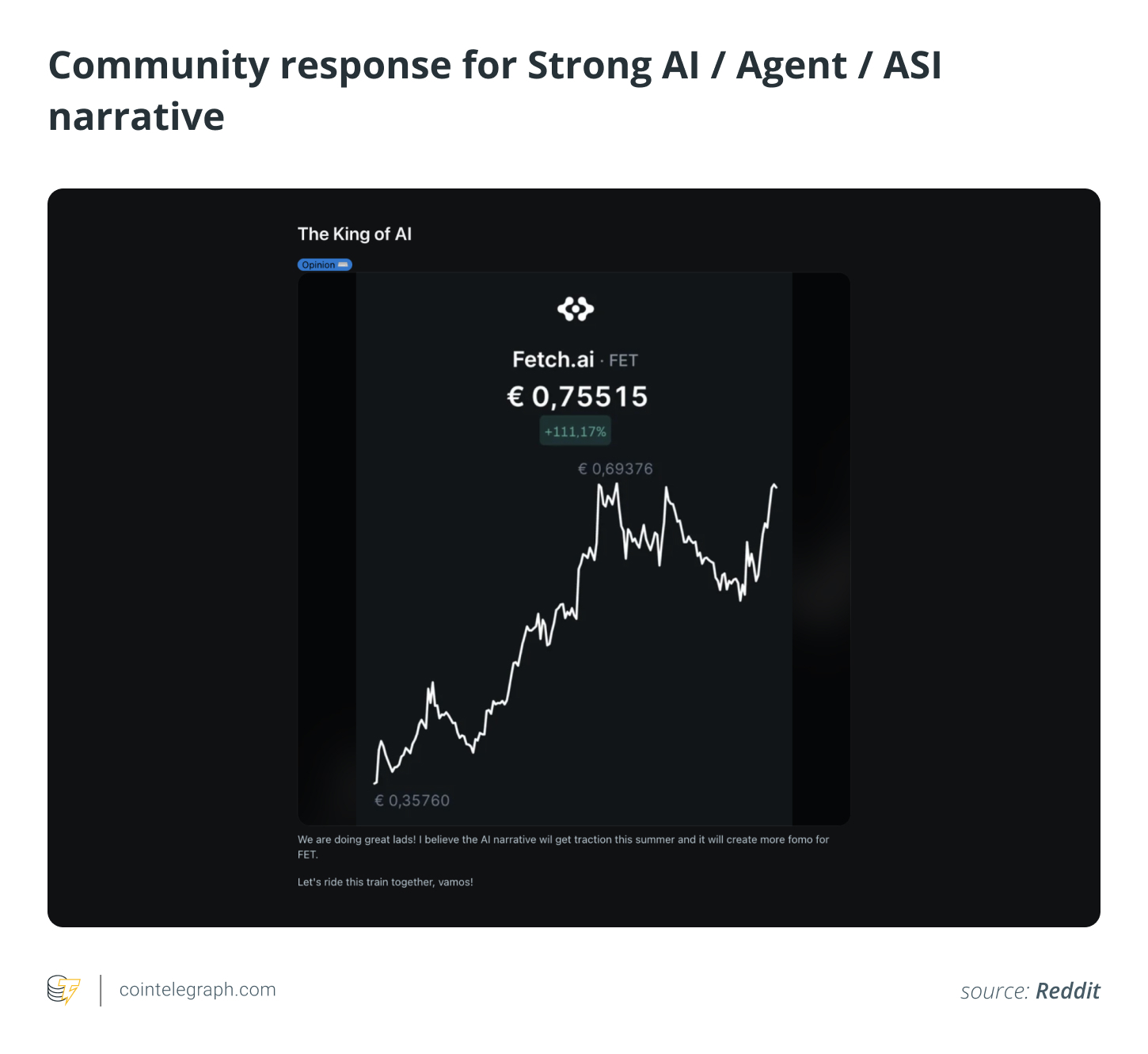
Once you have a trend and a possible asset (like Fetch.ai’s FET), your next step is to dive deeper and see how people are really feeling about it in real-time.
-
Action: Spend a few minutes looking at the asset’s official X page, its subreddit, and what credible influencers are saying. Take notes on the main points being discussed, both good and bad.
-
The Prompt: “Analyze the following summary of what the community thinks about Fetch.ai (FET). Classify the sentiment as mostly Bullish, Bearish, or Neutral. What are the main good things and bad things people are talking about?”
-
Bullish Points:
A strong AI/agent/ASI story, owning its own LLM and infrastructure, gives hope of differentiation.
Big institutions and funds are showing interest (like Interactive Strength’s plan to buy $500 million in tokens).
The community feels the price is low compared to its potential, and many see a chance for big gains.
-
Bearish Points:
Product execution and performance, slow features, betas not yet polished and questions around whether agent tech works as promised.
Tokenomics/supply and holder concentration, risk of big holders and fears about centralization.
Dependency on altseason/market cycles: Many believe gains are contingent on broader market strength, not just FET fundamentals.
-
Neutral Points:
Price movements are being viewed with caution: Recent gains are welcomed, but many feel FET is still far below its all-time highs; the risk of support levels failing is also frequently mentioned.
Technical chart watchers point to resistance zones and Fibonacci levels; some believe in possible upside if certain barriers are broken, while others warn of pullbacks or stagnation.
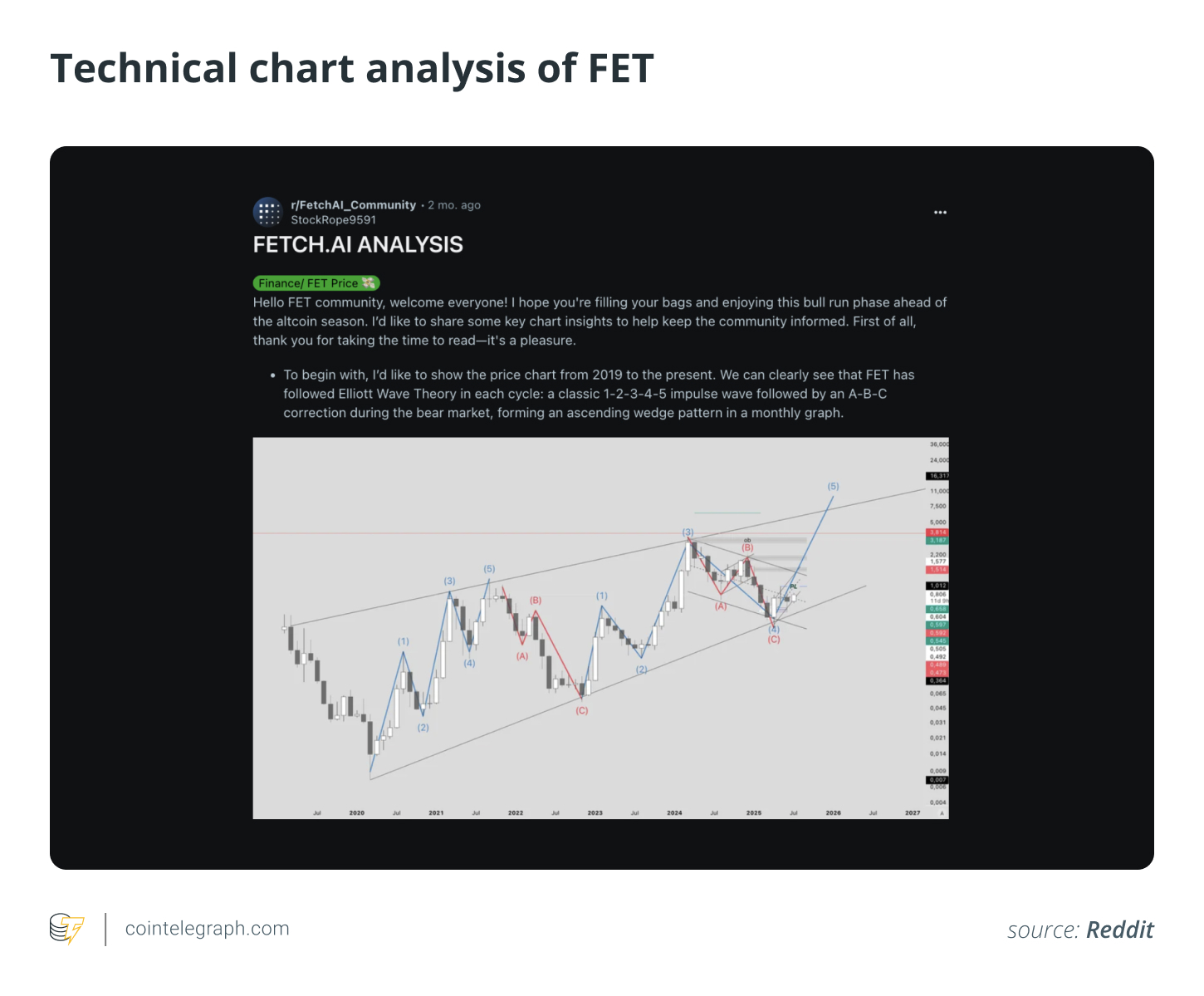
How to Use the Output: This gives you a deeper understanding of what’s behind the price. A chart might look good, but if you find out that people are starting to feel negative because of a valid concern (like token unlocks), it could be a warning sign. Strong positive sentiment based on real progress can give you more confidence in a good technical setup.
Step 3: Understanding Technical Data
This is where you use ChatGPT as an unbiased technical analysis guide. You give it objective data from your charting platform, and it gives you a neutral explanation.
-
Action: Open your charting platform for your chosen asset. Note the key values for the price and your preferred indicators on a specific timeframe (e.g., the daily chart).
-
The Prompt: “Imagine you are a technical analyst. Give a neutral interpretation of the following technical data for the Avalanche (AVAX)/USD daily chart. Do not give financial advice.
Price Action: The price has just gone above a key resistance level at $75, which was the high from the last quarter.
Volume: The breakout candle was supported by trading volume that was 150% higher than the 20-day average volume.
RSI (Relative Strength Index): The daily RSI is at 68. It’s in positive territory but is getting close to the overbought level of 70.
Moving Averages: The 50-day moving average has just crossed above the 200-day moving average, a pattern known as a ‘Golden Cross.’
-
Your Task:
Explain what this combination of indicators usually means in the market.
What would a technical trader look for to confirm this positive move?
What specific signs (like price action, volume) would suggest that this breakout is failing (a ‘fakeout’)?”
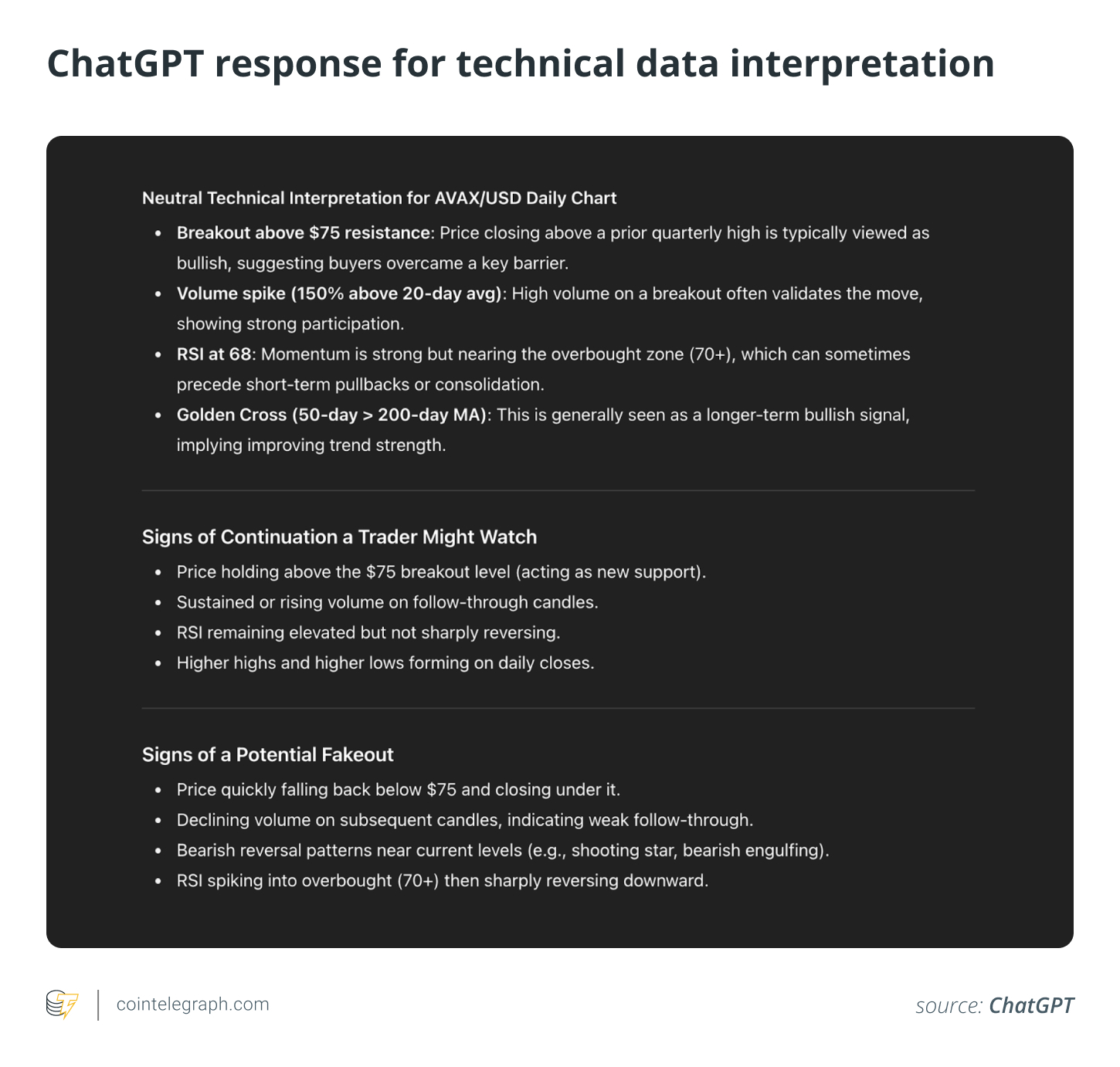
The output gives a neutral view on Avalanche’s (AVAX) chart, showing how traders see the breakout above $75, strong volume, near-overbought RSI, and golden cross; it helps you spot if it’s going to continue (staying above $75 with strong volume) or a fakeout (dropping back below with weak volume or reversals) and can be used for other charts, without giving financial advice.
Step 4: Put Data Together into a Trade Plan
This last step combines everything. You feed all the information you’ve gathered — the market story, sentiment, and technicals — into ChatGPT to create a complete, logical trading plan.
-
Action: Combine the main points from the previous three steps into a single block of text.
-
The Prompt: “Create a complete and objective trading plan for Chainlink (LINK) based only on the data I give you below. Divide the output into three sections: 1) The Positive Case, 2) Possible Risks and Negative Factors, and 3) An Invalidation Thesis. Provided Data:
Narrative: The main market story is ‘tokenizing real-world assets,’ and Chainlink is often mentioned as a key piece of infrastructure for this trend.
Sentiment: People feel very positive because of the recent announcement that the Cross-Chain Interoperability Protocol (CCIP) is being used by a major global banking group.
Technical Analysis: LINK has broken out of a six-month trading range, going above the $45 resistance level with high volume. The daily RSI is 66.”
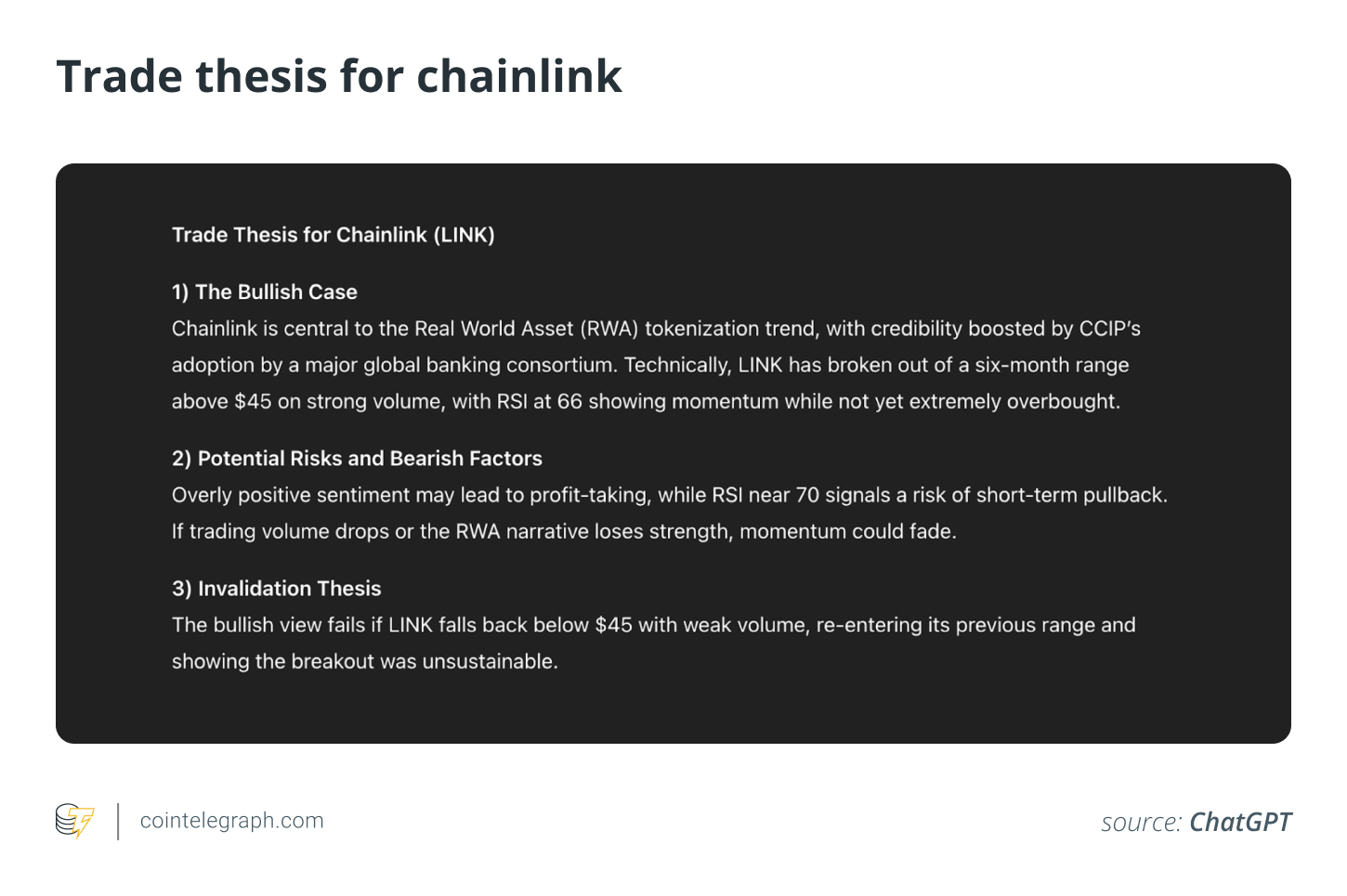
The output should be used as an objective framework: It outlines the good things (positive case), the main problems (risks), and the clear conditions that would cancel the setup (invalidation). This allows you to carefully monitor Chainlink’s price movements and the strength of the story without making financial recommendations.
The Future of Trading with ChatGPT
The main purpose of the four-step process is to give you a systematic way to link big market trends, like RWAs, with specific data points and technical analysis. This shows how ChatGPT can be used as a tool to put together information you provide.
Within this system, the model can organize information from news and social media, understand technical inputs, and create outputs based on the parameters you set in the prompt. The model does not do its own analysis or give financial advice. You are always responsible for checking the data, evaluating the risks, and making any trades. Using this human-led, AI-assisted process should encourage a more structured and careful approach to market analysis.
This article is for informational purposes only and does not constitute financial advice. Trading cryptocurrencies involves a high degree of risk, and readers should conduct their own research and consult with a financial advisor before making any investment decisions.