

What actions did El Salvador undertake regarding its Bitcoin holdings?
As a security-focused precaution, the Salvadoran government reorganized approximately 6,274 BTC (valued around $678 million at the time of this report) by transferring them from a single digital address into 14 separate, newly created addresses. Each of these new addresses now holds a maximum of 500 BTC.
Prior to late August 2025, El Salvador maintained its
national Bitcoin holdings
within a solitary address. While simple, this structure presented an inherent security risk: any future discovery of a vulnerability could potentially compromise the entire digital reserve.
The National Bitcoin Office (ONBTC) publicly declared that their
Bitcoin assets had been divided and distributed across 14 distinct addresses.
By capping each wallet at 500 BTC, they implemented a “shard and spread” strategy. This approach aims to minimize potential losses in the event that a single address is ever compromised. Blockchain data confirms that these transfers were executed swiftly and completely.
Through this fragmentation, El Salvador has effectively established protective “firebreaks.” Consequently, even if one
wallet
were to be breached, the resulting financial impact would be limited.
Fun Fact:
El Salvador distinguished itself as the world’s first nation to
adopt Bitcoin as legal tender
on September 7, 2021. This move established Bitcoin as an official currency alongside the United States dollar.
Why is quantum computing a relevant factor in this decision?
While Bitcoin’s current cryptographic security is strong, it’s been speculated that future quantum computers
might
possess the computational power to break the mathematical algorithms that secure private keys.
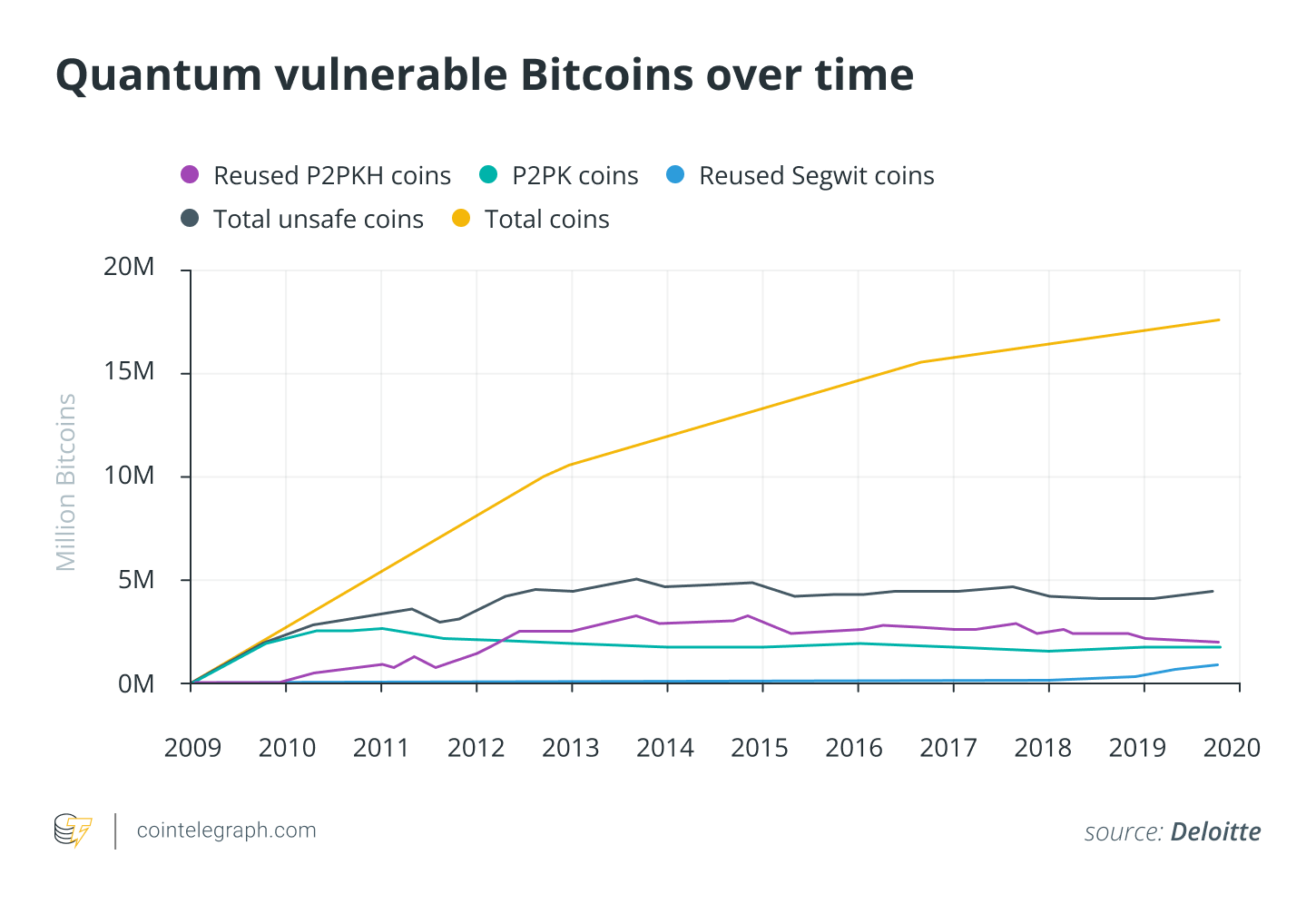
Bitcoin’s security heavily depends on the Elliptic Curve Digital Signature Algorithm (ECDSA). Whenever Bitcoin is transferred from a specific address, the public key associated with that address becomes visible on the blockchain.
In a hypothetical future era dominated by post-quantum computing, sufficiently advanced machines could potentially reverse-engineer these exposed public keys to derive their corresponding private keys. This would enable unauthorized access to and theft from those vulnerable addresses.
El Salvador’s ONBTC, the government entity overseeing the nation’s Bitcoin strategy, specifically cited this potential risk. In its public statements, the ONBTC
emphasized
the vulnerability of exposed public keys and explained the rationale behind distributing the funds across new, previously unused addresses.
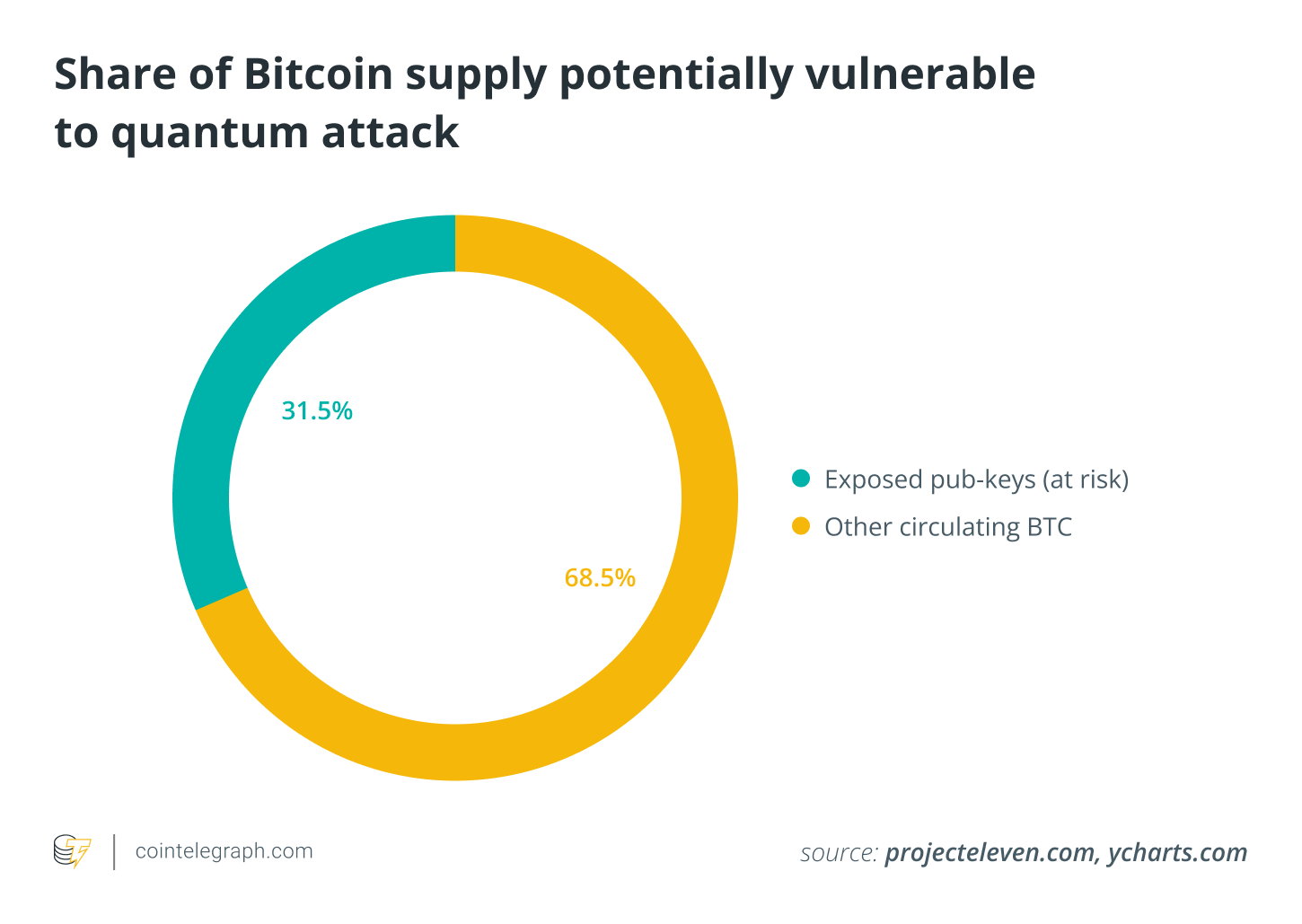
– Percentage of BTC potentially at risk. Source:
Project Eleven
(January 17, 2025) and
YCharts
(June 18, 2025)
Related Article:
Bitcoin Requires Upgrades to Withstand Quantum Computing Threats Within the Next 5 Years
Is this threat an immediate concern?
It is generally considered improbable. Experts largely agree that currently available quantum computers lack the computational capabilities to break Bitcoin’s cryptographic protections. Most predictions place this risk decades into the future, if it ever truly materializes. Furthermore, the Bitcoin network retains the ability to upgrade its cryptographic protocols should such a need arise.
As of 2025, no publicly accessible quantum computer has come remotely close to cracking 256-bit ECDSA at the scale required for Bitcoin.
Project Eleven, a quantum research firm,
estimated
that potentially over
6 million
BTC could be vulnerable if elliptic-curve keys were to be compromised. However, they also pointed out that no machine implementing Shor’s algorithm has yet successfully cracked even a simple 3-bit test key. In essence, while the field is advancing, a significant gap remains before Bitcoin’s security is genuinely at risk.
Leading voices within the industry have played down the urgency of this threat. MicroStrategy’s Michael Saylor
dismissed quantum threat concerns
as largely “hype.” He added that if the risk becomes genuine, the Bitcoin network can adapt through software and hardware improvements, mirroring the routine upgrades implemented in other crucial systems.
Good to Know:
The U.S. National Institute of Standards and Technology (NIST)
initiated
the process of standardizing post-quantum cryptography in 2022.
What is the actual benefit of distributing the Bitcoin across multiple wallets?
The primary advantages are that moving funds to new addresses keeps public keys concealed, and dividing the total balance limits the potential damage should any individual address be successfully compromised.
Unused Bitcoin addresses do not expose public keys. By migrating its entire reserve into several fresh wallets, El Salvador has ensured that none of its current holdings reveal potentially vulnerable data.
The limit of 500 BTC per wallet provides an additional layer of security. In the hypothetical event of a quantum-based exploit, no single breach would be capable of draining the entire national treasury. It’s analogous to storing treasure in multiple vaults rather than a single chest.
Transparency has not been sacrificed in this process. The ONBTC maintains a publicly accessible
dashboard
that displays the wallet addresses, balancing security measures with public accountability.
Given that quantum computers are not yet a threat, what motivated this action now?
El Salvador’s motivation for splitting its Bitcoin reserve isn’t based on an imminent quantum computing threat. It’s intended to demonstrate responsible governance on the global stage. The move signals foresight, transforming a potential threat into a narrative of responsible stewardship, and reassures skeptics that the nation’s commitment to Bitcoin is a strategic long-term plan, not simply a publicity stunt.
President Nayib Bukele has centered his political image around Bitcoin since
making it legal tender
in 2021. This bold decision garnered praise from crypto enthusiasts but drew strong criticism from established institutions like the International Monetary Fund (IMF).
By late 2024, El Salvador had reached a preliminary agreement with the IMF, formalized in February 2025 as a 40-month,
$1.4-billion
Extended Fund Facility. The documentation repeatedly highlighted the risks associated with Bitcoin, and by mid-2025, the IMF had already conducted its first program review and Article IV consultation.
Against this backdrop, El Salvador’s decision to reinforce its Bitcoin custody – even against a quantum threat that may not materialize for decades – appears less like science fiction paranoia and more like a carefully considered act of statecraft.
By framing this upgrade as a proactive hedge against future cryptographic vulnerabilities, the government is positioning itself as a forward-thinking player, not merely reacting to events but actively anticipating them, while also engaging with critics both domestically and abroad.
Important Note:
According to IMF guidelines, Article IV consultations
are
mandatory annual reviews of a country’s economy. El Salvador’s 2025 review specifically identified Bitcoin as a factor in its assessment of financial stability.
What are the differing viewpoints on this decision?
Supporters view this as a visionary blueprint, while skeptics consider the quantum aspect to be exaggerated. However, most agree that the underlying custody practices are fundamentally sound.
Advocates
contend
that El Salvador has established a fragmented, transparent, and future-proof framework for sovereign Bitcoin custody. They argue that even if the quantum threat is distant, there is no harm in proactively preparing for it.
Skeptics
counter
that the move is primarily driven by public relations rather than genuine security concerns. Given the negligible risk of a quantum attack in the near future, they argue that the reorganization doesn’t significantly alter El Salvador’s overall risk profile.
Despite their skepticism, critics generally acknowledge that the practice of splitting holdings and avoiding key reuse is a good security measure for Bitcoin management, even independently of the quantum computing angle.
Could this action establish a precedent for other nations and institutions?
While wallet-splitting might seem unusual, it establishes a clear and auditable protocol for sovereign Bitcoin custody, which is adaptable for future cryptographic needs. Even if quantum risks are not imminent, this reframes Bitcoin as an asset class deserving of institutional best practices.
The domain of nation-state Bitcoin custody is largely unexplored territory. El Salvador’s actions offer insight into how governments can balance security with transparency, demonstrating techniques that could be adopted by exchanges, custodians, and even corporations.
For institutional investors holding substantial amounts of Bitcoin, this situation highlights the importance of best practices: avoiding address reuse, distributing reserves across multiple wallets, and considering long-term security risks.
Whether other entities follow El Salvador’s lead will depend on how seriously they perceive the quantum threat. However, the simple act of appearing proactive, rather than reactive, might encourage others to implement similar measures.
Was this action truly necessary?
Perhaps not strictly necessary, but definitely a prudent move. Splitting the reserve incurs minimal cost, limits potential risk, and reinforces the notion that El Salvador views its Bitcoin holdings as a strategic national asset, not a mere publicity stunt.
El Salvador’s action doesn’t suggest that a quantum attack is imminent. It indicates that a sovereign holder is proactively addressing low-probability, high-impact risks. By mitigating potential worst-case scenarios, maintaining transparency, and demonstrating readiness to adapt its custody practices, the country is treating its Bitcoin holdings like a strategic asset, rather than a gimmick.
Regardless of whether the “quantum threat” materializes in decades or never, the operational upgrades are worthwhile. The cost of early preparation is minor, consisting primarily of process adjustments. In contrast, the consequences of being unprepared could be catastrophic. Within that context, distributing $678 million across multiple secure locations appears less like excessive hype and more like responsible financial management.