
Before dedicated spot Bitcoin exchange-traded funds (ETFs) were available – and even prior to Bitcoin futures ETFs – investment vehicles holding crypto-related stocks played a crucial role in cultivating initial investor interest in the crypto space. These funds represented the first approachable way for individuals to gain exposure to Bitcoin through their conventional brokerage accounts. This indirect method, often described as a “picks-and-shovels” approach, offered a straightforward way to participate in Bitcoin’s growth, though it didn’t involve directly owning the cryptocurrency. The arrival of spot Bitcoin ETFs somewhat overshadowed these crypto equity ETFs. Nonetheless, crypto equity ETFs still hold unique value for investors, particularly those focused on the crypto mining sector, which forms the essential infrastructure of the crypto industry. Here’s what investors and financial advisors should consider before delving into crypto mining investments.
Understanding the Investment Thesis Behind Mining Stocks
Investing in crypto mining companies presents an alternative method of gaining exposure to Bitcoin without actually holding the digital asset. Similar to how gold mining stocks relate to gold, well-managed Bitcoin mining firms can experience accelerated revenue and profit margin growth when Bitcoin’s value increases. This is largely due to the fact that many of their operational expenses, especially electricity costs, don’t rise as quickly, resulting in significant operating leverage.
Unlike direct Bitcoin ownership, investing in mining companies requires investors to evaluate and conduct thorough research on underlying businesses. This evaluation involves assessing factors such as electricity contracts, equipment upgrade schedules, company size, financial stability, and management effectiveness. Publicly traded miners routinely release production updates and comprehensive financial reports, offering investors tangible metrics to monitor.
Furthermore, many mining companies are diversifying their revenue streams by offering hosting and data center services. This strategy can help to mitigate volatility and stabilize financial performance throughout Bitcoin’s price fluctuations. However, it’s important to remember that mining stocks can be more volatile than Bitcoin itself and are particularly sensitive to fluctuations in electricity prices and capital expenditure needs.
Mining as a Targeted Infrastructure Investment vs. Broad Blockchain Strategies
The investment case for crypto mining is more narrowly focused than the broader blockchain investment theme. Revenue from mining activities typically correlates more directly with Bitcoin’s price movements. In contrast, the performance of broadly diversified blockchain investments can be influenced by factors such as trading volumes, payment processing activity, and other, less directly related trends. While diversification within blockchain ETFs can be beneficial, mining stocks offer a more transparent and direct link to the Bitcoin cycle for those seeking targeted exposure.
Most publicly listed mining companies are categorized within the technology sector, specifically within the software and services industry. Broader blockchain investments might have higher exposure to the financial sector, in addition to major tech companies. While miners offer a more direct connection to Bitcoin and are more easily monitored, they come with higher cyclicality and sensitivity to electricity and capital expenses.
The Growing Convergence of Mining and AI
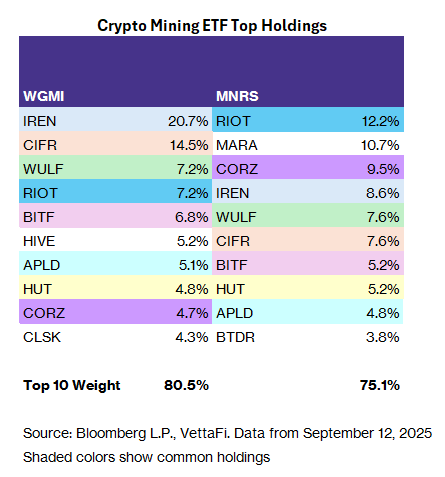
Crypto mining companies are uniquely positioned at the intersection of crypto and artificial intelligence (AI). They already manage critical resources such as power, land, and data center infrastructure. Some are now leveraging these assets to support AI and high-performance computing alongside Bitcoin mining activities, secured through long-term contracts. For example, Core Scientific Inc. (CORZ) entered into a series of 12-year hosting agreements with CoreWeave, an AI hyperscaler, and subsequently agreed to be acquired by CoreWeave, effectively transforming its mining facilities into AI infrastructure. Iren Ltd (IREN) is expanding its AI cloud capabilities by acquiring next-generation Nvidia GPUs, backed by dedicated financing, bringing its GPU fleet to 10,900 units. Riot Platforms (RIOT) is highlighting the 1.0 GW of secured power and land at its Corsicana, Texas facility, positioning it for high-density computing solutions, including AI/HPC applications. Companies with secured multi-year contracts and confirmed GPU orders/deliveries have the potential to generate robust cash flow opportunities.
Two Approaches to Crypto Mining ETFs
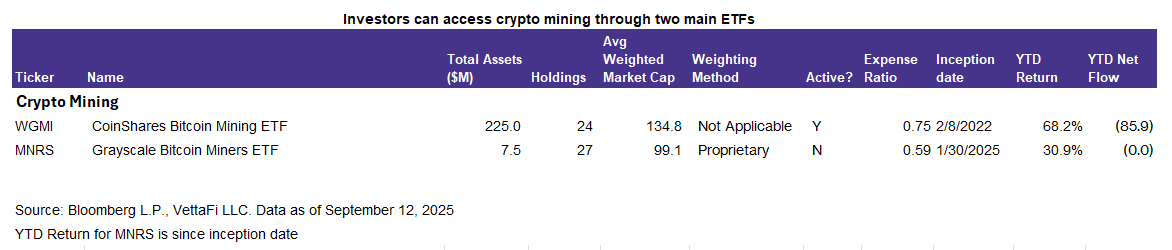
While there are several broader blockchain ETFs available, only two specifically focus on crypto mining stocks, each with significantly different investment strategies.
The CoinShares Bitcoin Mining ETF (WGMI) is the oldest and largest crypto mining ETF, managing $200 million in assets. It is actively managed, investing at least 80% of its net assets in companies deriving 50% or more of their revenue or profits from Bitcoin mining operations or from providing specialized chips, hardware, software, and services to miners. This active management provides greater flexibility in both holdings and weightings.
WGMI has allocated approximately 20% of its portfolio to IREN, which has increased by nearly 250% year-to-date. The remaining top five holdings include Cipher Mining (CIFR), Terawulf (WULF), RIOT, and Bitfarms Ltd (BITF), all of which have experienced double-to-triple-digit percentage gains YTD. As of September 12, WGMI was up 68% YTD (66% on a like-for-like basis, compared to 31% from the January 30 inception date of MNRS). The tradeoff for this active management is a slightly higher expense ratio compared to MNRS (75 basis points vs. 59 basis points).
The Grayscale Bitcoin Miners ETF (MNRS), launched in January of this year, currently holds around $7 million in assets. MNRS is passively managed, following a rules-based approach by tracking the Indxx Bitcoin Miners Index. This index focuses on companies generating at least 50% of their revenue from Bitcoin mining. These companies are weighted based on free-float market capitalization, with a single security cap of 15% applied to pure-play mining stocks. The total weight of companies that are not pure-play miners is capped at 15%. This prevents over-concentration within the ETF, while still ensuring a fair representation of the crypto mining industry.
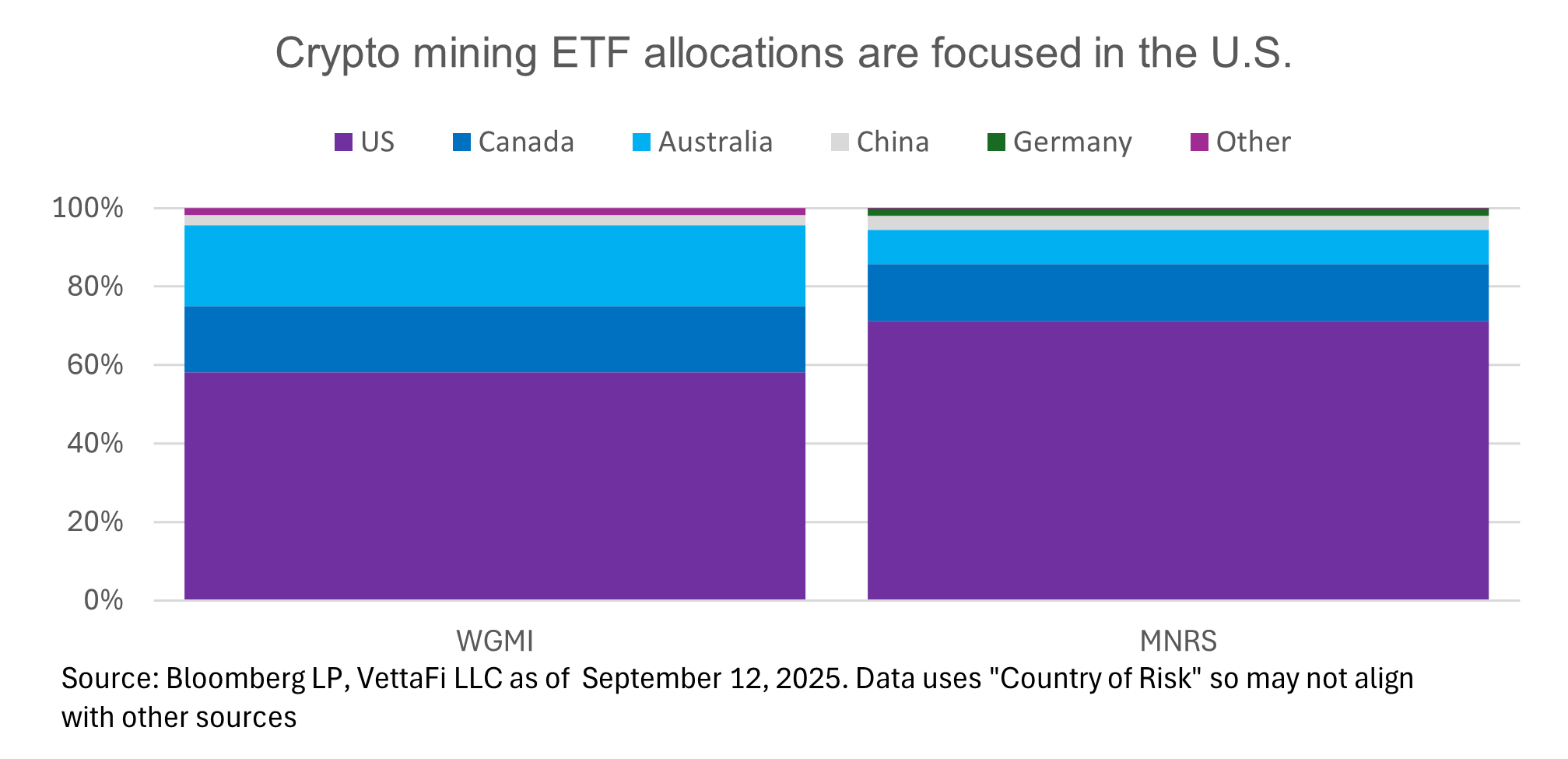
Its top five holdings constitute nearly 50% of the ETF’s portfolio, led by RIOT, Mara Holdings (MARA), CORZ, IREN, and WULF. The fund holds only one financial sector stock – Block Inc (XYZ) – and one consumer discretionary stock – Cango Inc (CANG). The remaining holdings are technology stocks, including semiconductor companies Nvidia (NVDA) and Intel (INTC). However, because Nvidia and Intel are not pure-play mining companies, their weights are capped at 2.3% and 2.1%, respectively, ensuring a focus on pure-play miners.
Like CoinShares, Grayscale is a reputable and well-known name in the crypto ETF space. Grayscale was a key advocate for the approval of spot Bitcoin ETFs and continues to introduce innovative products to the market.
Other Crypto Mining ETFs
It is worth noting that some crypto mining ETFs, such as the Viridi Bitcoin Miners ETF (RIGZ) and the VanEck Digital Assets Mining ETF (DAM), closed during the first half of 2023.
Blockchain ETFs, despite their broader focus, can also provide substantial exposure to crypto mining companies. For instance, the top holdings of the iShares Blockchain and Tech ETF (IBLC) consist primarily of mining companies, with the exception of Coinbase (COIN) and Galaxy Digital (GLXY). The Global X Blockchain ETF (BKCH) also emphasizes mining stocks, despite its wider investment mandate.
One advantage of broader blockchain ETFs is their flexibility. While many currently hold a significant proportion of crypto mining companies, they can easily incorporate other types of companies as they emerge. The evolving nature of this industry suggests that new companies will likely appear in the coming years.
Key Takeaways
Crypto mining equities offer a focused and quantifiable way to express a view on Bitcoin within a traditional investment portfolio, providing transparent operating metrics and readily available public information. For diversified exposure to this sector, miner-focused ETFs like WGMI (actively managed) and MNRS (indexed) provide distinct investment approaches.
For the latest insights, news, and strategies, visit the Crypto Content Hub.